

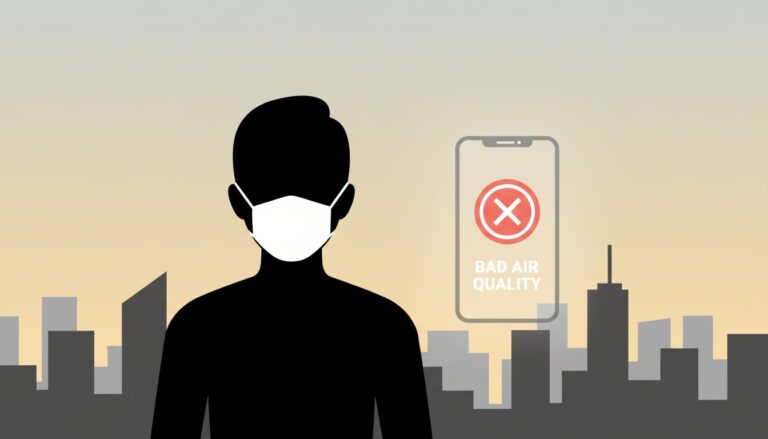
1. Hook: Wait, Why is the Sky Yellow?
안녕하세요! This is your editor from Daily Hangul.
Imagine this: It’s April in Seoul. The cherry blossoms are in full bloom, and you’re ready for a picnic at Han River. You step outside, take a deep breath, and… cough, cough. The sky isn’t blue; it’s a hazy, sepia-toned yellow. Your throat instantly feels scratchy.
Welcome to 황사 (Hwangsa – Yellow Dust) season.
For a C2-level learner like you, simply knowing the word “mask” isn’t enough. You need to understand the nuances between Yellow Dust and Fine Dust, decipher the KF rating system, and express your physical symptoms like a native. If you walk into a pharmacy asking for just a “mask,” you might end up with a fashion mask that does zero to protect your lungs.
Let’s dive into the survival guide for Korea’s “grey spring” and how to sound like an educated insider while protecting your health.
2. Deep Dive: Advanced Vocabulary & Nuances
Here are the three expressions that separate the tourists from the residents.
1. 미세먼지 농도 (Fine Dust Concentration)
- Pronunciation: [Mise-meonji Nong-do] ‘Nong’ sounds like the ‘gong’ in a bell, but with an N.
- Meaning:
- Literal: Fine dust thickness/density.
- Real Nuance: The specific index number everyone checks on their apps (like “MiseMise”) every morning.
- Editor’s Insight: Koreans distinguish between 미세먼지 (PM10) and 초미세먼지 (Ultrafine Dust, PM2.5). If you want to sound C2, don’t just say “The air is bad.” Say, “초미세먼지 농도가 최악이야” (The ultrafine dust concentration is the worst).
2. KF94 (Korea Filter 94)
- Pronunciation: [Ke-i-epeu Gu-sip-sa]
- Meaning: A mask certification that blocks 94% of particles.
- Editor’s Insight: In Korea, masks are a science.
- KF80: Breathable, good for mild days.
- KF94: The gold standard. Required for yellow dust.
- KF99: Hard to breathe, rarely used unless you work in industrial settings.
- Situation Check: If a friend asks what to buy, strictly recommend “무조건 KF94 사” (Buy KF94 no matter what).
3. 목이 칼칼하다 (Throat feels scratchy/dry)
- Pronunciation: [Mogi Kal-kal-ha-da]
- Meaning:
- Literal: My throat is spicy/rough.
- Real Nuance: This is the specific feeling caused by dust. It’s not a cold virus pain; it’s a dry, irritated sensation like you swallowed sand.
- Editor’s Insight: This is an onomatopoeic adjective. Using this instead of “목이 아파요” (My throat hurts) shows high linguistic sensitivity.
3. Textbook vs. Real Life (C2 Edition)
At this level, you should stop sounding like a news anchor and start sounding like a local complaining about the weather.
| Textbook (Formal/Written) | Real Life (Native/Natural) |
|---|---|
| 마스크를 꼭 착용하세요. (Please be sure to wear a mask.) |
마스크 안 쓰면 큰일 나요. 오늘 공기 완전 똥망이에요. (If you don’t wear a mask, you’re in trouble. The air is totally wrecked today.) ‘똥망’ is slang for ‘crappy/ruined’. |
| 미세먼지가 심해서 목이 아픕니다. (My throat hurts because the fine dust is severe.) |
미세먼지 때문에 목이 엄청 칼칼하네요. 삼겹살로 기름칠 좀 해야겠어요. (My throat is so scratchy due to the dust. I need to ‘grease it’ with pork belly.) Cultural belief: Pork belly clears dust from the throat. |
| 외출을 자제하는 것이 좋습니다. (It is good to refrain from going out.) |
이런 날은 집콕이 답이죠. (On days like this, staying ‘stuck at home’ is the answer.) |
Editor’s Note: The “Pork Belly (Samgyeopsal)” myth is scientifically unproven, but culturally, it is the most common joke/suggestion made on bad dust days. Use it to bond with Koreans!
4. Cultural Context: The ‘Nunchi’ of Air Quality
In Korea, checking the air quality index (AQI) is as routine as checking the time.
- The App Culture: If you see someone staring at a screen that’s flashing red or black with a skull icon, they are looking at the 미세미세 (MiseMise) app. Commenting, “오늘 8학군이네?” (slang referring to the app showing a quirky face for good air, or referencing the 8th school district implying ‘good environment’) is a very advanced joke, but simply asking “오늘 수치 어때요?” (How are the numbers today?) works wonders.
- Indoor Etiquette: Unlike shoes, you can keep your mask on indoors if the dust is extremely bad, but usually, people take it off once inside where air purifiers (공기청정기) are running.
- Visual Cues: If the N Seoul Tower is invisible from a distance, do not go for a jog. Koreans will look at you with concern, thinking you don’t care about your lungs.
5. Roleplay Scenario: At the Pharmacy (약국)
Situation: You need to buy masks in bulk because the forecast predicts a week of heavy Yellow Dust.
- Learner: (Looking for boxes) 사장님, 혹시 황사 방역용 마스크 대용량으로 있나요?
(Owner, do you happen to have the yellow dust protection masks in bulk/large capacity?) -
Pharmacist: 네, 여기 KF94랑 KF80 있어요. 어떤 걸로 드릴까요?
(Yes, we have KF94 and KF80. Which one would you like?) -
Learner: 미세먼지 차단율 높은 걸로 주세요. 요즘 목이 너무 칼칼해서요.
(Please give me the one with the high fine dust blocking rate. My throat has been so scratchy lately.) -
Pharmacist: 그럼 KF94 쓰셔야 해요. 숨쉬기는 좀 답답해도 이게 제일 확실하거든요.
(Then you must use KF94. It’s a bit stuffy to breathe, but this is the most certain one.) -
Learner: 알겠습니다. 그럼 KF94로 한 박스 주세요. 아, 혹시 인공눈물도 있나요? 눈도 뻑뻑해서요.
(Understood. Give me a box of KF94 then. Ah, do you have artificial tears too? My eyes are stiff/dry.)
6. 10-Second Shadowing Drill
Practice reading this smoothly. Focus on the pause after the particle ‘는’ to emphasize the contrast.
“봄철에는 / 황사도 문제지만, / 초미세먼지 입자가 작아서 / 일반 마스크로는 / 어림도 없어요.”
(In spring / yellow dust is a problem, but / because ultrafine dust particles are small / with a regular mask / it’s not even close [to being enough].)
- Intonation Tip: Raise your pitch slightly on ‘작아서’ (because they are small) to highlight the reason.
7. FAQ & Troubleshooting
- Q: Can I use the expression “목이 칼칼하다” when I have a cold?
- A: Yes, but it specifically describes that dry, scratchy feeling (like before you lose your voice). For a general sore throat with pain, “목이 따갑다” (stinging) or “목이 아프다” (painful) is better.
- Q: Is it rude to wear a black mask?
- A: No! A few years ago, white was standard, but now black, beige, and grey are fashion statements. Just make sure it says KF94 on the package.
8. Wrap-up
One-Liner Summary: When the sky turns yellow, forget fashion—grab a KF94, complain about your “칼칼한 목” (scratchy throat), and suggest Samgyeopsal for dinner.
Action Mission: Next time you see a grey sky in Korea (or check the app), text a Korean friend: “오늘 미세먼지 장난 아니네. 마스크 챙겼어?” (The dust is no joke today. Did you bring a mask?)
9. Quick Quiz
1. What does “KF” stand for in KF94?
A) Korean Fashion
B) Korea Filter
C) Korea Fine-dust
2. Which adjective best describes a throat irritated by dust?
A) 시원하다 (Cool/Refreshing)
B) 칼칼하다 (Scratchy/Dry)
C) 쫄깃하다 (Chewy)
3. Which mask grade offers the HIGHEST protection mentioned for daily use against yellow dust?
A) KF80
B) KF94
C) Dental Mask
(Answers: 1. B, 2. B, 3. B)
Frequently Asked Questions (FAQ)
Q: What does "황사" mean in Korean and how do you pronounce it?
A: In Korean, "황사" is pronounced [Hwangsa - Yellow Dust] and means: season.
Q: What does "초미세먼지" mean in Korean and how do you pronounce it?
A: In Korean, "초미세먼지" is pronounced [Ultrafine Dust, PM2.5] and means: . If you want to sound C2, don't just say "The air is bad." Say,
Q: What does "미세미세" mean in Korean and how do you pronounce it?
A: In Korean, "미세미세" is pronounced [MiseMise] and means: app. Commenting,







