

Phase 1: Introduction
Hello! This is your Daily Hangul Editor.
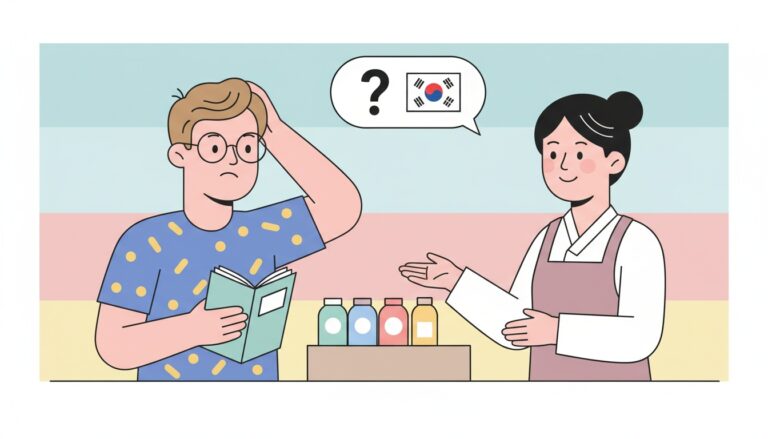
Picture this: You just landed in Seoul. You walk into a convenience store (pyeon-ui-jeom) to buy a bottle of water. Suddenly, the cashier looks you in the eye and asks a rapid-fire question: “Mem-beo-ship is-seu-se-yo?” (Do you have a membership card?)
Freeze. Panic. Blank stare. 😳
Your brain knows you studied Korean, but right now, all you hear is noise. Do you nod? Do you run away?
Don’t worry. I’ve seen hundreds of students go through this exact “deer in headlights” moment. It is the rite of passage for every beginner.
Today, I’m going to teach you the magic shield. These are the phrases that stop the rapid-fire Korean politely and get you the help you need. Knowing these doesn’t just save you from awkwardness; it makes Koreans think, “Oh, this person has manners!”
Phase 2: Deep Dive (The Magic Shield)
Here are the top 3 phrases you need to survive as an A1 beginner. We are skipping the robot textbook talk and going straight for what works.
1. 한국말 잘 못해요 (I can’t speak Korean well)
This is your #1 survival gear. It lowers the other person’s expectations immediately.
- Pronunciation: [Han-guk-mal jal mot-hae-yo]
- Sound Analogy:
- Han-guk-mal (Korean language)
- Jal sounds like Jolly.
- Mot sounds like Boat (but stop before the ‘t’ releases air).
- Hae-yo sounds like Hey-yo.
- Meaning: “I can’t speak Korean well.”
- Literal: Korean language / well / can’t do.
- Editor’s Insight: Notice we say “can’t do well” (jal mot-hae-yo). This is the Korean virtue of modesty. Saying “I don’t know Korean” sounds a bit cold. Saying “I can’t do it well” sounds like you are trying, and people love that.
- Situation Check: ✅ Casual (with strangers) / ✅ Formal
2. 천천히 말해 주세요 (Please speak slowly)
Use this when you want to understand but their speed is Rap God level.
- Pronunciation: [Cheon-cheon-hi mal-hae ju-se-yo]
- Sound Analogy:
- Cheon-cheon-hi (Slowly) – The ‘Cheon’ sounds like Chun-ky.
- Ju-se-yo (Please give/do) – Essential phrase!
- Meaning: “Please speak slowly for me.”
- Editor’s Insight: Pair this with a slightly apologetic smile. If you say it with a blank face, it might sound like a demand. With a smile, it’s a request for help.
3. 영어 하세요? (Do you speak English?)
When all else fails, it’s time to switch channels.
- Pronunciation: [Yeong-eo ha-se-yo?]
- Sound Analogy:
- Yeong-eo (English) – sounds like Young-o.
- Meaning: “Do you do/speak English?”
- Situation Check: Most younger Koreans in cities will understand this perfectly.
Phase 3: Textbook vs. Real Life
Let’s look at why you sound like a robot if you only rely on old textbooks.
| Textbook (Robot Mode) 🤖 | Real Life (Natural) ✨ | Why? |
|---|---|---|
| 저는 한국어를 할 줄 모릅니다. (Jeo-neun Han-guk-eo-reul hal jul mo-reum-ni-da) |
한국말 잘 못해요. (Han-guk-mal jal mot-hae-yo) |
The textbook version is too long and sounds like a military report. The Real Life version is softer and quicker. |
| 다시 말씀해 주십시오. (Da-si mal-sseum-hae ju-sip-si-o) |
네? 다시 말해 주세요. (Ne? Da-si mal-hae ju-se-yo) |
“Ne?” (What/Pardon?) is the most common way to ask someone to repeat themselves naturally. |
| 당신은 영어를 합니까? (Dang-sin-eun yeong-eo-reul ham-nik-ka?) |
영어 하세요? (Yeong-eo ha-se-yo?) |
Never use “Dang-sin” (You) with strangers! It can be offensive. Just drop the subject. |
Editor’s Note for A1: If “Hank-guk-mal jal mot-hae-yo” is too hard, just put your hand on your chest and say “Sorry… No Korean.” (English + Apologetic face) works 90% of the time in tourist areas!
Phase 4: Cultural Context (The Art of ‘Nunchi’)
In Korea, how you say no is more important than the words.
1. The Hand Wave 👋
If someone approaches you speaking Korean, you will often see Koreans wave their hand in front of their face (like fanning away a bad smell, but vertical). This gesture means “No,” “I don’t know,” or “I’m not the person you’re looking for.”
* Tip: You can use this hand wave while saying “Joesong-haeyo” (I’m sorry).
2. Eye Contact
Don’t stare too intensely when you don’t understand. It might look aggressive. Look slightly down or at their shoulder level to show you are flustered and sorry.
Phase 5: Real-Life Scenario
Situation: You are in a taxi. The driver asks you something complex about the route, but you only know the address.
Driver: (Speaking fast) 이 시간에 강남 가면 엄청 막히는데 서초로 돌아갈까요?
(If we go to Gangnam now, it’s jammed. Should we go around via Seocho?)
You: (Slightly panicked but smiling)
죄송해요, 한국말 잘 못해요.
(Joe-song-hae-yo, Han-guk-mal jal mot-hae-yo.)
(I’m sorry, I can’t speak Korean well.)
Driver: 아! 오케이, 오케이. English?
(Ah! Okay, okay. English?)
You: 네, 영어 하세요?
(Ne, Yeong-eo ha-se-yo?)
(Yes, do you speak English?)
Driver: Little bit! Where go?
You: (Showing phone map)
여기요. 감사합니다.
(Yeo-gi-yo. Gam-sa-ham-ni-da.)
(Here, please. Thank you.)
Phase 6: 10-Second Shadowing
Let’s practice the flow. Read this aloud. Focus on the pause!
“Ah, Joe-song-hae-yo. / Han-guk-mal / jal mot-hae-yo.”
- Ah, Joe-song-hae-yo (Start with a sigh/apology marker)
- …pause…
- Han-guk-mal (Korean)
- Jal mot-hae-yo (Can’t do well – say this part slightly faster!)
Phase 7: FAQ & Troubleshooting
- Q: Can I just speak English immediately?
- A: You can, but it’s considered rude to assume everyone speaks English. A simple “Joe-song-hae-yo” (Sorry) before switching to English works wonders for your image.
- Q: What if I say “I can’t speak Korean” but I said it so perfectly they think I’m lying?
- A: Haha, this happens! If you nail the pronunciation, they might keep talking. In that case, use the X gesture with your arms (crossing your wrists) and smile awkwardly. It’s the universal sign for “System Error.”
Phase 8: Wrap-up
One-Liner Summary: admitting you aren’t fluent is not a failure; it’s the first step to communication.
🔥 Today’s Mission:
Next time you are at a Korean mart or restaurant, even if you understand what they said, pretend you didn’t for a second and practice saying: “죄송해요, 한국말 잘 못해요.” See how kindly they react!
Got a funny story about a language barrier misunderstanding? Tell me in the comments below! I read every single one.
Phase 9: Pop Quiz
1. Which phrase sounds most natural when you don’t understand?
A) I am a foreigner. (나는 외국인이다)
B) I refuse to speak. (말하기 싫어요)
C) I can’t speak Korean well. (한국말 잘 못해요)
2. What is the polite gesture to use when saying you don’t know?
A) Finger guns
B) Hand wave in front of face
C) Thumbs down
3. True or False: You should use “Dang-sin” (You) to ask if someone speaks English.
A) True
B) False
(Answers: 1. C, 2. B, 3. B)







