

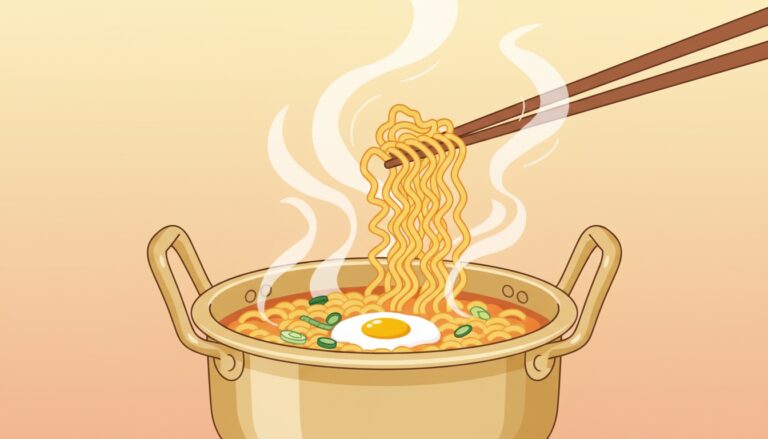
Hello! This is your Daily Hangul Editor.
Have you ever wondered why the Ramyeon (라면) you eat at a Han River convenience store or a friend’s house tastes so much better than when you make it alone?
As a veteran tutor, I often hear students say, “Teacher, I followed the recipe on the back, but it tastes boring.”
Here is the secret: Koreans rarely follow the “official” water amount. We cook with feeling (감 – gam).
Today, we are going to upgrade your Ramyeon game from ‘survival food’ to ‘soul food.’ This isn’t just about cooking; it’s about understanding the Korean obsession with texture (식감). Let’s dive in!
Phase 2: Deep Dive (Core Expressions)
These are the terms that will make your Korean friends nod in approval. We are targeting B2 level nuances here!
1. 꼬들꼬들하다 [kkodeul-kkodeul-hada]
- Pronunciation: Ggo-deul Ggo-deul ha-da (The double ‘ㄱ’ sounds strong, like a sharp ‘k’ without a puff of air.)
- Meaning: Firm / Al dente / Chewy
- Editor’s Insight: This is the Holy Grail of Ramyeon texture. If you let the noodles boil too long, they become ‘퍼지다’ (peo-ji-da: soggy/bloated), which is a tragedy in Korea.
- Situation Check: Perfect for casual settings. You can say to your friend, “나는 꼬들꼬들한 면이 좋아.” (I like firm noodles.)
2. 물 조절 [mul jo-jeol]
- Pronunciation: Mool Jo-jul
- Meaning: Water control (Adjusting the water amount)
- Editor’s Insight: ‘조절’ means regulation or control. In Ramyeon philosophy, slightly less water than the package suggests makes the broth richer (zzan-mat).
- Situation Check: Used when criticizing or praising the chef. “와, 오늘 물 조절 완벽한데?” (Wow, the water control is perfect today?)
3. 파 송송 계란 탁 [pa song-song gye-ran tak]
- Pronunciation: Pa (like Papa) Song-Song, Gye-ran (like Get-on) Tak
- Meaning: Chopped green onions and a cracked egg.
- Editor’s Insight: This is an idiom derived from the sound of chopping green onions (song-song) and cracking an egg (tak). It symbolizes the finishing touches that make instant noodles a proper meal.
- Situation Check: Use this when someone asks what you need for Ramyeon. It’s a very witty, native-like phrase.
Phase 3: Textbook vs. Real Life
How to sound like a local when cooking:
| Textbook (Standard) | Real Life (Street/Casual) |
|---|---|
| 조리법을 따르세요. (Follow the recipe.) |
물 좀 적게 잡아야 맛있어. (You gotta use a bit less water to make it tasty.) |
| 면이 익었습니까? (Are the noodles cooked?) |
면 꼬들꼬들해? 지금 먹어야 돼! (Are the noodles firm? We gotta eat now!) |
| 계란을 넣을까요? (Shall I put in an egg?) |
계란 하나 풀까? (Shall we ‘loosen/crack’ an egg?) |
Note: Notice the verb ‘풀다’ (to loosen/beat) for eggs instead of just ‘넣다’ (to put in). It sounds much more natural in cooking contexts.
Phase 4: Cultural Context (The “Air” Technique)
In Western pasta cooking, you usually leave the pasta in the water. In Korea, you will see people constantly lifting the noodles up and down with chopsticks while boiling.
Why? We believe the cold air shocks the noodles, making them more 쫄깃하다 (chewy/elastic).
The “Lid” Etiquette (뚜껑 매너):
If you are eating from a nickel-silver pot (양은냄비), it is culturally iconic to eat the noodles off the inverted pot lid. If your friend offers you the lid as a plate, don’t look for a bowl. Accept the lid. It’s the highest form of Ramyeon bonding!
Phase 5: Real Scenario Roleplay
Setting: Two friends, Jinho (Korean) and Sarah (You), are cooking late-night snack (야식) at a share house.
Jinho: (Holding the water pot) 물 이 정도면 될까? 좀 많은 것 같은데.
(Is this much water okay? It seems like a bit too much.)
Sarah: (Looking closely) 물 조절이 생명이야! 조금만 버리자. 나 짠 거 좋아해.
(Water control is life! Let’s pour a little out. I like it salty.)
Jinho: 오케이. 면 넣는다? 익으면 말해 줘.
(Okay. Putting the noodles in. Tell me when it’s cooked.)
Sarah: (Lifting noodles with chopsticks) 들었다 놨다 해야 더 쫄깃해져. 지금 딱 꼬들꼬들해. 불 끄자!
(You have to lift it up and down to make it chewier. It’s perfectly al dente now. Turn off the fire!)
Jinho: 역시 배운 사람이네. 파 송송 계란 탁 해서 먹자.
(As expected from an educated person [compliment]. Let’s add green onions and an egg and eat.)
Phase 6: 10-Second Shadowing Drill
Read this aloud to practice your intonation. Pause at the slashes (/).
“라면은 / 물 조절이 생명인 거 알지? // 면이 퍼지기 전에 / 꼬들꼬들할 때 / 빨리 먹어야 해.”
(You know water control is life for Ramyeon, right? We have to eat it quickly while it’s firm, before it gets soggy.)
Phase 7: FAQ & Troubleshooting
- Q: Can I use ‘꼬들꼬들하다’ for rice too?
- A: Yes! If you like rice that is firm and not mushy (like sticky rice), you can say “꼬들밥 (kkodeul-bap)”.
- Q: Is it rude to make slurping sounds?
- A: In a formal business dinner? Yes. While eating Ramyeon with friends? No. In fact, a little bit of slurping sound (후루룩 sound) shows you are enjoying it. Just don’t be excessively loud.
Phase 8: Wrap-up
One-Liner Summary:
Great Ramyeon comes from ‘물 조절’ (water control) and eating it while it is ‘꼬들꼬들하다’ (firm).
Your Mission:
Next time you cook noodles, try the “lifting technique” and tell yourself (or your pet), “면발이 쫄깃쫄깃해!” (The noodle strands are chewy!)
Tell me in the comments:
Do you prefer your eggs 풀어서 (beaten/mixed in broth) or 통째로 (whole/poached)?
Phase 9: Pop Quiz
- Which word describes noodles that are boiled too long and have lost their texture?
a) 꼬들꼬들하다 (Kkodeul-kkodeul-hada)
b) 퍼지다 (Peo-ji-da)
c) 쫄깃하다 (Jjol-git-hada) -
What does “파 송송 계란 탁” imply?
a) We are out of ingredients.
b) The essential finishing touches for Ramyeon.
c) The sound of boiling water. -
What is the “Golden Rule” Sarah mentioned in the roleplay?
a) Follow the package instructions.
b) Water control (물 조절) is life.
c) Always eat alone.
(Answers: 1-b, 2-b, 3-b)
Frequently Asked Questions (FAQ)
Q: What does "꼬들꼬들하다 [kkodeul-kkodeul-hada]" mean in Korean and how do you pronounce it?
A: In Korean, "꼬들꼬들하다 [kkodeul-kkodeul-hada]" is pronounced [Ggo-deul Ggo-deul ha-da (The double 'ㄱ' sounds strong, like a sharp 'k' without a puff of air.] and means: Firm / Al dente / Chewy
Q: What does "물 조절 [mul jo-jeol]" mean in Korean and how do you pronounce it?
A: In Korean, "물 조절 [mul jo-jeol]" is pronounced [Mool Jo-jul] and means: Water control (Adjusting the water amount)
Q: What does "파 송송 계란 탁 [pa song-song gye-ran tak]" mean in Korean and how do you pronounce it?
A: In Korean, "파 송송 계란 탁 [pa song-song gye-ran tak]" is pronounced [Pa (like Papa] and means: Chopped green onions and a cracked egg.







