

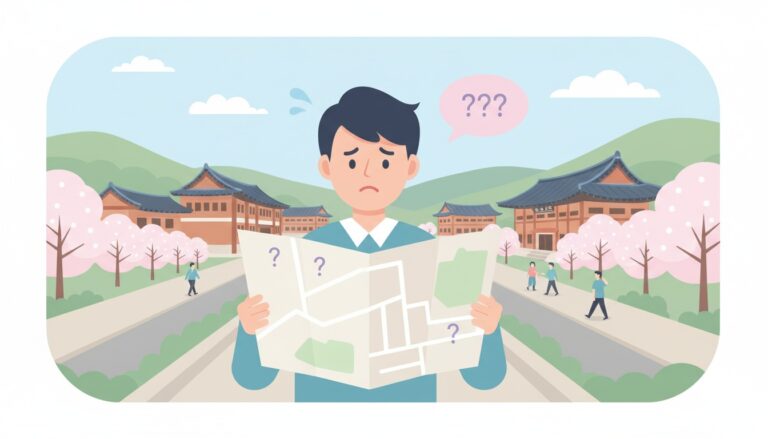
Phase 1: The Panic of the First Day 🏫
Hello! This is your Senior Editor at Daily Hangul.
Imagine this: It’s the first day of the semester. Your schedule says “Humanities Bldg Room 304,” but you are currently standing in front of a building that looks like a spaceship, and you have 5 minutes left. Korean university campuses are notoriously huge (and often built on mountains—hello, leg day!).
Getting lost isn’t just about being late; it’s the fear of walking into the wrong lecture hall and having 50 pairs of eyes stare at you. Today, we’re not just learning directions. We are learning how to ask for help so naturally that the person might just walk you there.
Note: This guide combines real questions from our B1-level students at Seoul National University and Yonsei University.
Phase 2: Essential Expressions (Deep Dive)
1. [건물 이름]을 찾고 있는데요…
- Pronunciation: [Geon-mul i-reum]-eul chat-go it-neun-de-yo…
- Sound Tip: ‘는(neun)’ isn’t ‘noon’. It sounds closer to the ‘nun’ in “nun”.
- Tone: Trail off slightly at the end. Don’t say it sharply!
- Meaning: “I am looking for [Building Name]…”
- Editor’s Insight: This is the Gold Standard for B1 learners. Instead of directly asking “Where is it?” (which can sound demanding), you state your situation using -는데요. It implies, “I’m looking for this place, (can you please help me?)” without saying the second part. It shows you have manners.
- Situation Check: ✅ Perfect for strangers, professors, or older students.
2. 혹시 이 근처에 [장소]가 있나요?
- Pronunciation: Hok-si i geun-cheo-e [Jang-so]-ga it-na-yo?
- Sound Tip: ‘혹시(Hoksi)’ is your magic shield. It means “by any chance.” Always start with this to sound polite.
- Meaning: “By any chance, is [place] around here?”
- Editor’s Insight: Use this when you are completely disoriented. You aren’t sure if you are even in the right zone. It lowers the burden on the listener.
3. 죄송한데, 제가 길을 좀 잃어서요.
- Pronunciation: Joe-song-han-de, je-ga gi-reul jom ir-eo-seo-yo.
- Meaning: “I’m sorry, but it’s because I’m a bit lost.”
- Editor’s Insight: This uses the -아/어서요 (reason) grammar. admitting you are lost instantly makes Koreans want to help you. We have a culture of Jeong (affection/helping), and seeing a lost foreigner triggers our “Help Mode.”
Phase 3: Textbook vs. Real Life 🥊
| Textbook Korean (Robot Mode 🤖) | Real Korean (Insider Mode 😎) |
|---|---|
| 도서관이 어디입니까? (Where is the library?) | 저기요, 혹시 도서관이 어디 쪽이에요? (Excuse me, by any chance, which direction is the library?) |
| 오른쪽으로 가십시오. (Please go right.) | 저기 편의점 끼고 오른쪽으로 도시면 돼요. (Just turn right around that convenience store.) |
| 여기입니까? (Is it here?) | 여기가 304호 맞나요? (Is this room 304, right?) |
Editor’s Note: Notice the use of ‘쪽(jjok – direction/side)’ instead of just ‘where’. It sounds much softer and more natural.
Phase 4: Cultural Context & Manners (Nunchi 101) 🧠
1. The “Student Rush” Nunchi
If someone is running with a piece of toast in their mouth or walking extremely fast with headphones on, do not stop them. They are likely late too. Look for someone walking slowly, looking at their phone, or sitting on a bench.
2. The Hand Gesture
When you ask, “Is it that way?”, do not point with your index finger ☝️. That can be seen as rude or accusatory. Instead, use an open hand 🫱 to gesture toward the direction.
Phase 5: Real-Life Scenario (Roleplay) 🎬
Setting: A confused foreign student (Alex) stops a Korean student (Ji-min) near the main gate.
Alex: (Looking at phone, then hesitantly approaching) 저기요, 죄송한데 잠시만요.
(Excuse me, sorry but do you have a moment?)
Ji-min: (Takes off one earbud) 네?
(Yes?)
Alex: 제가 경영관을 찾고 있는데요… 혹시 어디로 가야 하는지 아세요?
(I’m looking for the Management Building… do you happen to know where I should go?)
Ji-min: 아, 경영관이요? 저기 언덕 위로 쭉 올라가셔야 돼요.
(Ah, Management Building? You have to go straight up that hill over there.)
Alex: 아, 저 언덕이요? 감사합니다!
(Ah, that hill? Thank you!)
(Acting Tip: When saying ‘저기요’, bow your head slightly. Do not tap them on the shoulder!)
Phase 6: 10-Second Shadowing 🗣️
Try to read this in one breath, pausing at the slash marks.
“Excuse me, I’m looking for the student center, do you know where it is?”
저기요, 죄송한데 / 학생회관을 찾고 있는데요 / 혹시 어딘지 아세요?
[Jeogiyo, joesonghande / hak-saeng-hoe-gwan-eul chat-go it-neun-de-yo / hok-si eo-din-ji a-se-yo?]
Focus: Put a rising intonation on ‘요(yo)’ to sound polite and inquiring.
Phase 7: FAQ & Troubleshooting ⛑️
- Q: Can I just show them the map on my phone?
- A: Yes! But don’t just shove the phone in their face. Say “여기로 가고 싶은데요…” (I want to go here…) while showing the screen. This is a survival hack if your pronunciation fails.
- Q: What if they use complex words like ‘Intersection’ or ‘Alley’?
- A: If you panic, just ask for a landmark. “큰 건물 옆이에요?” (Is it next to a big building?) usually simplifies their answer.
Phase 8: Wrap-up 🎁
- Summary: Don’t ask direct questions like a robot. Use “~을 찾고 있는데요” to soften your request and state your purpose.
- Mission: Next time you are on campus (or even a mall), ask a staff member where the restroom is using the “-는데요” form, even if you already know!
- Your Turn: Have you ever gotten lost in Korea? Tell me in the comments how you survived!
Phase 9: Pop Quiz 📝
1. Which is the most natural way to stop a stranger?
a) 야! (Hey!)
b) 당신! (You!)
c) 저기요, 죄송한데… (Excuse me, sorry but…)
2. Fill in the blank to soften the sentence: “_____ 이 근처에 식당이 있나요?”
a) 당장 (Right now)
b) 혹시 (By any chance)
c) 절대 (Never)
3. True or False: You should tap someone on the shoulder to get their attention.
(Answer: False! Just say ‘Jeogiyo’ and bow slightly.)
(Answers: 1-c, 2-b, 3-False)
Frequently Asked Questions (FAQ)
Q: What does "[건물 이름]을 찾고 있는데요..." mean in Korean and how do you pronounce it?
A: In Korean, "[건물 이름]을 찾고 있는데요..." is pronounced [Geon-mul i-reum] and means: a key conversational Korean expression covered in this lesson.
Q: What does "혹시 이 근처에 [장소]가 있나요?" mean in Korean and how do you pronounce it?
A: In Korean, "혹시 이 근처에 [장소]가 있나요?" is pronounced [Hok-si i geun-cheo-e [Jang-so] and means: a key conversational Korean expression covered in this lesson.
Q: What does "죄송한데, 제가 길을 좀 잃어서요." mean in Korean and how do you pronounce it?
A: In Korean, "죄송한데, 제가 길을 좀 잃어서요." is pronounced [Joe-song-han-de, je-ga gi-reul jom ir-eo-seo-yo.] and means: "I'm sorry, but it's because I'm a bit lost."







