

Phase 1: The Hook & Empathy (Introduction)
Hello! This is your Senior Editor at Daily Hangul.
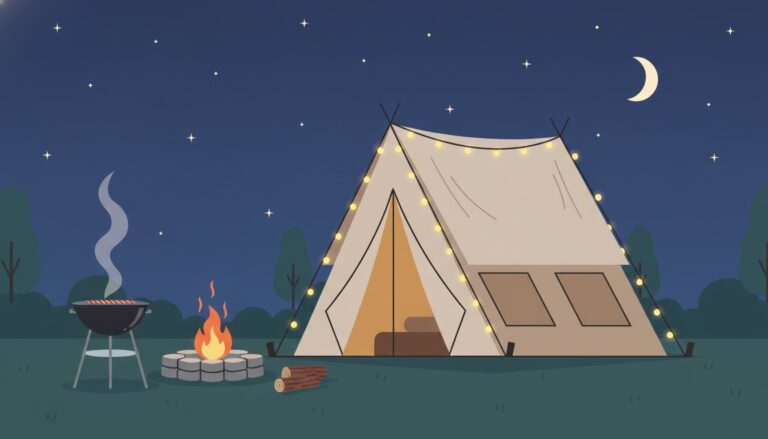
Imagine this: You’ve booked a stunning luxury glamping site in Gapyeong or Jeju. The string lights are twinkling, the premium Hanwoo beef is marbling perfectly, and the charcoal is glowing. Everyone is excited. But as the smoke rises, you find yourself stuck saying “Mashisseoyo” (It’s delicious) for the tenth time.
At a C1 level, simply saying food is “good” isn’t enough. In a glamping setting, the conversation flows around the atmosphere (분위기), the skill of grilling, and the shared labor. If you stay silent or stick to textbook phrases, you might come off as a passive guest rather than an active participant in the fun.
Today, we’re going to upgrade your vocabulary from “Tourist” to “Glamping Pro.” These are the nuances that will make your Korean friends say, “Wa, you really get the Korean vibe!”
(Transparency Note: This guide is curated based on real feedback from advanced learners who felt awkward during social group trips in Korea.)
Phase 2: Deep Dive into Core Expressions
Here are the three heavy-hitters you need for a glamping BBQ night.
1. 숯불 향이 제대로 배었네요 (The charcoal scent has infused properly)
- Pronunciation: [Sut-bul hyang-i je-dae-ro bae-eon-ne-yo]
- Sut sounds like ‘soot’.
- Bae sounds like the ‘ba’ in ‘baker’.
- Meaning:
- Literal: The charcoal fire scent has soaked in properly.
- Real Nuance: “This tastes amazing specifically because of the smoky flavor.” This is the ultimate compliment to the person grilling.
- Editor’s Insight: At an advanced level, specific praise is key. The verb 배다 (to permeate/infuse) is high-level vocabulary. Using this shows you appreciate the cooking method, not just the food.
- Situation Check: Safe for both Casual and Formal (with respectful endings).
2. 불멍 때리다 (To stare blankly at the fire)
- Pronunciation: [Bul-meong ttae-ri-da]
- Meong rhymes with ‘lung’ but with an ‘m’.
- Meaning:
- Literal: To hit ‘fire-blank-stare’.
- Real Nuance: Zoning out while watching the campfire to relax. ‘Bul-meong’ is a cultural phenomenon in Korea.
- Editor’s Insight: You don’t “watch” the fire; you “do Bul-meong.” It’s a valid activity. If someone asks what you are doing, don’t say “Looking at fire.” Say, “불멍 중이에요” (I’m in the middle of fire-zoning).
- Situation Check: Mostly Casual, but widely understood and accepted in all camping contexts.
3. 뒷정리는 복불복으로 할까요? (Shall we leave the cleanup to luck/a game?)
- Pronunciation: [Dwit-jeong-ni-neun bok-bul-bo-gu-ro hal-kka-yo?]
- Meaning:
- Literal: Shall we do the back-cleaning (cleanup) by fortune-or-no-fortune?
- Real Nuance: “Let’s play a game (like Rock-Paper-Scissors) to decide who cleans up.” 복불복 (Bok-bul-bok) refers to a game of chance.
- Editor’s Insight: In Korean camping culture, cleaning up is a communal burden. Suggesting a game relieves the tension of “who will do it?” and makes you the fun atmosphere maker.
- Situation Check: Best for Friends/Colleagues (Casual/Semi-formal).
Phase 3: Textbook vs. Real Life (The Vibe Check)
Let’s look at how a C1 speaker shifts from “correct” to “natural.”
| Textbook (Grammatically Correct but Stiff) | Real Life (Glamping Insider Vibe) |
|---|---|
| 고기를 제가 굽겠습니다. (I will grill the meat.) |
집게 저 주세요. 제가 굽부심이 좀 있거든요. (Give me the tongs. I have some “grilling pride.”) |
| 분위기가 아주 좋습니다. (The atmosphere is very good.) |
와, 오늘 분위기 깡패네요. (Wow, the atmosphere is a “gangster” [killer/amazing] today.) |
| 고기가 다 익었습니다. (The meat is fully cooked.) |
지금이 딱 먹기 좋은 타이밍이에요. (Now is the perfect timing to eat.) |
Note: 굽부심 (Gup-bu-sim) is a combination of Gupda (to grill) + Jabusim (pride). It’s a playful way to say you are confident in your grilling skills.
Phase 4: Cultural Context & Manners (Nunchi)
The “Grill Master” Hierarchy
In a glamping BBQ, the person holding the 집게 (tongs) and 가위 (scissors) holds the power. However, it is considered bad manners to let the oldest person or the guest grill alone.
* The Nunchi Move: Even if you can’t grill well, you should offer: “제가 좀 도울까요?” (Shall I help a bit?) or at least be the one to constantly refill their drink and wrap lettuce wraps (Ssam) for them.
The “Bokkeumbap” Finale
No matter how full you are, if there is a flat iron griddle (gridiron), Koreans often finish with fried rice. Refusing this is like leaving a concert before the encore. Even one spoon is a gesture of participation.
Phase 5: Roleplay Script (Real Scenario)
Setting: A luxury glamping site in Gapyeong. Evening. The fire is roaring.
Characters:
* Min-jun: Korean friend (Host)
* Alex: You (Advanced Learner)
Min-jun: (Flipping meat) 아, 불이 너무 세서 고기가 탈 것 같은데.
(Ah, the fire is too strong, I think the meat might burn.)
Alex: (Handing over a plate) 가장자리로 옮길까요? 숯불 향만 입히게.
(Shall we move it to the edge? Just to let the charcoal scent coat it.)
Min-jun: 오, 알렉스 센스 있는데? 그래야겠다.
(Oh, Alex, you’ve got sense! Let’s do that.)
Alex: (Smiling) 오늘 고기 굽부심 좀 부려보려고 했는데, 민준 씨한테 양보할게요.
(I was planning to show off my grilling pride today, but I’ll yield to you, Min-jun.)
Min-jun: 하하. 대신 설거지는 복불복인 거 알지?
(Haha. Instead, you know dishwashing is up to chance, right?)
Alex: 당연하죠. 잠시 후에 불멍 때리면서 진지하게 승부하시죠.
(Of course. Let’s have a serious match later while spacing out by the fire.)
Phase 6: 10-Second Shadowing Drill
Read this aloud to practice your rhythm. Focus on the pauses to sound thoughtful.
“배도 부르고 / 따뜻한 불 앞에 있으니까 / 세상 부러울 게 없네요. // 이게 바로 / 글램핑의 맛이죠.”
- Translation: I’m full, and being in front of the warm fire, I have nothing to envy in the world. This is exactly the taste (joy) of glamping.
- Tip: Stretch the word “맛이죠” slightly to emphasize the feeling of satisfaction.
Phase 7: FAQ & Troubleshooting
Q: Since we are drinking and camping, can I switch to Banmal (casual language) immediately?
* Editor’s Answer: No. Alcohol loosens the mood, but hierarchy remains. Wait for the Korean person to suggest, “우리 말 편하게 할까요?” (Shall we speak comfortably?) or “말 놓으세요” (Please lower your speech). Until then, stick to polite ~요 endings, even if you are joking around.
Q: What if I hate the smoke smell?
* Editor’s Answer: Complaining about the smoke is a buzzkill. Instead, jokingly say “제가 전생에 훈제 오리였나 봐요. 연기가 저만 따라다니네요.” (I must have been a smoked duck in my past life. The smoke follows only me.) It turns a nuisance into a joke.
Phase 8: Wrap-up & Action Item
- One-Liner Summary: Don’t just eat; compliment the 숯불 향 (charcoal scent), mention your 굽부심 (grilling pride), and enjoy 불멍 (fire-spacing).
- Action Mission: Next time you are at a BBQ (even a restaurant), ask for the tongs by saying “제가 굽부심이 좀 있어서요” and grill a few pieces for your friends!
- Your Turn: Have you ever experienced “Bul-meong”? How did you describe it in your language? Tell me in the comments!
Phase 9: Pop Quiz
1. Which word combines “Grilling” and “Pride”?
A) 굽신굽신 (Gup-shin)
B) 굽부심 (Gup-bu-sim)
C) 불부심 (Bul-bu-sim)
2. What is the most natural thing to say when staring at the campfire?
A) 불을 관찰하고 있어요. (I am observing the fire.)
B) 불이 뜨거워요. (The fire is hot.)
C) 불멍 때리고 있어요. (I am zoning out with the fire.)
3. Meaning of “숯불 향이 배다”:
A) The charcoal is wet.
B) The meat is burnt.
C) The charcoal scent has infused into the food.
(Answers: 1-B, 2-C, 3-C)
Frequently Asked Questions (FAQ)
Q: What does "숯불 향이 제대로 배었네요 (The charcoal scent has infused properly)" mean in Korean and how do you pronounce it?
A: In Korean, "숯불 향이 제대로 배었네요 (The charcoal scent has infused properly)" is pronounced [Sut-bul hyang-i je-dae-ro bae-eon-ne-yo] and means: a key conversational Korean expression covered in this lesson.
Q: What does "불멍 때리다 (To stare blankly at the fire)" mean in Korean and how do you pronounce it?
A: In Korean, "불멍 때리다 (To stare blankly at the fire)" is pronounced [Bul-meong ttae-ri-da] and means: a key conversational Korean expression covered in this lesson.
Q: What does "뒷정리는 복불복으로 할까요? (Shall we leave the cleanup to luck/a game?)" mean in Korean and how do you pronounce it?
A: In Korean, "뒷정리는 복불복으로 할까요? (Shall we leave the cleanup to luck/a game?)" is pronounced [Dwit-jeong-ni-neun bok-bul-bo-gu-ro hal-kka-yo?] and means: Literal: Shall we do the back-cleaning (cleanup) by fortune-or-no-fortune?







