

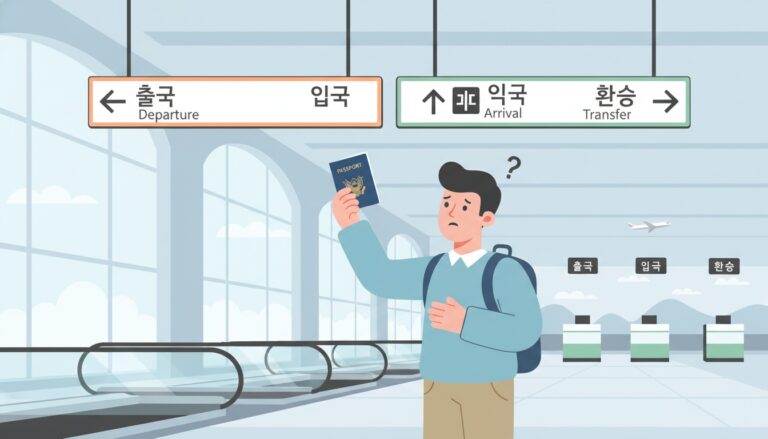
Lost at Incheon Airport? Don’t Panic! 3 Phrases to Find Your Gate Instantly
Introduction
Hello, this is Daily Hangul!
Have you ever felt that sudden rush of panic when you look at your boarding pass, look at the time, and realize Incheon International Airport is much, much bigger than you thought?
This is a “Synthetic Example” based on stories from many of my students:
A common pattern I see is learners memorizing long, complex sentences like “Could you please tell me the direction to the boarding gate?” By the time they finish the sentence in their head, they are already stressed. In reality, airport terminals are loud and busy. You don’t need perfect grammar; you need speed and clarity.
Today, we will learn how to ask “Where is the gate?” effectively, so you can enjoy your duty-free shopping instead of running for your life!
Summary
- Today’s Key Phrases:
- … 게이트 어디예요? (… geiteu eodiyeyo?)
- 이쪽 맞아요? (Ijjok majayo?)
- 탑승구 (Tapseunggu)
- Safe to use: With airport staff, crew members, or passersby.
- Level: A1 (Survival). Even if you are a total beginner, these short phrases work because they rely on keywords and body language.
Table of Contents
- Today’s Key Phrases Deep Dive
- Textbook vs. Real Korean
- Unique Analysis: The “Eye Contact” Strategy
- Real-Life Role Play: Incheon Airport Info Desk
- Shadowing Challenge
- FAQ
- Wrap-up & Quiz
Today’s Key Phrases Deep Dive
1. 게이트 어디예요? (Geiteu eodiyeyo?)
- Meaning: Where is the gate?
- Geiteu = Gate (Konglish/Loanword)
- Eodiyeyo? = Where is it?
- Usage & Register:
- Who: Airport staff or strangers.
- Tone: Polite informal (Haeyo-che / 해요체). It is polite enough for strangers but quick to say.
- Tutor’s Secret Note:
Koreans use the English word “Gate” very often at the airport. You don’t always need to use the traditional Korean word. Warning: Don’t drop the “yo” (요) at the end. Saying just “Geiteu eodi?” sounds like you are talking to a child or being rude. - Pronunciation Clinic:
- Geiteu: It is 3 syllables (Ge-i-teu). Don’t say it as one syllable “Gate”. Pronounce the final ‘eu’ (으) softly.
- Examples:
- 10번 게이트 어디예요? (Sip-beon geiteu eodiyeyo?)
Where is Gate 10? - 탑승구 어디예요? (Tapseunggu eodiyeyo?)
Where is the boarding gate? - 저기요, 게이트 어디예요? (Jeogiyo, geiteu eodiyeyo?)
Excuse me, where is the gate?
- 10번 게이트 어디예요? (Sip-beon geiteu eodiyeyo?)
- Alternatives:
- Formal: 탑승구는 어디입니까? (Tapseunggu-neun eodi-imnikka?) – Too stiff for quick questions.
- Casual: 게이트 어디야? (Geiteu eodiya?) – Only for close friends.
- Mini Quiz:
- Fill in the blank: _____ 게이트 어디예요? (Excuse me / Over there)
-
Click to see answer
저기요 (Jeogiyo)
2. 이쪽 맞아요? (Ijjok majayo?)
- Meaning: Is this the right way? / Is this side correct?
- Ijjok = This side / This way
- Majayo = Is it correct?
- Usage & Register:
- Use this while pointing in a specific direction. It saves time describing where you are going.
- Tutor’s Secret Note:
This is the ultimate “Cheat Key.” You don’t need to know the words for “left,” “right,” or “straight.” Just point and ask, “Ijjok majayo?” - Pronunciation Clinic:
- Ijjok: The ‘jj’ (ㅉ) is a tense sound. Push air out sharply. It sounds stronger than the English ‘J’.
- Examples:
- 타는 곳, 이쪽 맞아요? (Taneun got, ijjok majayo?)
Is the boarding place this way? - 출국장, 이쪽 맞아요? (Chulgukjang, ijjok majayo?)
Is the departure hall this way? - (Pointing finger) 이쪽 맞아요? ((Pointing finger) Ijjok majayo?)
(Pointing) Is this right?
- 타는 곳, 이쪽 맞아요? (Taneun got, ijjok majayo?)
- Alternatives:
- Polite: 이쪽으로 가면 돼요? (Ijjogeuro gamyeon dwaeyo?) – Can I go this way?
Textbook vs. Real Korean
How does a textbook teach asking for directions vs. how Koreans actually do it when rushing for a flight?
| Feature | Textbook Korean (Book Korean) | Real Korean (Survival Mode) |
|---|---|---|
| Phrase | 실례합니다. 탑승구는 어느 쪽에 있습니까? (Sillyehamnida. Tapseunggu-neun eoneu jjoge itseumnikka?) |
저기요, 24번 게이트 어디예요? (Jeogiyo, isipsa-beon geiteu eodiyeyo?) |
| Focus | Perfect grammar & Full sentence | Keywords & Numbers |
| Speed | Slow and articulate | Fast and direct |
| Situation | Exam room | Running with luggage |
✅ Checklist: When to use what?
* Use Real Korean when: You are in a line, asking a busy staff member, or in a hurry.
* Use Textbook Korean when: You are writing an email to the airport help desk (which you likely won’t do).
Unique Analysis: The “Confusion Scenario” Solution
Scenario: You ask “Where is the gate?” and the staff replies with a long sentence in Korean that you don’t understand.
Don’t Panic! Use the “Restate” Technique.
Instead of saying “I don’t understand,” simply point in the direction they gestured and ask for confirmation.
- Staff: (Says something complex about going straight and turning left)
- You (Confused but smart): 아, 저쪽이요? 감사합니다! (Ah, jeojjogiyo? Gamsahamnida!)
- Meaning: Ah, over there? Thank you!
This turns a failed listening exercise into a successful communication.
Real-Life Role Play: At Incheon Airport
Context: You have 30 minutes before boarding. You are at the Information Desk.
🗣️ Dialogue
Traveler: 저기요, 205번 게이트 어디예요?
(Jeogiyo, ibaeko-beon geiteu eodiyeyo?)
Excuse me, where is Gate 205?
Staff: 205번이요? 셔틀 트레인 타셔야 해요.
(Ibaeko-beonyo? Syeoteul teurein tasyeoya haeyo.)
Gate 205? You need to take the Shuttle Train.
Traveler: (Surprised) 셔틀 트레인이요? 어디서 타요?
(Syeoteul teureiniyo? Eodiseo tayo?)
A shuttle train? Where do I take it?
Staff: (Pointing down) 지하로 내려가세요.
(Jiharo naeryeogaseyo.)
Go down to the basement.
Traveler: 아, 아래쪽이요? 감사합니다!
(Ah, araejjogiyo? Gamsahamnida!)
Ah, down there? Thank you!
💡 Culture Tip:
Incheon Airport has a “Concourse” (satellite terminal) for many foreign airlines. If your gate number is 101-270, you MUST take the Shuttle Train. It takes extra time, so ask immediately!
Shadowing Challenge
Let’s practice speaking naturally. Repeat this 3 times.
Script:
“저기요, 게이트가 어디예요? 이쪽 맞아요?”
(Jeogiyo, geiteuga eodiyeyo? Ijjok majayo?)
“Excuse me, where is the gate? Is this the right way?”
Checklist:
* [ ] 1st Try (Slowly, checking pronunciation)
* [ ] 2nd Try (Normal speed, imagine you are holding a passport)
* [ ] 3rd Try (Fast speed, visualize you are late!)
✨ Pronunciation Point:
Link the words naturally. Not “I-jjok-ma-ja-yo” but “Ijjongmajayo?” (The ‘k’ sound in jjok softens slightly before ‘m’).
FAQ (Frequently Asked Questions)
Q1: Can I just say “Gate?” in English?
A: Yes! At Incheon Airport, most staff understand basic English words. However, saying “Geiteu eodiyeyo?” shows effort and is more polite than just shouting a noun.
Q2: What is the difference between ‘Gate’ (게이트) and ‘Tapseunggu’ (탑승구)?
A: They mean the same thing. ‘Tapseunggu’ is the Sino-Korean word (Boarding Mouth/Entrance), and ‘Gate’ is the loanword. Signs usually show both or just the number.
Q3: How do I say “Is it far?”
A: You can say “멀어요?” (Meoreoyo?). This is very useful to know if you need to run!
Wrap-up & Action Item
Today’s Summary:
To survive at the airport, you only need to know how to ask the location (…eodiyeyo?) and confirm the direction (…ijjok majayo?).
Your Mission:
Next time you watch a K-Drama or a travel vlog about Korea, look for scenes at the airport. Listen for the word “Geiteu” or “Tapseunggu.” If you hear it, pause and repeat the sentence!
Discussion:
Have you ever gotten lost in a foreign airport? Tell me your story in the comments!
Final Quiz
1. How do you say “Where is the gate?” in polite Korean?
a) Geiteu isseo?
b) Geiteu eodiyeyo?
c) Geiteu annyeong?
2. If you want to confirm if “This way” is correct, what do you say?
a) Ijjok majayo?
b) Jeogi eodiyeyo?
c) Meoreoyo?
3. Fill in the blank: If your gate is 101+, you might need to take the _____ Train.
(Answer: Shuttle)
⬇️ Click to check answers
1. b) Geiteu eodiyeyo?
2. a) Ijjok majayo?
3. Shuttle (Syeoteul)
Frequently Asked Questions (FAQ)
Q: What does "게이트 어디예요? (Geiteu eodiyeyo?)" mean in Korean and how do you pronounce it?
A: In Korean, "게이트 어디예요? (Geiteu eodiyeyo?)" is pronounced [see lesson guide] and means: Where is the gate?
Q: What does "이쪽 맞아요? (Ijjok majayo?)" mean in Korean and how do you pronounce it?
A: In Korean, "이쪽 맞아요? (Ijjok majayo?)" is pronounced [see lesson guide] and means: Is this the right way? / Is this side correct?







