

Laughing Through Tears? 😭😂 Unlocking the Secret of Korean ‘Haehak’ (Humor)
Introduction
Hello, this is Daily Hangul!
Have you ever watched a Korean drama where a character is in a terrible situation—maybe they went bankrupt or lost their job—but they suddenly start laughing or making jokes? Or perhaps you’ve read a Korean short story that feels incredibly sad yet undeniably funny at the same time?
This isn’t just random writing; it’s the essence of the Korean spirit.
📖 The Composite Case: “Why is he laughing?”
(This is a composite case based on questions from multiple advanced learners wondering about emotional reactions in K-media.)
Many students ask me: “Teacher, in the drama, the protagonist just lost his house, but he’s dancing and singing. Is he crazy?”
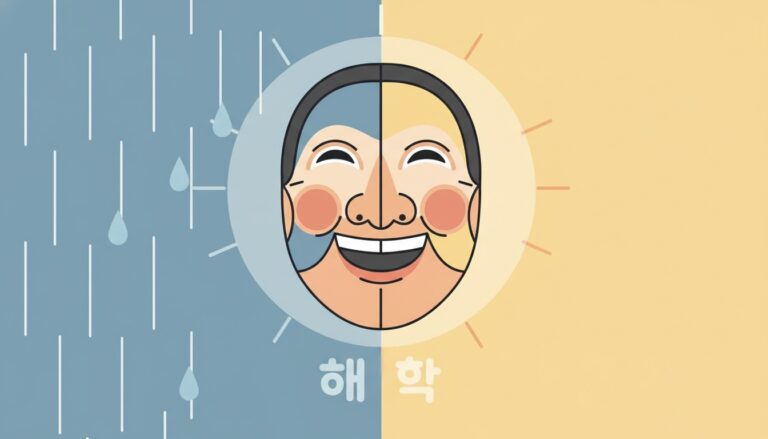
No, he is practicing Haehak (해학). In Western culture, tragedy and comedy are often separated. But in Korean culture and literature, they are deeply intertwined. Haehak is the humor that embraces sorrow—it’s about overcoming pain through laughter, rather than fighting it with anger.
Today, we will dive into this unique “Korean Wit” found in literature and how it survives in modern language. This is C2-level cultural context that will make you look like a true expert on Korea!
Summary at a Glance
- Today’s Expressions: Utpeuda (Funny-sad), Unsu joeun nal (Irony), Giga makhida (Dumbfounded).
- Safe Zone: These are great for deep conversations with friends or discussing culture/movies.
- Difficulty Level (C2): While the words are simple, understanding the irony and cultural background requires advanced emotional intelligence in Korean.
Table of Contents
- Today’s Key Expressions Deep Dive
- Textbook vs. Real Korean (The Art of Irony)
- Unique Analysis: The Irony Translator
- Real-Life Role Play: The disastrous date
- Shadowing Challenge
- FAQ
- Wrap-up & Quiz
Today’s Key Expressions Deep Dive
1. 웃프다 (Utpeuda)
- Meaning: Funny but sad / Bittersweet
- Origin: A compound of 웃기다 (Utgida – funny) + 슬프다 (Seulpeuda – sad).
Usage & Register:
* To whom: Friends, peers, or online comments (Casual/Polite).
* Style: Highly common in modern conversation to describe the spirit of Haehak.
Tutor’s Secret Note 🤫:
Koreans love this word because reality is rarely 100% happy or 100% sad. Use this when you share a mistake that was tragic at the moment but funny now.
* Warning: Do not use this for serious tragedies (like a funeral). It is only for situational misfortunes.
Pronunciation Clinic:
* The t (ㅅ) in Ut stops abruptly before the p (프) sound. It’s not u-seu-peu-da, it is ut-peu-da.
Examples:
* Friend: 내 통장 잔고 보니까 진짜 웃프다. (Nae tongjang jango bonikka jinjja utpeuda.)
* English: Looking at my bank account balance, it’s really funny but sad.
* Work: 야근하면서 야식 먹는데 상황이 좀 웃프네요. (Yageunhamyeonseo yasik meongneunde sanghwang-i jom utpeuneyo.)
* English: Eating a late-night snack while working overtime… the situation is a bit bittersweet.
* Drama: 그 주인공의 인생은 정말 웃픈 이야기야. (Geu juingong-ui insaeng-eun jeongmal utpeun iyagiya.)
* English: That protagonist’s life is a truly funny-sad story.
Alternatives:
* More Formal: 비극적이지만 희극적이다 (Bigeukjeogijiman huigeukjeogida – It is tragic yet comic)
* More Casual: 웃겨 (Utgyeo – It’s funny [ignoring the sadness])
Mini Quiz (Click to see answer)
Fill in the blank: “I fell down in front of my crush. It was so ______.”
Answer: 웃펐어 (Utpeosseo)
2. 운수 좋은 날 (Unsu joeun nal)
- Meaning: A lucky day (Literal) / A terribly unlucky day (Actual/Ironic usage)
- Origin: Title of a famous short story by Hyun Jin-geon (1924). The protagonist makes a lot of money (lucky), only to find his wife dead at home (tragic).
Usage & Register:
* To whom: Anyone familiar with Korean culture (Education level sensitive).
* Style: Used metaphorically.
Tutor’s Secret Note 🤫:
If a Korean says “Ah, today is a Unsu joeun nal,” check their facial expression. If they look tired, they are being sarcastic. It is the pinnacle of Korean literary irony.
Pronunciation Clinic:
* Un (운) + Su (수). Make sure not to say Un-shoe.
Examples:
* Self-talk: 비 오는데 우산도 없고… 완전 운수 좋은 날이네. (Bi oneunde usan-do eopgo… wanjeon unsu joeun nal-ine.)
* English: It’s raining and I have no umbrella… what a “lucky day” (total disaster).
* Friend: 지갑 잃어버리고 넘어지고, 너 오늘 운수 좋은 날 찍니? (Jigap ireobeorigo neomeojigo, neo oneul unsu joeun nal jjingni?)
* English: Lost your wallet, fell down… are you filming “A Lucky Day” today?
* Literal Usage: 복권 당첨됐다! 진짜 운수 좋은 날이야! (Bokgwon dangcheom-dwaetda! Jinjja unsu joeun nal-iya!)
* English: I won the lottery! It really is a lucky day! (Rarely used without irony in literature contexts, but possible).
3. 기가 막히다 (Giga makhida)
- Meaning: To be dumbfounded / at a loss for words / (Positive) Amazing
- Literal: My energy (Gi/Qi) is blocked.
Usage & Register:
* To whom: Usually peers or lower status when complaining; can be used to superiors if praising something.
Tutor’s Secret Note 🤫:
In Korean satire (Golgye – 골계), characters often use this when authority figures do something stupid. It captures the feeling of “This is so absurd, I can’t even speak.”
Examples:
* Negative (Absurd): 말하는 거 보니 기가 막히네. (Malhaneun geo boni giga makhine.)
* English: Hearing you talk, I’m absolutely dumbfounded (You are talking nonsense).
* Positive (Amazing): 이 집 김치 맛이 기가 막혀요. (I jip gimchi masi giga makhieoyo.)
* English: This restaurant’s kimchi taste is breathtaking (unbelievably good).
* Situation: 버스를 놓쳤는데 택시도 안 잡혀. 기가 막힐 노릇이다. (Beoseu-reul nochyeonneunde taeksi-do an japhyeo. Giga makhil noreusida.)
* English: Missed the bus, can’t get a taxi. It’s an absurd situation.
Textbook vs. Real Korean: The Art of Irony
How do you express “This is ridiculous” in a literary/witty way?
| Context | Textbook Korean (Book Korean) | Real Korean (Street/Literature Vibe) | Nuance |
|---|---|---|---|
| Confusion | 이해가 안 돼요. (Ihaega an dwaeyo.) | 귀신이 곡할 노릇이네. (Gwisini gokal noreusine.) | Textbook is plain. Real Korean uses a proverb: “Even a ghost would wail” (It’s mysterious/absurd). |
| Bad Luck | 운이 나빠요. (Uni nappayo.) | 뒤로 넘어져도 코가 깨진다. (Dwiro neomeojyeodo koga kkaejinda.) | “Even if I fall backward, my nose breaks.” (Extreme irony/bad luck). |
| Mockery | 너나 잘하세요. (Neona jal-haseyo.) | 똥 묻은 개가 겨 묻은 개 나무란다. (Ttong mudeun gae-ga gyeo mudeun gae namuranda.) | “The dog with poop scolds the dog with chaff.” (The pot calling the kettle black). |
📝 Situation Checklist
- Business Meeting: Use Textbook Korean.
- Drinking with friends: Use Real Korean proverbs/idioms for humor.
- Writing a diary: Use Real Korean to express deep feelings.
Unique Analysis: The Irony Translator
Korean Haehak often involves saying the opposite of what you mean to soften the blow of tragedy. Here is how to translate the “inner heart.”
| Phrase (Korean) | Literal Meaning | Satirical Meaning (Haehak) |
|---|---|---|
| 잘~ 한다! (Jal~ handa!) | You are doing well! | Stop it, you are making a mess. |
| 팔자 좋다. (Palja jota.) | Your destiny/fortune is good. | You are lazy / You have no worries (said with envy/scorn). |
| 꼴값 떤다. (Kkolgap tteonda.) | Creating the price of one’s shape. | Acting ridiculous / Don’t act cool when you are not. |
Real-Life Role Play: The Disastrous Date
Situation: Min-su is telling his friend Ji-eun about a date that went horribly wrong. Instead of crying, he is using Haehak (humor).
Characters:
* Min-su: Unlucky guy.
* Ji-eun: Supportive friend.
Dialogue:
Ji-eun: 데이트 어땠어? 분위기 좋았어?
(Deiteu eottaesseo? Bunwigi joasseo?)
How was the date? Was the vibe good?
Min-su: 어, 아주 기가 막혔지. 만나자마자 비가 쏟아지더라.
(Eo, aju giga makhyeotji. Mannajamaja biga ssodajideora.)
Oh, it was breathtaking (absurd). As soon as we met, rain poured down.
Ji-eun: 헐, 우산은 있었고?
(Heol, usan-eun isseotgo?)
Oh no, did you have an umbrella?
Min-su: 아니, 내가 사려고 뛰다가 넘어져서 바지가 찢어졌어. 완전 운수 좋은 날이었어. 하하.
(Ani, naega saryeogo ttwidaga neomeojyeoseo baji-ga jjijeojyeosseo. Wanjeon unsu joeun nal-ieosseo. Haha.)
No, I ran to buy one, fell, and ripped my pants. It was a totally “lucky day.” Haha.
Ji-eun: 야… 진짜 웃프다. 그 여자분은 뭐라셔?
(Ya… jinjja utpeuda. Geu yeojabun-eun mworasyeo?)
Hey… that’s really funny but sad. What did she say?
Min-su: 그냥 웃더라고. 액땜했다고 치지 뭐.
(Geunyang utdeorago. Aekttaemhaetdago chiji mwo.)
She just laughed. I’ll just consider it as warding off bad luck.
💡 Culture Tip: Min-su uses “Haha” even though it’s sad. In Korea, laughing off bad luck (액땜 – Aekttaem) is a way to show resilience and not burden the listener with too much negativity.
Shadowing Challenge 🗣️
Let’s practice the spirit of Haehak. Imagine you just missed the last bus, but you decide to laugh about it.
Script:
아이고, 버스도 놓치고 비도 오네. 내 인생 참 스펙타클하다! 웃자, 웃어!
(Aigo, beoseu-do nochigo bi-do one. Nae insaeng cham seupektakeul-hada! Utja, useo!)
Translation: Oh my, missed the bus and it’s raining. My life is truly spectacular! Let’s laugh, just laugh!
Checklist:
* [ ] Read slowly checking pronunciation.
* [ ] Read with a sarcastic/resigned tone.
* [ ] Read fast as if talking to yourself.
Pronunciation Point:
* 놓치고 (Nochigo): The ‘h’ (ㅎ) blends with ‘ch’ (ㅊ). Pronounce it strongly as [No-chi-go].
FAQ: Questions from Readers
Q1: Can I use “웃프다 (Utpeuda)” to my boss?
A: It is better to avoid it in formal reporting. However, during a casual team lunch or coffee break, it is acceptable. It shows you have a young, trendy sense of humor.
* Safe option: 참 아이러니하네요. (Cham aireonihaneyo – It is very ironic.)
Q2: Is satire (Golgye) considered rude?
A: Satire targets the situation or powerful people who abuse power. If you use satire against a friend who is genuinely suffering, it is bullying. Use it carefully! Haehak warms the heart; Satire stings.
Conclusion & Today’s Mission
One Line Summary:
Korean humor (Haehak) is about finding laughter in sadness—use 웃프다 (Utpeuda) when things go wrong but you want to stay positive!
Today’s Mission:
Think of a small misfortune that happened to you recently (e.g., spilling coffee). Write a sentence using “웃프다” or “기가 막히다” in the comments below!
Your Turn:
Have you ever experienced a “Unsu joeun nal” (ironically lucky day)? Tell me your story!
Final Quiz
1. Which word combines “Funny” and “Sad”?
A) 슬기다 (Seulgida)
B) 웃프다 (Utpeuda)
C) 기쁘다 (Gippeuda)
2. What is the true meaning when someone says “It is a ‘Unsu joeun nal'” after a disaster?
A) They are genuinely happy.
B) They are using irony/sarcasm.
C) They won the lottery.
3. Fill in the blank: “The situation was so absurd, I was dumbfounded.” -> “기가 ______.”
Check Answers
1. B) 웃프다
2. B) They are using irony/sarcasm.
3. 막혔다 (Makhyeotda) or 막히다 (Makhida)
Frequently Asked Questions (FAQ)
Q: What does "웃프다 (Utpeuda)" mean in Korean and how do you pronounce it?
A: In Korean, "웃프다 (Utpeuda)" is pronounced [see lesson guide] and means: Funny but sad / Bittersweet
Q: What does "운수 좋은 날 (Unsu joeun nal)" mean in Korean and how do you pronounce it?
A: In Korean, "운수 좋은 날 (Unsu joeun nal)" is pronounced [see lesson guide] and means: A lucky day (Literal) / A terribly unlucky day (Actual/Ironic usage)
Q: What does "기가 막히다 (Giga makhida)" mean in Korean and how do you pronounce it?
A: In Korean, "기가 막히다 (Giga makhida)" is pronounced [see lesson guide] and means: To be dumbfounded / at a loss for words / (Positive) Amazing







