

Introduction
Hello, this is Daily Hangul!
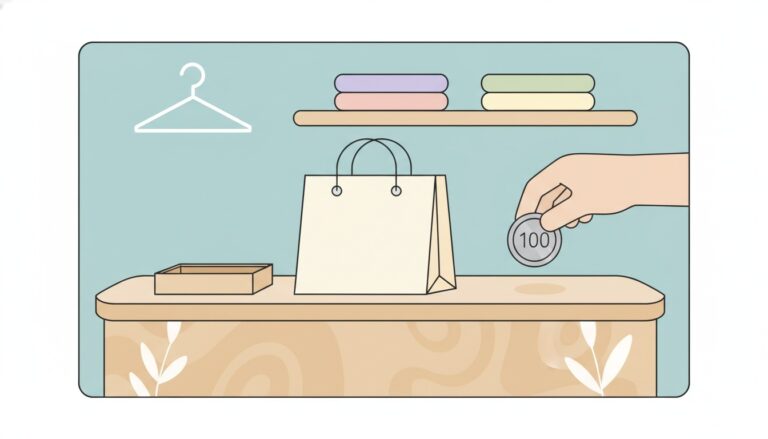
Imagine this scenario: You’ve just bought a trendy coat at a boutique in Hongdae. You are excited, but the clerk hands you the receipt and the clothes… just as they are. You stand there holding a heavy coat in your arms, wondering, “Why didn’t they give me a bag?” and “How do I ask for one without sounding rude?”
Note: This is a “synthetic example” combined from stories of several students who felt awkward asking for a bag in Korean clothing stores.
In Korea, due to strict environmental regulations, stores (even clothing stores) cannot give out disposable bags for free. You almost always have to pay for them, and you often have to ask first. If you rely only on textbook Korean, you might not know the natural flow of this “paying for the bag” transaction. Let’s learn how to handle this smoothly!
Summary at a Glance
- Top 3 Expressions:
- 쇼핑백 있어요? (Do you have a shopping bag?)
- 담아 주세요. (Please put it in/bag it.)
- 봉투값 (Bag fee)
- Safety Level: Safe for clerks and strangers (Standard Politeness).
- Level A2 (Beginner-Intermediate): Essential because environmental laws make this a required interaction in every purchase.
Table of Contents
- Today’s Key Expressions: Deep Dive
- Textbook vs. Real Korean
- Tone Thermometer: Politeness Levels
- Real-Life Role Play: Gangnam SPA Brand Store
- Shadowing Challenge
- FAQ
- Wrap-up & Quiz
Today’s Key Expressions: Deep Dive
1. 쇼핑백 (Syopingbaek)
- Meaning: Shopping bag (Paper bag or higher quality bag)
- Usage & Register:
- Who: To store clerks.
- Tone: Standard polite nouns.
- Tutor’s Secret Note:
- In a convenience store, we say 봉투 (Bongtu – plastic bag). However, in a clothing store or department store, asking for a 봉투 might sound like you want a cheap plastic bag. Use 쇼핑백 (Syopingbaek) to refer to the branded paper bags.
- Warning: Do not just say “Bag” (백). In Korean, “Bag” usually means a handbag/purse.
- Pronunciation Clinic:
- [Syopingbaek] – Emphasize the ‘Syo’. The ‘k’ at the end is a stopped sound (don’t release the air).
- Examples:
- 쇼핑백 구매할게요. (Syopingbaek gumaehal-geyo.) – I will buy a shopping bag.
- 쇼핑백 큰 거 있나요? (Syopingbaek keun geo innayo?) – Do you have a large shopping bag?
- 이거 쇼핑백에 들어갈까요? (Igeo syopingbaek-e deureogalkkayo?) – Will this fit in the shopping bag?
- Alternatives:
- More Casual: 봉투 (Bongtu – usually plastic)
- More Formal: 종이 가방 (Jongi gabang – Paper bag)
- Mini Quiz:
-
Click to see answer
Question: If you are at a high-end store, you should ask for a _____ , not a Bongtu.
Answer: 쇼핑백 (Syopingbaek)
-
2. 담아 주세요 (Dama juseyo)
- Meaning: Please put it in (the bag).
- Usage & Register:
- Who: To store clerks after paying for the bag.
- Tone: Polite request (Haeyo-che).
- Tutor’s Secret Note:
- The verb 담다 (damda) means “to put something into a container.” This is more natural than saying “Give me a bag” (가방 주세요) because it implies the action of packing.
- Pronunciation Clinic:
- [Dama juseyo] – Connect the ‘m’ sound: ‘Da-ma’.
- Examples:
- 쇼핑백에 담아 주세요. (Syopingbaek-e dama juseyo.) – Please put it in a shopping bag.
- 봉투에 담아 주시겠어요? (Bongtu-e dama jusigess-eoyo?) – Could you put it in a bag? (More polite)
- 따로 담아 주세요. (Ttaro dama juseyo.) – Please put them in separate bags.
- Alternatives:
- Casual: 담아 줘 (Dama jwo)
- Formal: 넣어 주십시오 (Neoeo jusipsio – ‘Put inside’)
- Mini Quiz:
-
Click to see answer
Question: “Please ______ it in the bag.” (Hint: D____)
Answer: 담아 (Dama)
-
3. ~원 추가됩니다 (~won chugadoemnida)
- Meaning: An extra ~won will be added.
- Usage & Register:
- Who: What you will hear from the clerk.
- Tone: Business formal.
- Tutor’s Secret Note:
- You won’t say this, but you must understand it. When you ask for a bag, the clerk will almost mechanically say “100 won is added.” Don’t panic, they aren’t overcharging you; it’s the law!
- Pronunciation Clinic:
- [Chugadoemnida] – ‘doe’ sounds like ‘dwe’.
- Examples:
- 쇼핑백 100원 추가됩니다. (Syopingbaek baek-won chugadoemnida.) – 100 won will be added for the shopping bag.
- 봉투값 추가되는데 괜찮으세요? (Bongtugap chugadoeneunde gwaenchaneuseyo?) – There is an extra charge for the bag, is that okay?
- 환경부담금 추가됩니다. (Hwangyeongbudamgeum chugadoemnida.) – An environmental fee is added.
- Alternatives:
- Simpler hearing: ~원이에요. (It is ~won.)
- Mini Quiz:
-
Click to see answer
Question: What does ‘chuga’ (추가) mean?
Answer: Addition / Extra
-
Textbook vs. Real Korean
Context: In Korea, “Buying a bag” is not a separate purchase usually; it’s added to the total transaction at the checkout counter.
| Type | Expression | Nuance/Vibe |
|---|---|---|
| Book Korean | 쇼핑백을 사고 싶어요. (Syopingbaek-eul sago sipeoyo.) |
“I want to buy a shopping bag.” Grammatically correct but sounds like the bag is the main item you are shopping for. |
| Book Korean | 봉투가 필요합니까? (Bongtu-ga piryohamnikka?) |
“Do you need a bag?” Too stiff/military style. |
| Real Korean | 봉투 필요하세요? (Bongtu piryohaseyo?) |
“Do you need a bag?” Most common phrase clerks use. |
| Real Korean | 하나 담아 주세요. (Hana dama juseyo.) |
“Please bag one up for me.” Natural response implies you accept the cost. |
Situation Checklist:
* If the clerk asks nothing: Say “쇼핑백 주세요” (Give me a bag).
* If the clerk says “100 won added”: Nod and say “네” (Yes).
Unique Analysis: Tone Thermometer
How polite should you be when buying a 100-won bag? Let’s check the temperature.
| Level | Expression | Feel/Atmosphere |
|---|---|---|
| 5 (Hot/Formal) | 담아 주실 수 있으실까요? (Dama jusil su isseusilkkayo?) |
Extremely polite. Maybe you are buying a Chanel bag, or you broke something. A bit too much for buying a T-shirt. |
| 3 (Warm/Standard) | 담아 주세요. / 쇼핑백 하나 주세요. (Dama juseyo / Syopingbaek hana juseyo) |
Perfect. Clean, polite, and efficient. Use this 99% of the time. |
| 1 (Cold/Rude) | 봉투. / 담아 줘. (Bongtu / Dama jwo) |
Very rude to staff. Do not use unless you want to be the “foreigner with bad manners.” |
Real-Life Scenario: Role Play
Setting: A popular SPA brand (like Spao or Uniqlo) in Gangnam. Friday evening, busy line.
Characters:
* Clerk (C): Fast, efficient, tired.
* Guest (G): You (Foreign shopper).
(At the counter)
C: 결제 도와드릴게요. 봉투 필요하세요?
(Gyeolje dowadeurilgeyo. Bongtu piryohaseyo?)
Let me help you with payment. Do you need a bag?
G: 네, 쇼핑백 하나 주세요.
(Ne, syopingbaek hana juseyo.)
Yes, please give me one shopping bag.
C: 쇼핑백 100원 추가됩니다. 괜찮으세요?
(Syopingbaek baek-won chugadoemnida. Gwaenchaneuseyo?)
100 won will be added for the shopping bag. Is that okay?
G: 네, 담아 주세요.
(Ne, dama juseyo.)
Yes, please put it in.
C: 영수증은 버려 드릴까요?
(Yeongsujeung-eun beoryeo deurilkkayo?)
Shall I throw away the receipt?
G: 아니요, 주세요. 감사합니다.
(Aniyo, juseyo. Gamsahamnida.)
No, please give it to me. Thank you.
Culture Tip: In busy stores like this, everything happens fast. Have your card ready, and expect the “bag question” immediately.
Shadowing & Speaking Challenge
Let’s practice a slightly longer sentence for when you buy a gift.
Script:
“이거 선물할 건데, 쇼핑백에 따로 담아 주실 수 있나요?”
(Igeo seonmulhal geonde, syopingbaek-e ttaro dama jusil su innayo?)
[This is for a gift, so could you put it in a shopping bag separately?]
Checklist:
* [ ] Listen and repeat slowly (Focus on ‘ttaro’ – separately).
* [ ] Repeat at normal speed.
* [ ] Say it without looking at the text.
Pronunciation Point:
* 따로 (Ttaro): Make sure to use the tense ‘Tt’ sound (Double consonant ㄸ). It means ‘separately’.
Frequently Asked Questions (FAQ)
Q1: Can I just take a bag from the pile behind the counter?
* No! Never do this. Bags are inventory with a barcode. Taking one without paying is technically theft, though usually, they will just stop you and ask you to pay. Always ask first.
Q2: What is the difference between ‘Jong-i bag’ and ‘Shopping bag’?
* 종이 가방 (Jongi gabang) literally means “paper bag.” 쇼핑백 (Syopingbaek) is the Konglish term more commonly used in retail for the handled bags you get at stores. Both are understood, but Syopingbaek is more common in retail.
Q3: How much do bags usually cost?
* Plastic bags (convenience stores): 20~50 KRW.
* Paper Shopping bags (clothing stores): 100~1,000 KRW depending on size and brand.
Wrap-up & Action Item
Summary: Today we learned that bags aren’t free in Korea! Use “쇼핑백 주세요” to buy one and “담아 주세요” to ask them to pack it.
Today’s Mission:
Next time you go to a convenience store or a clothing store in Korea (or a Korean market abroad), try to listen for the word “봉투 (Bongtu)” or “쇼핑백 (Syopingbaek)” from the clerk. Did they ask you first?
Comment below: Have you ever awkwardly carried clothes in your hands because you didn’t know how to ask for a bag? Share your story!
Final Quiz
1. What is the most natural way to ask a clerk to put your clothes in a bag?
a) 가방 줘. (Gabang jwo.)
b) 담아 주세요. (Dama juseyo.)
c) 봉투 사요. (Bongtu sayo.)
2. Why do clerks ask if you need a bag in Korea?
a) Because they want to give you a free gift.
b) Because they are legally required to charge for disposable bags.
c) Because they are curious.
3. Fill in the blank:
“쇼핑백 100원 ______ 됩니다.” (100 won will be added.)
Hint: C_ _ _ _
See Answers
1. b) 담아 주세요. (Dama juseyo.)
2. b) Because they are legally required to charge for disposable bags.
3. 추가 (Chuga)
Frequently Asked Questions (FAQ)
Q: What does "쇼핑백 (Syopingbaek)" mean in Korean and how do you pronounce it?
A: In Korean, "쇼핑백 (Syopingbaek)" is pronounced [see lesson guide] and means: Shopping bag (Paper bag or higher quality bag)
Q: What does "담아 주세요 (Dama juseyo)" mean in Korean and how do you pronounce it?
A: In Korean, "담아 주세요 (Dama juseyo)" is pronounced [see lesson guide] and means: Please put it in (the bag).
Q: What does "~원 추가됩니다 (~won chugadoemnida)" mean in Korean and how do you pronounce it?
A: In Korean, "~원 추가됩니다 (~won chugadoemnida)" is pronounced [see lesson guide] and means: An extra ~won will be added.







