

Introduction
Hello, this is Daily Hangul!
Imagine this scenario: You are at a trendy cafe in Seoul. You successfully ordered your Iced Americano. The staff smiles and asks, “Point jeokrip hasigeyo?” (Do you want to earn points?). You say yes. Then comes the dreaded moment. They wait for you to recite your phone number.
Suddenly, your mind goes blank. Is ‘one’ hana or il? Do I just say the digits? Why is everyone looking at me?
Note: This is a synthetic example based on patterns observed in many A1 learners.
A common mistake pattern I see in my students is mixing the two number systems. One student, ‘Alex’, tried to say 010-1234. He started with Gong-Hana-Gong… and the staff looked confused. Why? because in Korea, phone numbers strictly use the Sino-Korean system, not the Native system. Also, the speed at which Koreans say numbers is like a rap verse!
Today, we will fix this so you never have to panic at a register or a delivery call again.
Summary at a Glance
- Topic: Saying phone numbers using Sino-Korean numbers.
- Key Expressions: 0-10 (Sino system), the word for “dash” (-), and the prefix 010.
- Usage: Essential for deliveries, reservations, cafe loyalty points, and exchanging contacts.
- Level: A1 (Beginner).
- Why helpful: Numbers are the first thing you’ll need for “survival” life in Korea.
Table of Contents
- Today’s Key Expressions: Deep Dive
- Textbook vs. Real Korean
- Pronunciation Analysis: The ‘1’ vs ‘2’ Struggle
- Real-Life Scenario: Cafe Loyalty Points
- Shadowing Challenge
- FAQ
- Wrap-up & Quiz
Today’s Key Expressions: Deep Dive
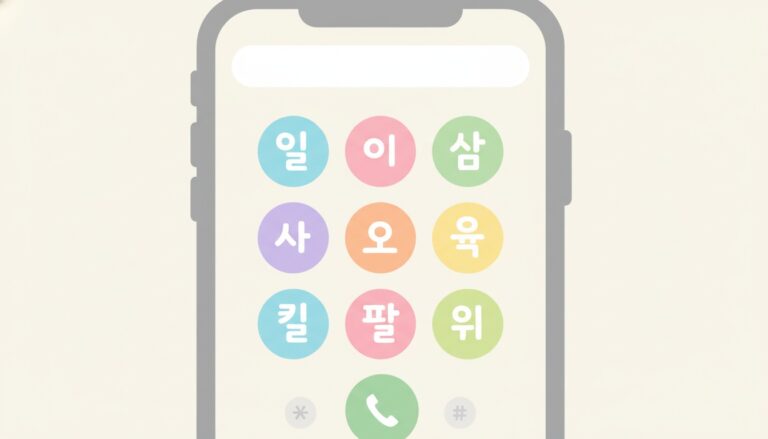
1. The Digits 0 to 9 (Sino-Korean)
- Expression: 영/공 ~ 구 (Yeong/Gong ~ Gu)
- Meaning: 0 to 9
- Usage & Register:
- Phone numbers always use the Sino-Korean system.
- For ‘0’, strictly use 공 (Gong) when saying phone numbers, not ‘영 (Yeong)’.
- Tutor’s Secret Note:
- Memorizing these is non-negotiable. Koreans say these very fast. Think of it as a rhythm rather than individual words.
- Warning: If you say “Hana, Dul, Set” (Native system), people will understand you, but it sounds like a toddler counting candies.
- Pronunciation Clinic:
- 1 (일 – Il) vs 2 (이 – I): This is the hardest part. ‘Il’ has an ‘L’ sound at the end. ‘I’ is just a clean vowel.
- 3 (삼 – Sam) vs 4 (사 – Sa): Make sure to close your lips for ‘m’ in Sam.
- The List:
- 0: 공 (Gong)
- 1: 일 (Il)
- 2: 이 (I)
- 3: 삼 (Sam)
- 4: 사 (Sa)
- 5: 오 (O)
- 6: 육 (Yuk)
- 7: 칠 (Chil)
- 8: 팔 (Pal)
- 9: 구 (Gu)
2. The Magic Prefix “010”
- Expression: 공일공 (Gong-il-gong)
- Meaning: 010 (The universal mobile prefix in Korea)
- Usage:
- Almost every mobile phone in South Korea starts with 010.
- When asked for your number, you start here automatically.
- Examples:
- 제 번호는 공일공이에요. (Je beonho-neun gong-il-gong-ieyo.)
- My number starts with 010.
- 제 번호는 공일공이에요. (Je beonho-neun gong-il-gong-ieyo.)
3. The “Dash” (-)
- Expression: 에 (E)
- Meaning: “Dash” or “hyphen” inside a phone number.
- Usage:
- Written as ‘-‘, spoken as 에 (e).
- It helps break up the rhythm so the listener doesn’t get lost.
- Tutor’s Secret Note:
- Grammatically, this comes from the possessive particle ‘의 (ui)’, but in modern pronunciation, it simplifies to 에 (e). Don’t try to pronounce it ‘ui’; just say ‘e’ like in ‘bed’.
- Examples:
- 1234-5678 → 1234 에 5678 (Il-i-sam-sa e o-yuk-chil-pal)
Mini Quiz: Click to see the answer
How do you say “010-1234”?
Answer: 공일공에 일이삼사 (Gong-il-gong-e Il-i-sam-sa)
Textbook vs. Real Korean
How does a learner speak vs. How a local speaks?
| Context | Book Korean (Textbook) | Real Korean (Survival) |
|---|---|---|
| Asking for a number | 전화번호가 무엇입니까? (Jeonhwabeonho-ga mueosimnikka?) |
번호 좀 알려주세요. (Beonho jom allyeojuseyo.) |
| Answering | 제 전화번호는 010… 입니다. (Je jeonhwabeonho-neun 010… imnida.) |
Just the numbers (e.g., Gong-il-gong-e…) |
| Ending | …입니다. (…imnida.) |
…요. / …이번(2)이요. (…yo / …ibeon-iyo.) |
Tutor’s Tip: In busy cafes or loud bars, nobody uses the full sentence “My phone number is…”. Just start reciting the digits clearly. It’s faster and perfectly polite.
Analysis: The Pronunciation Trap (1 vs 2)
Problem: In a noisy environment, 일 (Il – 1) and 이 (I – 2) sound incredibly similar.
Solution: The Context & Length Strategy
| Number | Sound | Tip for Speaking |
|---|---|---|
| 1 (일) | Short, sharp ‘L’ ending. | Make the ‘L’ sound distinct. Lift your tongue to the roof of your mouth. |
| 2 (이) | Long vowel ‘EE’. | Sometimes Koreans elongate this slightly to distinguish it: “Ii~”. |
If the staff looks confused, use your fingers! There is no shame in using body language to confirm 1 or 2.
Real-Life Scenario: Role Play
Situation: ordering coffee at a franchise cafe (like Mega Coffee or Compose Coffee). The staff asks for points.
Characters:
* Staff: Busy part-timer.
* Learner: You (A1 Level).
Turn 1
Staff: 포인트 적립하세요? (Pointeu jeokrip haseyo?)
Do you want to earn points?
Turn 2
Learner: 네, 적립해 주세요. (Ne, jeokrip-hae juseyo.)
Yes, please earn (add) them.
Turn 3
Staff: 번호 눌러주시거나 말씀해 주세요. (Beonho nulleojusigeona malsseumhae juseyo.)
Please type your number or say it.
Turn 4
Learner: 공일공에, 이삼사오에, 육칠팔구요. (Gong-il-gong-e, i-sam-sa-o-e, yuk-chil-pal-gu-yo.)
It’s 010-2345-6789.
Turn 5
Staff: 네, 적립됐습니다. (Ne, jeokrip-dwaetseumnida.)
Okay, points added.
Shadowing Challenge
Let’s practice a realistic speed. Try to say this full number in under 5 seconds.
Target: 010-5678-1234
Script:
공일공에 오육칠팔에 일이삼사
(Gong-il-gong-e O-yuk-chil-pal-e Il-i-sam-sa)
Checklist:
* [ ] Did you say 공 (Gong) for zero?
* [ ] Did you use 에 (e) for the dashes?
* [ ] Did you pronounce the ‘L’ in 일 (Il) and 칠 (Chil) clearly?
Repeat this 3 times! Get the rhythm into your tongue.
FAQ (Frequently Asked Questions)
Q1: Can I use Hana, Dul, Set (Native numbers) for phone numbers?
* A: No. Phone numbers are 100% Sino-Korean. If you use Native numbers, people might think you are counting items, not giving a code.
Q2: Do I have to say ‘e’ (dash)?
* A: In very fast speech, some Koreans skip it. However, as a learner, using it is safer. It groups the numbers (3-4-4 pattern), making it much easier for the listener to type them in correctly.
Q3: How do I say “No” if I don’t want points?
* A: Just say “아니요, 괜찮아요” (Aniyo, gwaenchana-yo – No, it’s okay/fine).
Wrap-up & Action Item
Today’s Summary: Phone numbers use Sino-Korean numbers (Il, I, Sam…), ‘0’ is Gong, and the dash is pronounced ‘e’.
Today’s Mission:
Find your own phone number. Write it down in Hangul pronunciation (e.g., 공일공에…). Record yourself saying it until you can say it smoothly without pausing.
Question for you:
Which number is hardest for you to pronounce? ‘Il’ (1) or ‘Yuk’ (6)? Let me know in the comments!
Final Quiz
Check your knowledge (Scroll for answers)
- Which number system is used for phone numbers?
a) Native Korean (Hana, Dul)
b) Sino-Korean (Il, I) -
How do you pronounce the “dash” (-) in a phone number?
a) Ui (의)
b) Dash (대시)
c) E (에) -
Fill in the blank for ‘0’: [ ______ ]
(Hint: It starts with G)
Answers:
1. b) Sino-Korean
2. c) E (에)
3. Gong (공)
Frequently Asked Questions (FAQ)
Q: What does "The Digits 0 to 9 (Sino-Korean)" mean in Korean and how do you pronounce it?
A: In Korean, "The Digits 0 to 9 (Sino-Korean)" is pronounced [see lesson guide] and means: 0 to 9
Q: What does "The Magic Prefix "010"" mean in Korean and how do you pronounce it?
A: In Korean, "The Magic Prefix "010"" is pronounced [see lesson guide] and means: 010 (The universal mobile prefix in Korea)
Q: What does "The "Dash" (-)" mean in Korean and how do you pronounce it?
A: In Korean, "The "Dash" (-)" is pronounced [see lesson guide] and means: "Dash" or "hyphen" inside a phone number.







