

Introduction
Hello, this is Daily Hangul!
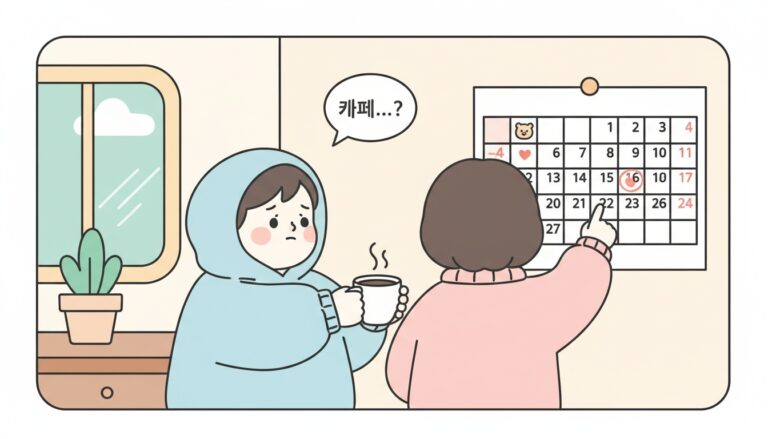
Have you ever wanted to ask a Korean friend to hang out, or ask a colleague for a quick meeting, but stopped because you were afraid of sounding rude? “What if I sound like I’m asking for a date when I just want coffee?” or “What if I sound too aggressive?”
Synthetic Case Study:
Many beginners share a similar experience (let’s call this a synthetic case based on common patterns). A learner named “Alex” once told his boss, “너 시간 있어? (Neo sigan isseo?)” intending to ask for a meeting time. The office went silent. Why? He used the casual form (Banmal) to a superior, which sounds like a challenge to a fight rather than a request for a meeting!
Textbooks often teach “Do you have time?” as a direct translation, but in Korea, Nunchi (reading the room) and Register (politeness levels) change everything. Today, let’s learn how to ask for someone’s time safely and naturally.
At a Glance: Today’s Summary
- Safe for Everyone: 시간 있어요? (Sigan isseoyo?)
- Polite/Business: 언제 시간 되세요? (Eonje sigan doeseyo?)
- Considerate: 혹시 바쁘세요? (Hoksi bappeuseyo?)
- Difficulty: A1 (Beginner) – Essential for moving from “saying hello” to “building relationships.”
Table of Contents
- Deep Dive: Essential Expressions
- Textbook vs. Real Korean
- Tutor’s Analysis: The Tone Thermometer
- Real-Life Role Play
- Shadowing Challenge
- FAQ
- Final Quiz
Today’s Essential Expressions: Deep Dive
1. 시간 있어요? (Sigan isseoyo?)
- Meaning: Do you have time?
- Usage & Register:
- Who: Colleagues (same level), acquaintances, shop staff.
- Style:
Haeyo-che(Polite ending). This is the standard, safest phrase.
- Tutor’s Secret Note:
- Context matters: If you say this with a serious face to a colleague, they might think, “Uh oh, did I make a mistake?” If you say it with a smile, it implies, “I want to chat/hang out.”
- Warning: Do not drop the “yo” (시간 있어?) unless you are very close friends.
- Pronunciation Clinic:
- Link the sounds: It sounds like
[Si-ga-ni-sseo-yo]because of the linking rule (Ren-eum).
- Link the sounds: It sounds like
- Examples:
- Lunch: 점심에 시간 있어요? (Jeomsime sigan isseoyo?) – Do you have time at lunch?
- Date: 이번 주말에 시간 있어요? (Ibeon jumare sigan isseoyo?) – Do you have time this weekend?
- Work: 잠깐 시간 있어요? (Jamkkan sigan isseoyo?) – Do you have a moment?
- Alternative: 시간 있으세요? (Sigan isseuseyo? – slightly more respectful)
- Mini Quiz:
- Q: To ask for a moment briefly, add this word: “_____ 시간 있어요?”
-
Click to see answer
잠깐 (Jamkkan)
2. 언제 시간 되세요? (Eonje sigan doeseyo?)
- Meaning: When are you available? (Lit: When does time become [available] for you?)
- Usage & Register:
- Who: Seniors, clients, or when scheduling a specific appointment.
- Style:
Haeyo-che+ Honorific-(eu)si-.
- Tutor’s Secret Note:
- This puts the ball in their court. It is very polite because you are adjusting to their schedule, not forcing yours.
- Pronunciation Clinic:
- 되세요 (Doeseyo): Make sure not to say “Dwaeseyo.” The ‘oe’ sound is crucial.
- Examples:
- Business: 다음 주 언제 시간 되세요? (Daeum ju eonje sigan doeseyo?) – When are you free next week?
- Meeting: 회의 언제 시간 되세요? (Hoe-ui eonje sigan doeseyo?) – When are you available for a meeting?
- Call: 통화 언제 시간 되세요? (Tonghwa eonje sigan doeseyo?) – When are you free for a call?
- Alternative: 편하실 때 알려주세요. (Pyeonhasil ttae allyeojuseyo. – Let me know when you are comfortable.)
3. 혹시 바쁘세요? (Hoksi bappeuseyo?)
- Meaning: Are you busy by chance?
- Usage & Register:
- Who: Approaching someone who looks busy or a superior.
- Style: Indirect/Soft politeness.
- Tutor’s Secret Note:
- Koreans love indirectness. Asking “Are you busy?” is often better than “Do you have time?” because it gives the listener an easy way to say “Yes, I’m busy” without feeling guilty.
- Keyword: 혹시 (Hoksi) means “by chance.” It instantly softens any question.
- Pronunciation Clinic:
- Double Consonant: ‘Bb’ in Bappeuseyo needs to be strong and tense.
- Examples:
- Office: 부장님, 혹시 바쁘세요? (Bujangnim, hoksi bappeuseyo?) – Boss, are you busy by chance?
- Phone: 지금 혹시 바쁘세요? (Jigeum hoksi bappeuseyo?) – Are you busy right now?
- Favor: 저기요, 혹시 바쁘세요? (Jeogiyo, hoksi bappeuseyo?) – Excuse me, are you busy? (Asking a stranger)
Textbook vs. Real Korean
| Context | Textbook / Formal | Real Korean (Spoken) | Situation |
|---|---|---|---|
| Asking for a Date | 이번 주말에 약속이 있습니까? (Ibeon jumare yaksogi itseumnikka?) |
주말에 뭐 해요? (Jumare mwo haeyo?) |
Natural casual conversation |
| Asking a Coworker | 시간이 날 때 저에게 말씀해 주세요. (Sigani nal ttae jeoege malsseumhae juseyo.) |
시간 될 때 톡 주세요. (Sigan doel ttae tok juseyo.) |
Via KakaoTalk/Messenger |
Quick Check:
* Textbook: Good for writing or very formal speeches.
* Real Korean: “Mwo haeyo?” (What are you doing?) is the most common way to subtly check availability for a date.
Tutor’s Analysis: The “Politeness” Thermometer
How you end your sentence changes the “temperature” (distance) between you and the listener.
| Level | Expression | Temperature | Context |
|---|---|---|---|
| 1 (Hot/Close) | 야, 시간 있어? (Ya, sigan isseo?) |
0°C (No distance) | Close friends, siblings. Rude to others. |
| 2 (Warm) | 시간 있어요? (Sigan isseoyo?) |
36.5°C (Standard) | Polite standard. Safe for most daily interactions. |
| 3 (Cool/Respect) | 시간 괜찮으세요? (Sigan gwaenchaneuseyo?) |
50°C (Respectful) | Slightly formal. Good for seniors or awkward relationships. |
| 4 (Cold/Formal) | 시간 되십니까? (Sigan doesimnikka?) |
100°C (Rigid) | Military, news, or extremely formal business settings. |
Real-Life Scenario: Role Play
Setting: An office pantry (break room). 2:00 PM.
Characters: Min-ji (Junior) and Hyeon-woo (Senior/Senior Colleague).
Min-ji: (Knocking on the open door frame) 현우 선배님, 혹시 바쁘세요?
(Hyeon-woo seonbaenim, hoksi bappeuseyo?)
[Hyeon-woo senior, are you busy by chance?]
Hyeon-woo: 어, 민지 씨. 아니요, 괜찮아요. 왜요?
(Eo, Min-ji ssi. Aniyo, gwaenchanayo. Waeyo?)
[Oh, Min-ji. No, I’m okay. Why?]
Min-ji: 잠깐 시간 되시면, 커피 한잔하실래요?
(Jamkkan sigan doesimyeon, keopi hanjanhasillaeyo?)
[If you have a moment, would you like to have a cup of coffee?]
Hyeon-woo: 좋아요. 나가요.
(Joayo. Nagayo.)
[Sounds good. Let’s go out.]
💡 Culture Tip:
Even if you are asking for something simple like coffee, using “Hoksi” (by chance) and honorifics (Seonbaenim) is essential in a Korean workplace to show respect.
Shadowing Challenge (Speaking Practice)
Instructions: Read this out loud 3 times. Focus on the linking sounds.
Script:
“저기요, 혹시 시간 있으세요? 물어볼 게 있어요.”
(Jeogiyo, hoksi sigan isseuseyo? Mureobol ge isseoyo.)
[Excuse me, do you have time by chance? I have something to ask.]
Checklist:
* [ ] 1st Try (Slowly)
* [ ] 2nd Try (Normal Speed)
* [ ] 3rd Try (With Emotion/Eye Contact)
Pronunciation Focus:
* 있으세요 sounds like [I-sseu-se-yo].
FAQ: Frequently Asked Questions
Q1: Can I say “Do you have a DATE?” (데이트 있어요?) to ask if someone is busy?
* No! “Date” (데이트) in Korean specifically means a romantic date. If you ask a coworker “Do you have a date?”, it sounds like you are asking about their love life. Use 약속 (Yaksok – appointment/plan) instead.
* Correct: 오늘 저녁에 약속 있어요? (Do you have plans this evening?)
Q2: What if I want to say “I don’t have time”?
* You can say 시간 없어요 (Sigan eopseoyo). But to be softer, say: 지금은 좀 바빠요 (Jigeumeun jom bappayo – I’m a bit busy right now).
Wrap-up & Today’s Mission
Summary:
To ask for someone’s time safely, remember the magic word “혹시” (Hoksi) and stick to “시간 있어요?” or “언제 시간 되세요?” for higher respect.
Today’s Mission:
1. Check your messaging app (KakaoTalk/WhatsApp).
2. Translate your last “Are you free?” message into Korean using one of the phrases above.
Tell me in the comments:
Who do you want to ask out for coffee using these phrases? (e.g., A Korean friend, a tutor, or a crush!)
Final Quiz
- Which phrase is the most polite way to ask a boss for a meeting time?
a) 야, 시간 있어? (Ya, sigan isseo?)
b) 시간 있어요? (Sigan isseoyo?)
c) 언제 시간 되세요? (Eonje sigan doeseyo?) -
What does “Hoksi” (혹시) mean?
a) Right now
b) By chance
c) Hurry up -
Fill in the blank: To ask if someone has plans, say “_____ 있어요?” (Hint: Yaksok)
Answers: 1. (c) 2. (b) 3. 약속 (Appointment/Plan)
Frequently Asked Questions (FAQ)
Q: What does "시간 있어요? (Sigan isseoyo?)" mean in Korean and how do you pronounce it?
A: In Korean, "시간 있어요? (Sigan isseoyo?)" is pronounced [see lesson guide] and means: Do you have time?
Q: What does "언제 시간 되세요? (Eonje sigan doeseyo?)" mean in Korean and how do you pronounce it?
A: In Korean, "언제 시간 되세요? (Eonje sigan doeseyo?)" is pronounced [see lesson guide] and means: When are you available? (Lit: When does time become [available] for you?)
Q: What does "혹시 바쁘세요? (Hoksi bappeuseyo?)" mean in Korean and how do you pronounce it?
A: In Korean, "혹시 바쁘세요? (Hoksi bappeuseyo?)" is pronounced [see lesson guide] and means: Are you busy by chance?






