

Don’t Shrink Your Favorite Sweater! Mastering Korean Fabric Vocabulary
Introduction
Hello, this is Daily Hangul!
Have you ever bought a beautiful sweater in a boutique in Seoul, only to wash it at your Airbnb and find it shrunk to the size of a doll’s clothes? Or perhaps you stood in a clothing store in Dongdaemun, touching a shirt and wondering, “Is this breathable for the humid Korean summer?” but couldn’t ask the staff?
Composite Case (Synthesized from learner experiences):
We often hear from students like ‘Sarah’ or ‘Mike’ (names changed), who bought clothes thinking they were easy-care cotton, only to realize later they were delicate wool or linen blends that required special care. They saw the tag but couldn’t decipher “모 (Mo)” or “마 (Ma).”
Learning fabric vocabulary isn’t just for fashion designers; it’s a survival skill for shopping and doing laundry in Korea! Textbooks usually teach generic words like “clothes” (옷), but real life requires you to know what those clothes are made of.
Summary at a Glance
- Today’s Expressions:
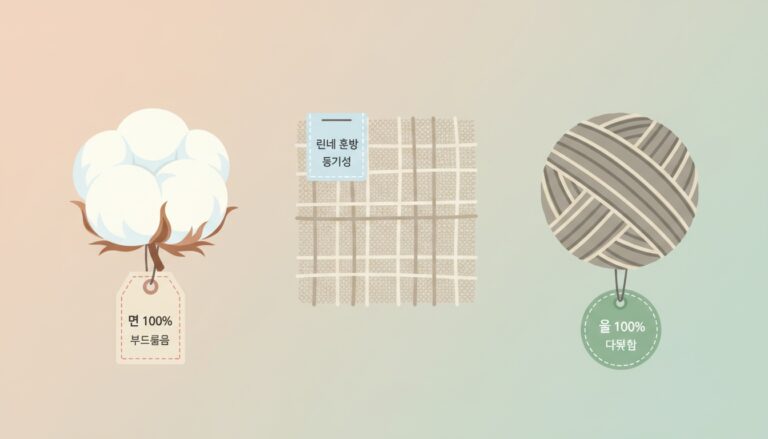
- 면 (Myeon) – Cotton
- 린넨 (Rin-nen) – Linen
- 울/모 (Ul/Mo) – Wool
- Safety Check: These are neutral nouns. You can use them with friends or shop staff.
- Level (C1 context): While the words are simple, using them to discuss laundry care or quality puts you in the “Advanced Daily Life” category.
Table of Contents
- Today’s Deep Dive: Fabric Trio
- Textbook vs. Real Korean
- Analysis: The “Laundry Disaster” Prevention Guide
- Real-Life Role Play: At a Dongdaemun Boutique
- Shadowing Challenge
- FAQ
- Wrap-up & Quiz
Today’s Key Expressions Deep Dive
1. 면 (Myeon)
- Meaning: Cotton
- Usage & Register: Used everywhere. Essential for T-shirts, underwear, and bedding.
- Tutor’s Secret Note: Koreans love “100% Cotton.” You will often see the word 순면 (Sun-myeon) which means “Pure Cotton.” If you have sensitive skin, ask for this.
- Pronunciation Clinic: It is one syllable. Don’t say “My-on.” It sounds more like “Myuhn” with a quick slide.
- /Myeon/ [면]
- Examples:
- 이거 면이에요? (I-geo myeon-i-e-yo?) – Is this cotton?
- 면 100% 티셔츠 있어요? (Myeon baek-peo-sen-teu ti-sheo-cheu iss-eo-yo?) – Do you have 100% cotton T-shirts?
- 면이라서 피부에 좋아요. (Myeon-i-ra-seo pi-bu-e jo-a-yo.) – It’s good for the skin because it’s cotton.
- Alternatives:
- 코튼 (Ko-teun) – Direct loanword from English (often used in marketing).
- Mini Quiz:
- I need a ____ shirt. (나는 ____ 셔츠가 필요해요.)
Click to see answer
면 (Myeon)
- I need a ____ shirt. (나는 ____ 셔츠가 필요해요.)
2. 린넨 (Rin-nen)
- Meaning: Linen
- Usage & Register: The hero of Korean summers.
- Tutor’s Secret Note: While “Linen” is the common loanword, you might see the Sino-Korean character 마 (Ma) on traditional clothing or bedding tags. They are slightly different botanically (hemp/ramie vs flax) but in casual shopping, both imply “cool, summer fabric.”
- Pronunciation Clinic: Pronounce the ‘R/L’ (ㄹ) softly. It sounds like “Rin-nen,” not a hard “Lin-nen.”
- /Rin-nen/ [린넨]
- Examples:
- 여름에는 린넨이 제일 시원해요. (Yeo-reum-e-neun rin-nen-i je-il si-won-hae-yo.) – Linen is the coolest in summer.
- 이거 린넨 셔츠예요? (I-geo rin-nen syeo-cheu-ye-yo?) – Is this a linen shirt?
- 린넨은 구김이 잘 가요. (Rin-nen-eun gu-gim-i jal ga-yo.) – Linen wrinkles easily.
- Alternatives:
- 마 (Ma) – Hemp/Ramie (Traditional term).
- Mini Quiz:
- This dress is made of ____. (이 원피스는 ____ 소재예요.)
Click to see answer
린넨 (Rin-nen)
- This dress is made of ____. (이 원피스는 ____ 소재예요.)
3. 울 / 모 (Ul / Mo)
- Meaning: Wool
- Usage & Register: 울 (Ul) is the English loanword used for fashion marketing (e.g., “Ul Sweater”). 모 (Mo) is the Sino-Korean word often found on the care label inside the clothes (e.g., “모 80%”). You need to know both.
- Tutor’s Secret Note: If you wash “Ul” or “Mo” in hot water, it will become a shirt for your dog. Beware! If you see “Mo,” assume dry cleaning.
- Pronunciation Clinic: “Ul” sounds like the ‘oul’ in ‘Soul’ (without the S). “Mo” is short and clear.
- /Ul/ [울], /Mo/ [모]
- Examples:
- 이거 울 니트예요? (I-geo ul ni-teu-ye-yo?) – Is this a wool knit?
- 모 함유량이 얼마나 돼요? (Mo ham-yu-ryang-i eol-ma-na dwae-yo?) – How much wool content is in this?
- 울 코트는 드라이클리닝 해야 해요. (Ul ko-teu-neun deu-ra-i-keul-li-ning hae-ya hae-yo.) – Wool coats must be dry-cleaned.
- Alternatives:
- 양모 (Yang-mo) – Sheep’s wool (specific).
- Mini Quiz:
- Winter coats are usually made of ____. (겨울 코트는 보통 ____로 만들어요.)
Click to see answer
울 (Ul) or 모 (Mo)
- Winter coats are usually made of ____. (겨울 코트는 보통 ____로 만들어요.)
Textbook vs. Real Korean
| Context | Textbook Korean (Book) | Real Korean (Street/Shop) |
|---|---|---|
| Asking Material | 이 옷의 소재는 무엇입니까? (I ot-ui so-jae-neun mu-eot-im-nik-ka?) “What is the material of this cloth?” |
이거 무슨 천이에요? (I-geo mu-seun cheon-i-e-yo?) “What fabric is this?” |
| Checking Wash | 세탁기로 세탁이 가능합니까? (Se-tak-gi-ro se-tak-i ga-neung-ham-nik-ka?) “Is washing with a machine possible?” |
이거 물세탁 돼요? (I-geo mul-se-tak dwae-yo?) “Does this take water washing?” |
| Suggesting | 이 옷은 면으로 만들어졌습니다. (I ot-eun myeon-eu-ro man-deul-eo-jyeot-seup-ni-da.) “This cloth is made of cotton.” |
이거 면이라 편해요. (I-geo myeon-i-ra pyeon-hae-yo.) “This is cotton so it’s comfy.” |
Situation Checklist:
* Department Store: Use slightly more formal language (ends in -yo).
* Street Market: You can be brief. “이거 면?” (Cotton?) is okay if you smile, but adding “-ieyo?” is safer.
Deep Analysis: The “Laundry Disaster” Prevention Guide
Foreigners often ruin clothes because they misunderstand the Korean tags. Here is the “Interpretation Scenario” to save your wardrobe.
| Tag (Korean) | Romanization | Real Meaning | Action |
|---|---|---|---|
| 물세탁 금지 | Mul-se-tak Geum-ji | No Water Wash | Go to the dry cleaner! |
| 단독 세탁 | Dan-dok Se-tak | Wash Alone | It will bleed color. Don’t mix with white socks. |
| 손세탁 | Son-se-tak | Hand Wash | Use delicate cycle or your hands. |
| 드라이 | Deu-ra-i | Dry Clean | Do not put in washing machine. |
Common Mistake Scenario:
A learner sees “세탁 (Se-tak)” and thinks “Okay, washing machine!” but misses the word 금지 (Geum-ji) which means Prohibited.
* Result: A toddler-sized sweater.
* Fix: Always look for the laundry symbol (usually a crossed-out bucket) if you can’t read the Hangul.
Real-Life Role Play: At a Dongdaemun Boutique
Setting: A trendy clothing store in Dongdaemun History & Culture Park. 2 PM. Casual atmosphere.
Characters: Guest (You), Staff (Store Employee).
Guest: (Touching a sweater) 저기요, 이거 소재가 뭐예요?
(Jeo-gi-yo, i-geo so-jae-ga mwo-ye-yo?)
Excuse me, what is this material?
Staff: 아, 그거 울이랑 아크릴 섞인 거예요.
(Ah, geu-geo ul-i-rang a-keu-ril seokk-in geo-ye-yo.)
Ah, that is a mix of wool and acrylic.
Guest: 까슬거리지 않아요? 피부가 좀 예민해서요.
(Kka-seul-geo-ri-ji an-a-yo? Pi-bu-ga jom ye-min-hae-seo-yo.)
Is it scratchy? My skin is a bit sensitive.
Staff: 아니요, 부드러워요. 만져보세요.
(A-ni-yo, bu-deu-reo-wo-yo. Man-jyeo-bo-se-yo.)
No, it’s soft. Try touching it.
Guest: 그럼 이거 하나 주세요. 아, 이거 물세탁 돼요?
(Geu-reom i-geo ha-na ju-se-yo. Ah, i-geo mul-se-tak dwae-yo?)
Then please give me one. Ah, can I water-wash this?
Staff: 니트라 줄어들 수 있으니 드라이 맡기시는 게 좋아요.
(Ni-teu-ra jul-eo-deul su iss-eu-ni deu-ra-i mat-gi-si-neun ge jo-a-yo.)
Since it’s a knit, it might shrink, so it’s better to dry clean it.
Cultural Tip:
* “까슬거리다 (Kka-seul-geo-ri-da)”: This is a very authentic Korean expression for the “scratchy/itchy” feeling of wool. Using this makes you sound very fluent!
* “드라이 맡기다 (Deu-ra-i mat-gi-da)”: Literally “entrust to dry cleaning.” We don’t say “do dry cleaning,” we say “entrust” it to the shop.
Shadowing Challenge
Instructions: Read this sentence aloud 3 times. It helps you check material before buying.
Script:
“피부가 예민해서 그런데, 혹시 면 100%인가요?”
Romanization:
(Pi-bu-ga ye-min-hae-seo geu-reon-de, hok-si myeon baek-peo-sen-teu-in-ga-yo?)
Meaning:
“My skin is sensitive, so (I’m asking), is this 100% cotton by any chance?”
Checklist:
– [ ] 1st Attempt (Slow)
– [ ] 2nd Attempt (Normal Speed)
– [ ] 3rd Attempt (Emotion: Concerned customer)
Pronunciation Point:
* Link the sound in 면 100% -> Myeon-baek. Don’t pause too long.
FAQ (Frequently Asked Questions)
Q1: Can I use “Cotton” instead of “Myeon”?
A: Yes! Young Koreans and fashion staff understand “Cotton” (코튼 – Ko-teun) perfectly. However, older shop owners in traditional markets will prefer 면 (Myeon).
Q2: What is “Poly”?
A: Koreans shorten “Polyester” to 폴리 (Pol-li). You will see tags like “폴리 100%” very often. It’s cheap and durable.
Q3: How do I ask if the clothes stretch?
A: Ask “스판이에요?” (Seu-pan-i-e-yo?). We use the word “Span” (from Spandex) to mean stretchy fabric.
Wrap-up & Action Item
Today we learned how to identify Myeon (Cotton), Rinnen (Linen), and Ul (Wool) to shop smarter and safer.
Today’s Mission:
Go to your closet (or a Korean online shopping site like Musinsa or Zigzag). Find one tag, read the material in Korean, and determine if it needs 물세탁 (Water wash) or 드라이 (Dry clean).
Tell me in the comments:
What is your favorite fabric to wear in summer? Myeon or Rin-nen?
Final Quiz
1. Which fabric is best for a very hot & humid Korean summer?
A) 울 (Ul)
B) 린넨 (Rin-nen)
C) 가죽 (Ga-juk – Leather)
2. If a tag says “물세탁 금지 (Mul-se-tak Geum-ji)”, what should you do?
A) Wash it in the washing machine.
B) Hand wash it with water.
C) Do NOT wash with water (Dry clean).
3. Fill in the blank: “This sweater is scratchy.” -> “이 스웨터 너무 ____거려요.”
(Hint: Kka-seul)
Answers:
1. B) 린넨 (Rin-nen)
2. C) Do NOT wash with water.
3. 까슬 (Kka-seul)
Frequently Asked Questions (FAQ)
Q: What does "면 (Myeon)" mean in Korean and how do you pronounce it?
A: In Korean, "면 (Myeon)" is pronounced [Clinic: It is one syllable. Don't say "My-on." It sounds more like "Myuhn" with a quick slide.] and means: Cotton
Q: What does "린넨 (Rin-nen)" mean in Korean and how do you pronounce it?
A: In Korean, "린넨 (Rin-nen)" is pronounced [Clinic: Pronounce the 'R/L' (ㄹ] and means: Linen
Q: What does "울 / 모 (Ul / Mo)" mean in Korean and how do you pronounce it?
A: In Korean, "울 / 모 (Ul / Mo)" is pronounced [Clinic: "Ul" sounds like the 'oul' in 'Soul' (without the S] and means: Wool







