

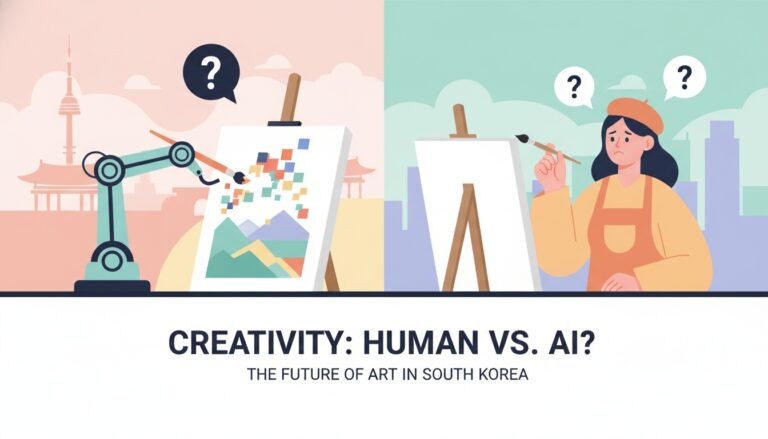
AI Wrote This? 🤖 Debating Copyright in Korean Like a Pro!
Hello, I’m Daily Hangul! 😊
Did you see the recent news about an AI winning a prestigious art competition? The world is buzzing about it!
I recently had a coffee chat with one of my advanced students, Sarah. She works at a tech company in Seoul and wanted to discuss this hot topic with her Korean colleagues during lunch. She tried to say, “The copyright law is ambiguous,” but she accidentally used a word that made it sound like the law was “squishy” like a jelly! 🍮 We had a good laugh, but it reminded me how important specific vocabulary is when discussing intellectual topics.
Today, we are going to dive into the AI & Future Jobs debate. Specifically, “Who owns the copyright of AI creations?” By the end of this post, you’ll be able to sound smart, logical, and culturally attuned when debating this in Korean. Let’s get started!
1. Today’s Core Expressions (Deep Dive)
To argue about AI, you need more than just “Yes” or “No.” You need these power words.
1. 저작권 (Jeojak-gwon)
- Meaning: Copyright
- [Tutor’s Secret Note 🤫]: This is the keyword of the day. In Korea, when you create content, people often ask about 저작권 문제 (copyright issues). If you want to sound like an expert, use the phrase “저작권 침해” (copyright infringement). It instantly elevates your level!
- [Pronunciation Clinic 🗣️]: Watch out! It’s not [Jeo-jak-gwon]. The ‘ㄱ’ meets ‘ㄱ’, so it sounds stronger. Pronounce it as [저자꿘 / Jeo-ja-kkwon].
2. 창작물 (Changjak-mul)
- Meaning: Creation / Creative work
- [Tutor’s Secret Note 🤫]: We don’t just say “picture” (그림) or “writing” (글) in serious debates. We call them 창작물. It implies effort and originality. If AI makes it, we often call it “AI 생성물” (AI-generated product) to distinguish it from human work.
3. 애매하다 (Aemae-hada)
- Meaning: To be ambiguous / vague / tricky
- [Tutor’s Secret Note 🤫]: This is the magic word for debates! When you don’t fully agree or the situation isn’t black and white, just say “좀 애매한데요…” (It’s a bit ambiguous/tricky…). It’s a very safe, polite way to disagree without saying “You are wrong.”
2. Textbook Korean vs. Real Korean
How do you ask “Who owns this?” in a discussion?
📘 Book Korean (The Robot Style)
“이 그림의 소유권은 누구에게 귀속됩니까?”
(To whom does the ownership of this painting belong?)
Sounds like you are reading a legal contract in a courtroom. Too stiff! 😓
📺 Real Korean (The Smart Colleague Style)
“근데 이거, 법적으로 누구 거라고 봐야 돼요?”
(But this, legally, whose thing should we view it as?)
This is how real Koreans discuss news over coffee. “~라고 봐야 돼요?” (How should we view it?) is a fantastic phrase to ask for opinions. 👍
3. Real-Life Scenario: The Debate 🗣️
Situation: You are at a cafe with your Korean coworker, Min-su, talking about ChatGPT writing a novel.
Min-su: 와, AI가 소설도 쓴다니 진짜 신기하네요.
(Wa, AI ga soseol-do sseundani jinjja singihaneyo.)
Wow, it’s fascinating that AI writes novels too.
You: 맞아요. 근데 그 저작권은 누구한테 있을까요?
(Majayo. Geunde geu jeojak-gwon-eun nuguhante isseulkkayo?)
Right. But who do you think has the copyright?
Min-su: 글쎄요, AI를 만든 개발자 아닐까요?
(Geulsseyo, AI-reul mandeun gaebalja anilkkayo?)
Well, wouldn’t it be the developer who made the AI?
You: 음, 그건 좀 애매한 것 같아요. 명령어를 입력한 사람은 저니까요.
(Eum, geugeon jom aemaehan geot gatayo. Myeongnyeong-eo-reul imnyeokan saram-eun jeonikkayo.)
Hmm, I think that’s a bit ambiguous. Because I’m the one who entered the prompts (commands).
[Daily Hangul’s Culture Tip 💡]
Did you notice the “음 (Eum)” and “~것 같아요 (I think/It seems)”? In Korean culture, even if you are 100% sure, it is polite to sound slightly unsure using “~gata-yo.” It opens up the space for the other person to share their opinion without feeling attacked. Debate softly!
4. FAQ – Daily Hangul Answers!
Q1: Can I call AI “he” or “she” (그/그녀) in Korean?
A: Generally, no. In English, we personify AI (e.g., “He gave me an answer”). But in Korean, AI is strictly treated as an object. Use “얘” (this kid/guy – casual) if you want to be funny, or just “이 프로그램” or “AI”. Using “그녀” for Siri sounds very poetic or translated.
Q2: How do I say “It depends” when asked about copyright?
A: You can say “상황에 따라 달라요” (It changes depending on the situation). Or, if you want to use super trendy slang, say “케바케예요” (It’s Ke-ba-ke). This comes from “Case by Case.” Using this will surprise your Korean friends!
5. Wrap-up & Today’s Mission
Today we learned how to discuss the hot topic of AI Copyright using words like 저작권 and 애매하다. Remember, the key to a good Korean debate is softness and logic combined!
🚀 Today’s Mission:
Go to Naver News (news.naver.com) and search for “AI 저작권”. Try to find the word “논란” (controversy) in the headlines. If you find it, you’ve spotted real Korean in action!
Pop Quiz! (Scroll down for answer)
How do you pronounce 저작권 (Copyright)?
.
.
.
.
Answer: [저자꿘] (Jeo-ja-kkwon)!
See you in the next lesson! 안녕! 👋
Frequently Asked Questions (FAQ)
Q: What does "창작물 (Changjak-mul)" mean in Korean and how do you pronounce it?
A: In Korean, "창작물 (Changjak-mul)" is pronounced [see lesson guide] and means: Creation / Creative work
Q: What does "애매하다 (Aemae-hada)" mean in Korean and how do you pronounce it?
A: In Korean, "애매하다 (Aemae-hada)" is pronounced [see lesson guide] and means: To be ambiguous / vague / tricky







