

Introduction
Hello, K-Culture fans! 👋 It’s Daily Hangul, here to upgrade your Korean skills! 🚀
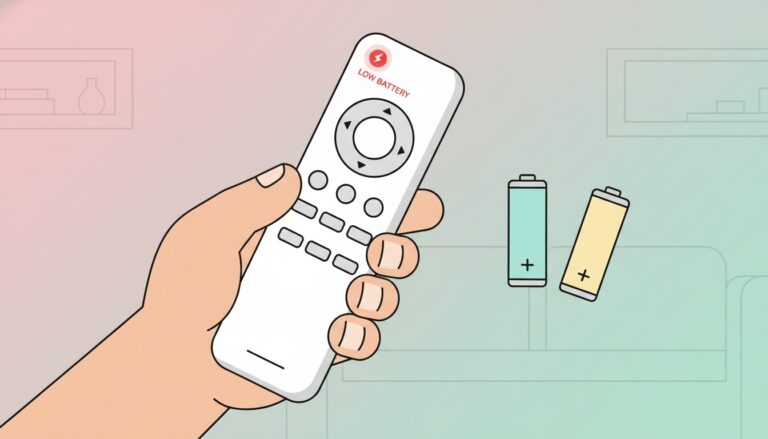
Imagine this: You just sat down with some fried chicken 🍗 to watch the latest episode of your favorite K-Drama. You press the button on the remote, but… nothing happens! 😱 The TV won’t turn on!
Don’t panic! Today, we will learn how to handle this common household emergency. Whether it’s for the TV, the air conditioner (AC), or the floor heating controller, these phrases will save your day. Let’s learn how to talk about changing batteries! 🔋
Key Expressions
1. 리모컨이 안 돼요.
- Pronunciation: [Rimokeoni an dwaeyo]
- Meaning: The remote control isn’t working.
- Explanation:
- 리모컨 (Rimokeon): Short for “Remote Control.” Koreans love shortening words!
- 안 돼요 (An dwaeyo): It means “It doesn’t work” or “No.” You can use this for any machine that is broken.
- 💡 Pronunciation Tip: When you say 리모컨이, the ‘n’ sound in con moves over to the next vowel. So it sounds like [Ri-mo-keo-ni]. Smooth, right? 😉
2. 건전지 / 배터리
- Pronunciation: [Geonjeonji] / [Baeteori]
- Meaning: Battery
- Explanation:
- 건전지 (Geonjeonji): This is the traditional Korean word for disposable batteries (like AA or AAA).
- 배터리 (Baeteori): This is just the English word “Battery” written in Hangul. Both are used frequently!
3. 약이 다 됐어요.
- Pronunciation: [Yagi da dwaesseoyo]
- Meaning: The battery is dead / It ran out of power.
- Explanation:
- 약 (Yak): Wait, doesn’t this mean “medicine”? 💊 Yes! But historically, older Koreans called batteries “medicine” because they gave energy to the machine. It’s a very common idiomatic expression!
- 다 됐어요 (Da dwaesseoyo): Literally “It is all done/finished.”
4. 갈아 끼우다
- Pronunciation: [Gara kkiuda]
- Meaning: To replace / To swap in
- Explanation: This is the specific verb for taking something old out and putting a new thing in (like batteries, light bulbs, or SIM cards).
Real Dialogue
Let’s see how this works in real life! Min-su and Jason are trying to watch TV.
Min-su: 제이슨, TV 좀 켜 줄래? (Jason, can you turn on the TV?)
Jason: 어? 리모컨이 안 돼요. (Huh? The remote isn’t working.)
Min-su: 정말? 불이 안 들어와? (Really? Is the light not coming on?)
Jason: 네. 약이 다 된 것 같아요. (Yes. I think the battery is dead.)
Min-su: 서랍에 새 건전지 있어. (There are new batteries in the drawer.)
Jason: 알겠어요. 제가 갈아 끼울게요! (Okay. I will replace them!)
Culture Tip 🇰🇷
Where to buy batteries in Korea?
If your remote dies late at night, don’t worry! You can find batteries at any Convenience Store (편의점 – Pyeonuijeom) like CU, GS25, or 7-Eleven. They are open 24/7! 🏪
Also, if you go to a store, you might see sizes labeled as:
* AA size: AA 건전지
* AAA size: AAA 건전지
Just say the letters “A-A” or “Triple A,” and everyone will understand you! easy peasy! 😎
Conclusion & Quiz
Now you won’t miss any important scenes in your K-Dramas because of a dead remote! You are ready to fix it like a pro. 🛠️
📝 Mini Quiz
- What is the Korean word for “Remote Control”?
( Hint: R _ _ _ _ _ _ n ) - If the battery is dead, you can say “___이 다 됐어요.” (Hint: Medicine 💊)
- True or False: You can buy batteries at a convenience store in Korea.
See you next time! 안녕! 👋
*
*
*
Answers:
1. 리모컨 (Rimokeon)
2. 약 (Yak)
3. True (O)
Frequently Asked Questions (FAQ)
Q: What does "리모컨이 안 돼요." mean in Korean and how do you pronounce it?
A: In Korean, "리모컨이 안 돼요." is pronounced [Rimokeoni an dwaeyo] and means: The remote control isn't working.
Q: What does "건전지 / 배터리" mean in Korean and how do you pronounce it?
A: In Korean, "건전지 / 배터리" is pronounced [Geonjeonji] and means: Battery
Q: What does "약이 다 됐어요." mean in Korean and how do you pronounce it?
A: In Korean, "약이 다 됐어요." is pronounced [Yagi da dwaesseoyo] and means: The battery is dead / It ran out of power.
Q: What does "갈아 끼우다" mean in Korean and how do you pronounce it?
A: In Korean, "갈아 끼우다" is pronounced [Gara kkiuda] and means: To replace / To swap in







