

Introduction
Annyeonghaseyo! (안녕하세요!) Welcome back to Daily Hangul, your best friend for upgrading your Korean skills! 😊
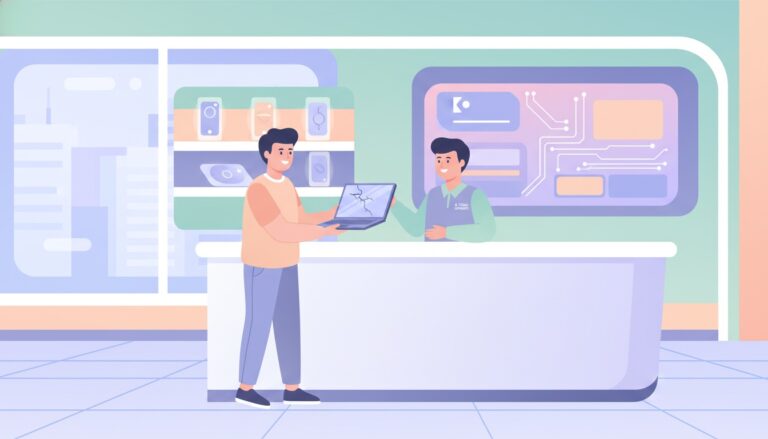
Imagine this: You are in Korea, the land of high-tech gadgets. You bought the latest smartphone or laptop, but suddenly… oh no! The screen goes black! 😱 Don’t panic! In K-Dramas, characters often rush to the service center and get things fixed in no time. Today, we will learn how to survive this situation.
We are going to learn essential phrases to request a repair for your electronics. With these expressions, you can confidently walk into a service center and say, “Fix this, please!” Let’s dive in! 🚀
Key Expressions
1. 고장 났어요 (It’s broken)
- Pronunciation: [Gojang nasseoyo]
- English Meaning: It is broken / It is out of order.
- Detail: This is the most important phrase! You can point to your phone, camera, or laptop and say this. It tells the staff that something is wrong.
- 💡 Pronunciation Tip: Notice the ‘ss’ in nasseoyo? When ‘ㅅ’ is at the bottom (batchim), it sounds like a ‘t’, but because it is followed by a vowel, it connects and sounds like a strong ‘S’. So it flows like [Gojang na-sseo-yo].
2. 수리 가능해요? (Is it possible to repair?)
- Pronunciation: [Suri ganeunghaeyo?]
- English Meaning: Is repair possible? / Can you fix it?
- Detail: ‘수리 (Suri)’ means repair, and ‘가능해요 (ganeunghaeyo)’ means ‘is it possible?’. Use this to ask if your device can be saved!
- 💡 Pronunciation Tip: The ‘H’ in ganeunghaeyo is often pronounced very softly or sometimes dropped in fast speech, sounding like [Ganeung-aeyo].
3. 무료예요? (Is it free?)
- Pronunciation: [Muryoyeyo?]
- English Meaning: Is it free of charge?
- Detail: You want to know if the repair cost is covered by the warranty. ‘무료 (Muryo)’ means free. If it’s not free, you might hear “유료 (Yuryo)” (paid).
- 💡 Pronunciation Tip: The ‘Ry’ sound in Muryo can be tricky. It’s a mix between an ‘L’ and an ‘R’. Try to tap your tongue against the roof of your mouth gently!
4. 언제 다 돼요? (When will it be done?)
- Pronunciation: [Eonje da dwaeyo?]
- English Meaning: When will it be finished?
- Detail: Koreans love speed (Palli-palli culture)! Use this to ask when you can pick up your device.
- 💡 Pronunciation Tip: ‘돼 (dwae)’ is a diphthong. Pronounce it quickly like ‘weh’ with a ‘d’ in front. [Dweh-yo].
Real Conversation
Let’s see how to use these in a Service Center (서비스 센터) situation!
A: Customer (You)
B: Staff
A: 안녕하세요. 제 노트북이 고장 났어요.
(Annyeonghaseyo. Je noteubugi gojang nasseoyo.)
Hello. My laptop is broken. 💻
B: 어디 봅시다. 음… 수리 가능해요.
(Eodi bopsida. Eum… suri ganeunghaeyo.)
Let me see. Hmm… repair is possible.
A: 다행이네요! 혹시 무료예요?
(Dahaengineyo! Hoksi muryoyeyo?)
That’s a relief! By any chance, is it free?
B: 네, 보증 기간이라서 무료예요.
(Ne, bojeung giganiraseo muryoyeyo.)
Yes, it is free because it is within the warranty period.
A: 감사합니다! 언제 다 돼요?
(Gamsahamnida! Eonje da dwaeyo?)
Thank you! When will it be done?
B: 30분 정도 걸려요.
(Samsip-bun jeongdo geollyeoyo.)
It takes about 30 minutes.
Culture Tip: What is “A/S”?
In Korea, you will often hear the term “A/S” (pronounced: A-i-e-seu). This stands for “After Service” (After-sales service).
While English speakers usually say “warranty service” or “repair,” Koreans almost exclusively use “A/S.”
– “A/S 센터” = Repair Center
– “A/S 기간” = Warranty Period
Also, Korean service centers are famous for being incredibly fast and comfortable. Many have comfortable sofas and free coffee while you wait! ☕️
Conclusion & Quiz
Great job today! Now you don’t have to worry if your electronics break down in Korea. You are ready to get that A/S!
📝 Mini Quiz
- How do you say “It’s broken” in Korean?
-> ________ 났어요. -
How do you ask “Is it free?”
-> ________예요? -
(True/False) In Korea, “A/S” means After Service (Repair/Warranty).
Answers:
1. 고장 (Gojang)
2. 무료 (Muryo)
3. True (O)
Frequently Asked Questions (FAQ)
Q: What does "고장 났어요 (It's broken)" mean in Korean and how do you pronounce it?
A: In Korean, "고장 났어요 (It's broken)" is pronounced [Gojang nasseoyo] and means: It is broken / It is out of order.
Q: What does "수리 가능해요? (Is it possible to repair?)" mean in Korean and how do you pronounce it?
A: In Korean, "수리 가능해요? (Is it possible to repair?)" is pronounced [Suri ganeunghaeyo?] and means: Is repair possible? / Can you fix it?
Q: What does "무료예요? (Is it free?)" mean in Korean and how do you pronounce it?
A: In Korean, "무료예요? (Is it free?)" is pronounced [Muryoyeyo?] and means: Is it free of charge?
Q: What does "언제 다 돼요? (When will it be done?)" mean in Korean and how do you pronounce it?
A: In Korean, "언제 다 돼요? (When will it be done?)" is pronounced [Eonje da dwaeyo?] and means: When will it be finished?







