

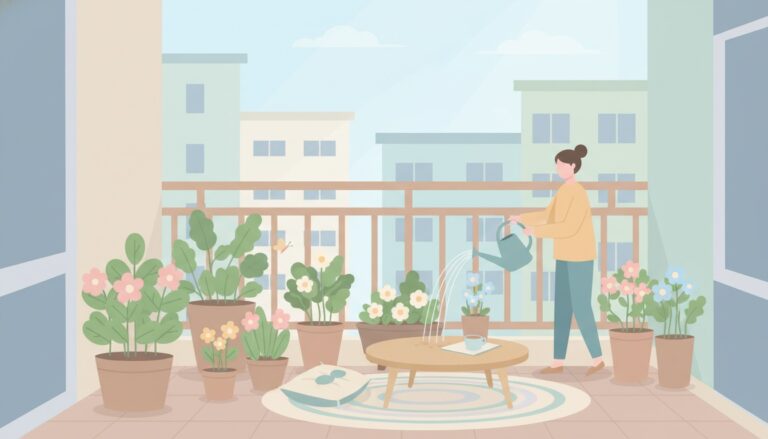
Hello! Daily Hangul here to upgrade your Korean skills! 👋✨
Happy weekend, everyone! How do you spend your weekends?
In Korea, many people love “Planterior” (Plant + Interior) these days. Taking care of plants is a popular way to relax and find peace. Have you seen K-drama characters talking to their plants or proudly showing off their mini-gardens on balconies? 🌱
Today, we are going to learn how to talk about watering plants and gardening. Let’s make your Korean bloom like a beautiful flower! 🌸
🌿 Key Expressions
Here are 3 essential expressions you need for your weekend gardening!
1. 화분에 물을 줘요.
- Pronunciation: [Hwabune mureul jwoyo]
- Meaning: I water the flowerpot.
- Explanation:
- 화분 (Hwabun) means “flowerpot.”
- 물을 줘요 (mureul jwoyo) comes from “물을 주다” (to give water). In English, you say “water the plants,” but in Korean, we literally say “give water.”
2. 식물을 키워요.
- Pronunciation: [Singmureul kiwoyo]
- Meaning: I grow plants / I raise plants.
- Explanation:
- 키우다 (Kiuda) is a very versatile verb! It means “to raise” or “to grow.” You can use this for plants, pets (dogs/cats), and even children! 🐶👶
3. 꽃이 활짝 폈어요.
- Pronunciation: [Kkochi hwaljjak pyeosseoyo]
- Meaning: The flowers have bloomed fully.
- Explanation:
- 활짝 (Hwaljjak) is an adverb describing something opening wide (like a flower or a smile).
- 피다 (Pida) means “to bloom.”
💡 Pronunciation Tip!
Let’s look at the word 꽃이 (Flowers + subject particle).
- Written: 꽃이
- Pronounced: [꼬치 / Kko-chi]
Why?
When the bottom consonant (Batchim) ㅊ meets the vowel ㅇ, the sound moves over to the next spot. So instead of stopping at “Kkot”, it flows into “Chi”. It sounds like “Kko-chi”! Try saying it smoothly! 🗣️
💬 Real Conversation
Imagine you are visiting a friend’s house on the weekend and see their balcony garden.
Minji: 와! 베란다에 꽃이 정말 많네요!
[Wa! Berandae kkochi jeongmal manneyo!]
(Wow! There are so many flowers on the balcony!)
Jason: 네, 주말마다 제가 화분에 물을 줘요.
[Ne, jumalmada jega hwabune mureul jwoyo.]
(Yes, I water the flowerpots every weekend.)
Minji: 정말 예뻐요. 식물을 키우는 게 재미있어요?
[Jeongmal yeppeoyo. Singmureul kiuneun ge jaemiisseoyo?]
(It’s really pretty. Is growing plants fun?)
Jason: 네, 보고 있으면 기분이 좋아져요.
[Ne, bogo isseumyeon gibuni joajyeoyo.]
(Yes, looking at them makes me feel good.)
🇰🇷 Culture Tip: “Companion Plants”
Did you know? In Korea, people don’t just call them “houseplants.” We often call them 반려식물 (Banryeo-sikmul), which translates to “Companion Plants.”
Just like “Companion Animals” (pets), Koreans treat plants with love and care, believing they provide emotional support and healing. If you tell a Korean friend, “This is my companion plant,” they will think your Korean mindset is very authentic! 🌵❤️
📝 Wrap-up & Quiz
Today we learned how to talk about a peaceful gardening weekend. Taking care of living things is always healing!
Let’s check what you remembered!
- Fill in the blank:
“I give water to the flowerpot.”
= 화분에 _____ 줘요. (Hint: Water) -
O / X Quiz:
The verb 키우다 (Kiuda) is ONLY used for plants.
(True / False)
Answers:
1. 물을 (Mureul)
2. X (False! You can use it for pets and children too!)
See you next time with more fun Korean! Annyeong! 👋😊
Frequently Asked Questions (FAQ)
Q: What does "화분에 물을 줘요." mean in Korean and how do you pronounce it?
A: In Korean, "화분에 물을 줘요." is pronounced [Hwabune mureul jwoyo] and means: I water the flowerpot.
Q: What does "식물을 키워요." mean in Korean and how do you pronounce it?
A: In Korean, "식물을 키워요." is pronounced [Singmureul kiwoyo] and means: I grow plants / I raise plants.
Q: What does "꽃이 활짝 폈어요." mean in Korean and how do you pronounce it?
A: In Korean, "꽃이 활짝 폈어요." is pronounced [Kkochi hwaljjak pyeosseoyo] and means: The flowers have bloomed fully.







