

Introduction
Hello! It’s Daily Hangul (DailyHangul.com), here to upgrade your Korean skills! 🚀
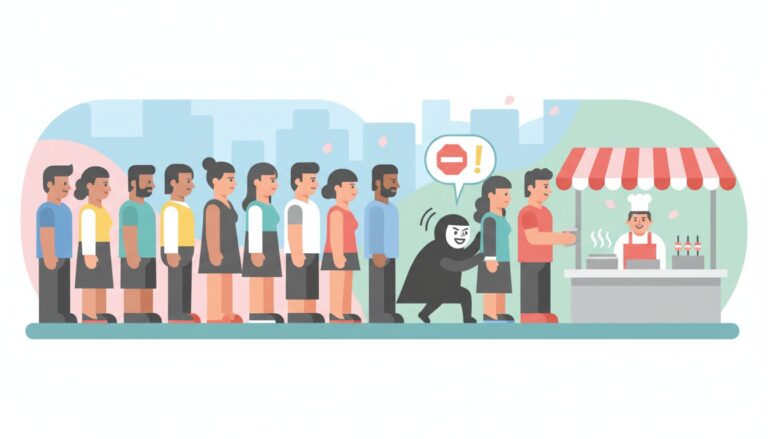
Have you ever waited in a long line for famous Korean street food (hotteok! 🥞) or to buy merchandise at a K-Pop concert, only to have someone suddenly jump in front of you? 😤 It happens!
In K-Dramas, the main character usually says something cool to stop the rude person, right? Today, we will learn how to handle this situation politely but firmly. You need these expressions to protect your spot! Let’s become the main character of our own story! 💪
Key Expressions
Here are 3 essential phrases to deal with line cutters.
1. 줄 서 계신 거예요? (Are you in line?)
- Pronunciation: [Jul seo gyesin geoyeyo?]
- Meaning: Are you in line?
- Explanation: Before getting angry, it’s best to check first! Maybe they are just looking at the menu. This is a very polite way to ask, “Are you standing in this line?”
- 💡 Pronunciation Tip:
- Jul (줄) sounds like ‘Jewel’ without the ‘we’ sound.
- Seo (서) sounds like ‘Saw’.
2. 새치기하지 마세요. (Please don’t cut in line.)
- Pronunciation: [Saechigi-haji maseyo]
- Meaning: Please don’t cut in line.
- Explanation: This is the core expression! ‘Saechigi’ (새치기) means ‘cutting in line’. Adding ‘-haji maseyo’ makes it a polite command meaning “Please don’t do it.”
- 💡 Pronunciation Tip:
- Sae (새) sounds like ‘Say’.
- Chi (치) is a strong ‘Ch’ sound like in ‘Cheese’.
3. 뒤로 가 주세요. (Please go to the back.)
- Pronunciation: [Dwiro ga juseyo]
- Meaning: Please go to the back.
- Explanation: If they admit they cut in, you can tell them where to go. ‘Dwi’ (뒤) means ‘back’ or ‘behind’.
- 💡 Pronunciation Tip:
- Dwi (뒤) can be tricky! Try saying “D-we” quickly together.
Real-life Conversation
Imagine you are waiting at a popular cafe in Seoul. ☕️
You (A): Excuse me. 줄 서 계신 거예요? [Jul seo gyesin geoyeyo?]
(Excuse me. Are you in line?)
Stranger (B): 아, 네. 급해서요. [A, ne. Geupaeseoyo.]
(Ah, yes. I’m in a hurry.)
You (A): 우리 다 기다리고 있어요. 새치기하지 마세요. [Uri da gidarigo isseoyo. Saechigi-haji maseyo.]
(We are all waiting. Please don’t cut in line.)
Stranger (B): 죄송합니다. [Joesonghamnida.]
(I’m sorry.)
You (A): 뒤로 가 주세요. [Dwiro ga juseyo.]
(Please go to the back.)
Cultural Tip 🇰🇷
“Nunchi” (눈치) in Public
In Korea, public order is very important. Most people stand in line very well for the subway, bus, and restrooms. If someone cuts in line, usually many people will stare at them (giving them “laser eyes” 👀).
However, sometimes older people might not notice the line. In this case, start with Expression #1 (Are you in line?) with a smile. It solves the problem softly without a fight! Being polite but firm is the Korean way. ✨
Conclusion & Quiz
Great job! Now you can defend your place in line like a pro. Don’t be afraid to speak up if someone ignores the queue!
Let’s practice! (Answers are at the bottom)
- Fill in the blank: “_______ haji maseyo!” (Don’t cut in line!)
- How do you say “Back” in Korean? (Hint: D__)
- (True/False) It is better to shout angrily immediately when someone cuts in line.
See you next time! 안녕! 👋
Answers:
1. Saechigi (새치기)
2. Dwi (뒤)
3. False (Start politely with “Are you in line?”)
Frequently Asked Questions (FAQ)
Q: What does "줄 서 계신 거예요? (Are you in line?)" mean in Korean and how do you pronounce it?
A: In Korean, "줄 서 계신 거예요? (Are you in line?)" is pronounced [Jul seo gyesin geoyeyo?] and means: Are you in line?
Q: What does "새치기하지 마세요. (Please don't cut in line.)" mean in Korean and how do you pronounce it?
A: In Korean, "새치기하지 마세요. (Please don't cut in line.)" is pronounced [Saechigi-haji maseyo] and means: Please don't cut in line.
Q: What does "뒤로 가 주세요. (Please go to the back.)" mean in Korean and how do you pronounce it?
A: In Korean, "뒤로 가 주세요. (Please go to the back.)" is pronounced [Dwiro ga juseyo] and means: Please go to the back.







