

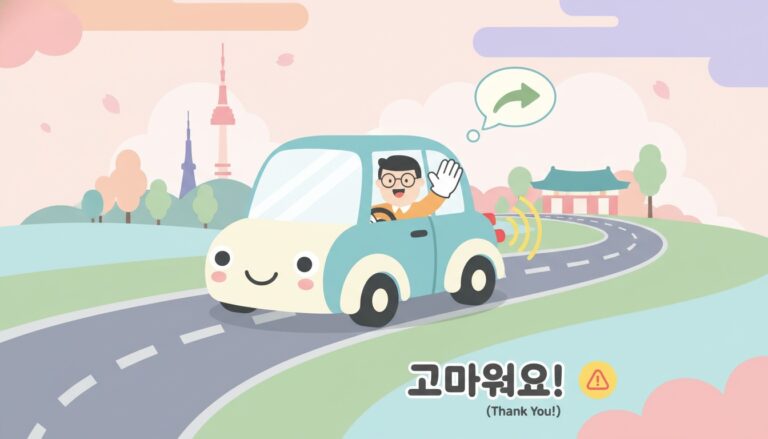
Hello! We are Daily Hangul (DailyHangul.com), here to upgrade your Korean skills! 👋
Have you ever watched a K-Drama scene where the main character drives a fancy car through the streets of Seoul? 🏙️ Driving in Korea can be fast-paced, but there is a lot of “Jeong” (affection/kindness) on the road too!
Today, we are going to learn how to be a polite driver in Korea. Specifically, we will learn how to yield to other cars and show good manners. Knowing these phrases will help you understand driving scenes in dramas better, and if you ever rent a car in Jeju or Seoul, you’ll be ready! Let’s drive into it! 🚗💨
Core Expressions: Being a Polite Driver 🚦
1. 먼저 가세요 (Please go first)
- Pronunciation: [Meonjeo gaseyo]
- English Meaning: Please go first / After you.
- Detailed Explanation: This is the most common phrase used when you want to yield to another car (or even a person walking).
- 먼저 (Meonjeo) means “first” or “ahead.”
- 가세요 (Gaseyo) means “please go.”
- You can use this when you stop at an intersection and want to signal the other car to move before you.
- 💡 Pronunciation Tip: Pay attention to ‘eo’ (어) in Meonjeo. It sounds like the ‘u’ in “cup” or “bus,” not ‘o’ in “go.” Keep your jaw relaxed!
2. 들어오세요 (Please come in)
- Pronunciation: [Deureo-oseyo]
- English Meaning: Please come in (merge).
- Detailed Explanation: You use this when you are letting a car merge into your lane. In K-Dramas, you might see a polite driver waving their hand and saying this phrase.
- 들어오다 (Deureo-oda) is the dictionary form for “to enter” or “to come in.”
- 💡 Pronunciation Tip: Liaison Rule! The final consonant ㄹ (l/r) in ‘들 (Deul)’ moves over to the next vowel ‘어 (eo)’. So instead of sounding like “Deul-eo,” it flows smoothly like [Deu-reo].
3. 양보해 주셔서 감사합니다 (Thank you for yielding)
- Pronunciation: [Yangbohae jusyeoseo gamsahamnida]
- English Meaning: Thank you for yielding.
- Detailed Explanation: This is a very polite and formal way to express gratitude.
- 양보 (Yangbo) means “yielding” or “concession.”
- If this is too long, you can simply say “감사합니다” (Gamsahamnida)!
- 💡 Pronunciation Tip: The ‘sh’ sound in 주셔서 (Jusyeoseo) should be soft. Also, remember that ‘Hamnida’ is written as ‘Hap-ni-da’ but pronounced ‘Ham-ni-da’ due to nasal assimilation!
Real Conversation: On the Road 🛣️
(Situation: Min-su is driving, and his foreign friend, Leo, is in the passenger seat.)
Leo: 와, 차가 정말 많아요. (Wow, there are so many cars.)
[Wa, chaga jeongmal manayo.]
Min-su: 맞아요. 어? 저 차가 끼어들고 싶어 하네요. (Right. Oh? That car wants to cut in.)
[Majayo. Eo? Jeo chaga kkieodeulgo sipeo haneyo.]
Min-su: (Waving hand) 들어오세요! ((Waving hand) Please come in!)
[Deureo-oseyo!]
Leo: 민수 씨는 운전을 참 친절하게 해요. (Min-su, you drive very kindly.)
[Min-su ssineun unjeoneul cham chinjeolhage haeyo.]
Min-su: 하하, 먼저 가세요 하면 기분이 좋잖아요. (Haha, saying “Please go first” makes me feel good.)
[Haha, meonjeo gaseyo hamyeon gibuni jotchanayo.]
Culture Tip: The “Hazard Light” Thank You 🚨
Here is a SUPER IMPORTANT Korean driving custom!
In Korea, if you can’t speak to the other driver, how do you say “Thank you” or “Sorry”?
You blink your hazard lights (emergency lights) 3 times! 💡💡💡
If someone lets you merge into their lane, it is polite to turn on your hazard lights for about 2-3 seconds immediately after merging. It’s a universal sign on Korean roads that means “Thank you for letting me in!” or “Sorry for cutting in!”
If you see this in a K-Drama, now you know exactly what it means! 😎
Wrap-up & Quiz 📝
Today we learned how to be a courteous driver in Korea. Remember, a little ‘Yangbo’ (Yielding) goes a long way!
Let’s check what you remember!
- How do you say “Please go first” in Korean?
( Hint: M_____ G_____ ) - What does “들어오세요” (Deureo-oseyo) mean?
a) Get out
b) Please come in (merge) - (True/False) In Korea, blinking hazard lights can mean “Thank you.”
[Answers]
1. 먼저 가세요 (Meonjeo gaseyo)
2. b) Please come in
3. True (It’s a very common gesture!)
See you next time! Drive safely! 안전 운전하세요! 🚘👋
Frequently Asked Questions (FAQ)
Q: What does "먼저 가세요 (Please go first)" mean in Korean and how do you pronounce it?
A: In Korean, "먼저 가세요 (Please go first)" is pronounced [Meonjeo gaseyo] and means: Please go first / After you.
Q: What does "들어오세요 (Please come in)" mean in Korean and how do you pronounce it?
A: In Korean, "들어오세요 (Please come in)" is pronounced [Deureo-oseyo] and means: Please come in (merge).
Q: What does "양보해 주셔서 감사합니다 (Thank you for yielding)" mean in Korean and how do you pronounce it?
A: In Korean, "양보해 주셔서 감사합니다 (Thank you for yielding)" is pronounced [Yangbohae jusyeoseo gamsahamnida] and means: Thank you for yielding.







