

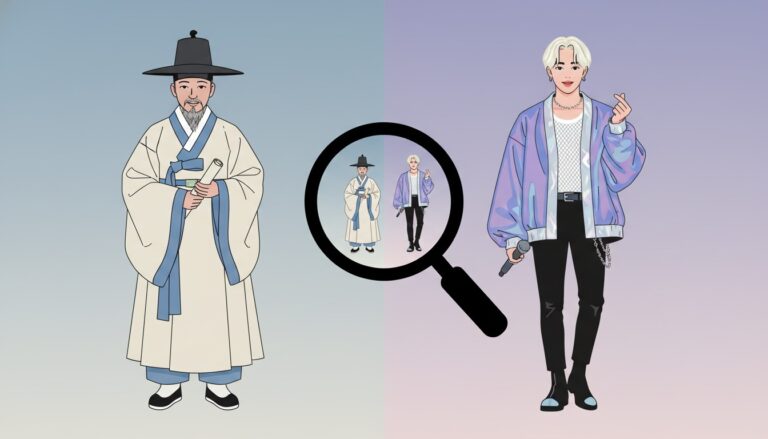
Secrets in the Painting: Reading Korean Portraits! 🎨
Introduction
Hello! It’s your Korean fluency booster, Daily Hangul (DailyHangul.com)! 👋
Have you ever watched a historical K-Drama like The Red Sleeve (옷소매 붉은 끝동) or Lovers of the Red Sky (홍천기)? 🎎 In those dramas, painting a person’s face is often a very serious and important mission.
Today, we are going to learn how to talk about portraits and the stories they tell about the era. Even if you go to a museum in Korea or just look at old photos of your favorite K-Pop idol’s childhood, these words will be super useful! Let’s dive into the art world! 🖼️✨
Key Expressions 🗝️
1. 초상화 (Portrait)
- Pronunciation: [Chosanghwa]
- English Meaning: Portrait
- Detail: This combines ‘Cho’ (likeness), ‘Sang’ (image), and ‘Hwa’ (painting). In Korea, kings’ portraits are specifically called Eojin (어진). You will hear this word often in historical dramas involving painters!
- 💡 Pronunciation Tip: The ‘hwa’ sound is soft. Make sure to pronounce ‘Cho’ clearly with a ‘ch’ sound like in ‘Cheese’.
2. 표정 (Facial Expression)
- Pronunciation: [Pyojeong]
- English Meaning: Facial expression
- Detail: When you look at a painting or a selfie, the pyojeong tells the mood. Is it happy? Sad? Serious?
- 💡 Pronunciation Tip: ‘Pyo’ sounds like the start of ‘Pure’. ‘Jeong’ has a soft ‘ng’ ending like ‘Song’.
3. 옷차림 (Attire / Outfit)
- Pronunciation: [Otcharim]
- English Meaning: Attire, Outfit, Way of dressing
- Detail: Fashion changes with time! Otcharim refers to how someone is dressed. It helps us guess the era or the person’s job.
- 💡 Pronunciation Tip: This involves a linking sound! ‘Ot’ ends with a ‘t’ sound, but when followed by ‘cha’, it flows together. Say it like [O-cha-rim] smoothly.
4. 시대 (Era / Period)
- Pronunciation: [Sidae]
- English Meaning: Era, Period, Times
- Detail: You might know the K-Pop group “Girls’ Generation” (Sonyeo Sidae). This word means a specific period in history.
Real Conversation 🗣️
Situation: Minji and Paul are at a museum looking at a painting from the Joseon Dynasty.
Paul: 이 그림 좀 봐! 표정이 정말 진지해.
(I geurim jom bwa! Pyojeong-i jeongmal jinjihae.)
Look at this painting! The expression is really serious.
Minji: 맞아. 이건 조선 시대의 초상화야.
(Maja. Igeon Joseon sidae-ui chosanghwa-ya.)
That’s right. This is a portrait from the Joseon era.
Paul: 옷차림이 지금이랑 많이 다르네.
(Otcharim-i jigeum-irang mani dareune.)
The attire is very different from now.
Minji: 응, 그 시대의 문화를 보여주는 거야.
(Eung, geu sidae-ui munhwa-reul boyeojuneun geoya.)
Yes, it shows the culture of that era.
Culture Tip 🇰🇷
Did you know? “One hair makes a different person!”
In traditional Korean portraits, realism was extremely important, but in a spiritual way. Painters believed that to capture the person’s spirit, they had to paint every single strand of hair exactly as it was! 🖌️
There is a saying: “Il-ho-bul-sa, jeuk-ta-in” (일호불사 즉타인). It means “If one strand of hair is different, it is someone else.” That is why Korean portraits look very detailed and honest—they didn’t use Photoshop back then! 😂
Wrap-up & Quiz 📝
Great job today! Now you can describe the people you see in art and photos. Let’s check if you remember the key words!
Quiz:
1. What is the Korean word for “Facial Expression”?
( Hint: P_ _ j _ _ _ g )
2. True or False: ‘Sidae’ (시대) means “Portrait”.
3. Fill in the blank: The way someone is dressed is called [ ] (Otcharim).
Answers:
1. 표정 (Pyojeong)
2. False (Sidae means Era/Period. Portrait is Chosanghwa!)
3. 옷차림
See you next time with more fun Korean! Annyeong! 👋
Frequently Asked Questions (FAQ)
Q: What does "초상화 (Portrait)" mean in Korean and how do you pronounce it?
A: In Korean, "초상화 (Portrait)" is pronounced [Chosanghwa] and means: Portrait
Q: What does "표정 (Facial Expression)" mean in Korean and how do you pronounce it?
A: In Korean, "표정 (Facial Expression)" is pronounced [Pyojeong] and means: Facial expression
Q: What does "옷차림 (Attire / Outfit)" mean in Korean and how do you pronounce it?
A: In Korean, "옷차림 (Attire / Outfit)" is pronounced [Otcharim] and means: Attire, Outfit, Way of dressing
Q: What does "시대 (Era / Period)" mean in Korean and how do you pronounce it?
A: In Korean, "시대 (Era / Period)" is pronounced [Sidae] and means: Era, Period, Times







