

Hello! I’m Daily Hangul (DailyHangul.com), here to upgrade your Korean skills! 👋
Did you know that 70% of Korea is covered in mountains? ⛰️ Hiking is a national pastime here! But sometimes, nature can be a bit too wild. Have you seen the K-Drama ‘Jirisan (지리산)’? Rangers often deal with dangerous situations in the mountains.
Today, we will learn crucial Survival Korean for when you encounter dangerous animals like wild boars (which are surprisingly common in Korean mountains!) or snakes. These expressions might just save your day! Let’s dive in! 🚀
Core Expressions: Survival Mode On! 🚨
1. 도와주세요! (Help me!)
- Pronunciation: [Dowajuseyo!]
- English Meaning: Help me!
- Detail: This is the most important phrase in any emergency. Whether you see a snake 🐍 or get lost, shout this loudly. It combines ‘to help’ (도와주다) with the polite request ending (세요).
- 💡 Pronunciation Tip: The ‘do’ sounds like ‘dough’. Connect ‘wa-ju’ smoothly. Say it with urgency!
2. 뛰지 마세요. (Don’t run.)
- Pronunciation: [Ttwiji maseyo.]
- English Meaning: Don’t run.
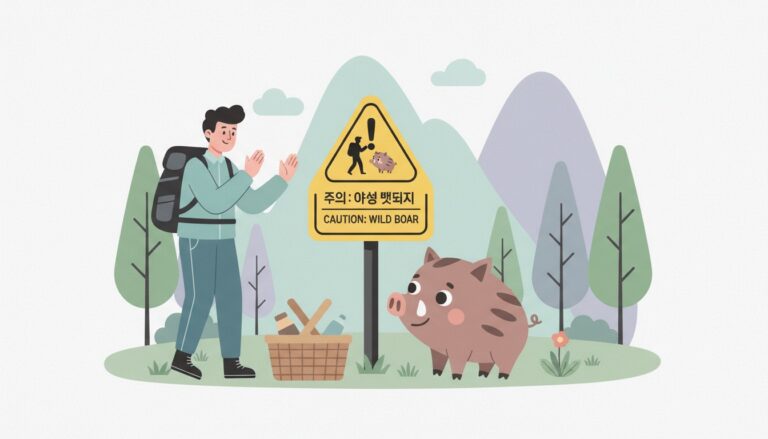
- Detail: If you see a wild boar (멧돼지) or a stray dog, running can trigger their chase instinct. Use this to warn your friends!
- Grammar: Verb stem + -ji maseyo (-지 마세요) = Please do not [Verb].
- 💡 Pronunciation Tip: The ‘Tt (ㄸ)’ is a tensed sound. Tense your tongue behind your teeth and say ‘T’ strongly without letting air out. It’s much stronger than a regular ‘T’.
3. 119에 전화해 주세요. (Please call 119.)
- Pronunciation: [Il-il-gu-e jeonhwahae juseyo.]
- English Meaning: Please call 119.
- Detail: In Korea, 119 is the number for Fire and Rescue (ambulance/emergency), similar to 911 in the US or 999 in the UK.
- 💡 Pronunciation Tip: Numbers in phone numbers are read in Sino-Korean numbers. 1 (Il), 9 (Gu). So it is ‘Il-il-gu’.
Real Conversation: Hiking Surprise 🌲
(Situation: Minji and Alex are hiking in Bukhansan, and they spot a wild boar nearby.)
Minji: 앗! 저기 멧돼지예요! 🐗
(At! Jeogi metdwaeji-yeyo!)
Oh! That’s a wild boar over there!
Alex: 정말요? 도망가야 해요? 🏃♂️
(Jeongmaryo? Domanggaya haeyo?)
Really? Should we run away?
Minji: 아니요! 뛰지 마세요. 가만히 있으세요.
(Aniyo! Ttwiji maseyo. Gamanhi isseuseyo.)
No! Don’t run. Stay still.
Alex: 무서워요. 도와주세요!
(Museowoyo. Dowajuseyo!)
I’m scared. Help me!
Minji: 제가 119에 전화할게요. 진정하세요.
(Jega 119-e jeonhwahalkkeyo. Jinjeonghaseyo.)
I will call 119. Please calm down.
Culture Tip: Safe Hiking in Korea 🇰🇷
Did you know that Korean mountains have specific “State Point Numbers” (국가지점번호)?
If you get lost or hurt and call 119, look for yellow signs with numbers on hiking trails. Telling the operator this number helps them find your exact location quickly! Also, wearing bright colors is recommended to avoid being mistaken for an animal by hunters during certain seasons. Safety first! 👷♀️
Wrap-up & Quiz 📝
Today we learned how to stay safe during emergencies in Korea. Remember, staying calm is key! Let’s check if you are ready for a safe trip.
Question 1. How do you say “Don’t run” in Korean?
( ) 마세요.
Question 2. What is the emergency rescue number in Korea?
( )
Question 3. True or False: You should run fast if you see a wild boar.
( )
[Answers]
1. 뛰지 (Ttwiji)
2. 119 (Il-il-gu)
3. False (X) – You should stay still or hide behind a tree/rock slowly.
See you next time! Stay safe! 안녕! 👋
Frequently Asked Questions (FAQ)
Q: What does "도와주세요! (Help me!)" mean in Korean and how do you pronounce it?
A: In Korean, "도와주세요! (Help me!)" is pronounced [Dowajuseyo!] and means: Help me!
Q: What does "뛰지 마세요. (Don't run.)" mean in Korean and how do you pronounce it?
A: In Korean, "뛰지 마세요. (Don't run.)" is pronounced [Ttwiji maseyo.] and means: Don't run.
Q: What does "119에 전화해 주세요. (Please call 119.)" mean in Korean and how do you pronounce it?
A: In Korean, "119에 전화해 주세요. (Please call 119.)" is pronounced [Il-il-gu-e jeonhwahae juseyo.] and means: Please call 119.







