

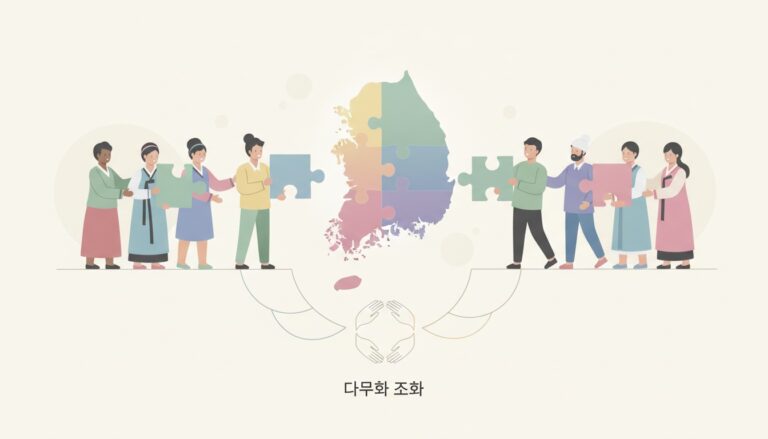
Introduction
Hello! It’s your favorite Korean tutor, Daily Hangul (DailyHangul.com)! 👋✨
Are you ready to take your Korean from “ordering bibimbap” to “discussing society”? Today, we are diving into a slightly more advanced but incredibly important topic: Identity and Multiculturalism.
If you watch Korean news or intellectual variety shows like “Non-Summit” (비정상회담), you will hear these words all the time! Learning these expressions will help you express your deep thoughts and understand the changing face of modern Korea. Let’s get smart together! 🤓📚
Key Expressions
Here are 4 key words to help you discuss society and people!
1. 다문화 (Damunhwa)
- Meaning: Multicultural / Multiculturalism
- Pronunciation: [Damunhwa]
- Explanation: This is a combination of 다 (Da) meaning ‘many’ and 문화 (Munhwa) meaning ‘culture’. In modern Korea, you will often hear terms like ‘다문화 가정’ (multicultural family) or ‘다문화 사회’ (multicultural society).
- 💡 Pronunciation Tip: The ‘h’ (ㅎ) in ‘hwa’ is sometimes pronounced very softly. It flows like Da-mu-nwa in fast speech.
2. 정체성 (Jeongcheseong)
- Meaning: Identity
- Pronunciation: [Jeongcheseong]
- Explanation: This is a fancy word used to describe who you are. In dramas, when a character is confused about their life, they might say “I am confused about my identity” (정체성의 혼란을 느껴).
3. 차별 (Chabyeol)
- Meaning: Discrimination
- Pronunciation: [Chabyeol]
- Explanation: Unfortunately, every society has this challenge. You often use this with the verb ‘받다’ (to receive) or ‘하다’ (to do).
- Example: 차별하지 마세요 (Don’t discriminate).
4. 존중하다 (Jonjunghada)
- Meaning: To respect
- Pronunciation: [Jonjunghada]
- Explanation: This is the key to solving social conflicts! It’s a bit more formal than just ‘liking’ someone. It means acknowledging their value. You hear this a lot in serious talks or debates.
Real Conversation Practice
Let’s see how Minji and Alex discuss a news report about Korean society.
Minji: 한국도 이제 다문화 사회가 된 것 같아.
(Hangukdo ije damunhwa sahoega doen geot gata.)
(I think Korea has become a multicultural society now.)
Alex: 맞아. 그래서 서로의 정체성을 이해하는 게 중요해.
(Maja. Geuraeseo seoroui jeongcheseong-eul ihaehaneun ge jungyohae.)
(Right. That’s why it is important to understand each other’s identity.)
Minji: 하지만 뉴스 보면 아직 차별이 좀 있는 것 같아 속상해.
(Hajiman nyuseu bomyeon ajik chabyeol-i jom inneun geot gata soksanghae.)
(But watching the news, I’m upset because it seems there is still some discrimination.)
Alex: 우리가 먼저 다양성을 존중하는 태도를 가져야 해!
(Uriga meonjeo dayangseong-eul jonjunghaneun taedoreul gajyeoya hae!)
(We need to have an attitude of respecting diversity first!)
Culture Tip 🇰🇷
“From Single Blood to Global Harmony”
Historically, Korea took great pride in being a “Danil Minjok” (단일민족 – Single Race Nation). For a long time, this was taught in schools to build national unity. However, in the 21st century, as more foreigners live in Korea and K-Culture goes global, this concept is changing rapidly!
Nowadays, the keyword is “Global Harmony”. Shows like Itaewon Class also highlight issues of diversity and discrimination, showing how the younger generation is embracing a more inclusive multicultural (다문화) mindset. Knowing these words shows you understand the deep changes happening in Korea right now! 😎
Wrap-up & Quiz
Today we learned some intellectual words to talk about society! You are now ready to debate in Korean! 🔥
📝 Mini Quiz
Fill in the blanks with the words we learned today.
- Korea is becoming a ███ society with people from many countries.
- We should not ███ against people based on their background.
- It is important to ███ other people’s differences.
Answers:
1. 다문화 (Damunhwa)
2. 차별 (Chabyeol)
3. 존중하다 (Jonjunghada)
See you next time! 안녕! 👋
Frequently Asked Questions (FAQ)
Q: What does "다문화 (Damunhwa)" mean in Korean and how do you pronounce it?
A: In Korean, "다문화 (Damunhwa)" is pronounced [Damunhwa] and means: Multicultural / Multiculturalism
Q: What does "정체성 (Jeongcheseong)" mean in Korean and how do you pronounce it?
A: In Korean, "정체성 (Jeongcheseong)" is pronounced [Jeongcheseong] and means: Identity
Q: What does "차별 (Chabyeol)" mean in Korean and how do you pronounce it?
A: In Korean, "차별 (Chabyeol)" is pronounced [Chabyeol] and means: Discrimination
Q: What does "존중하다 (Jonjunghada)" mean in Korean and how do you pronounce it?
A: In Korean, "존중하다 (Jonjunghada)" is pronounced [Jonjunghada] and means: To respect







