

Introduction
Hello! It’s Daily Hangul (DailyHangul.com), here to upgrade your Korean skills! 🌟
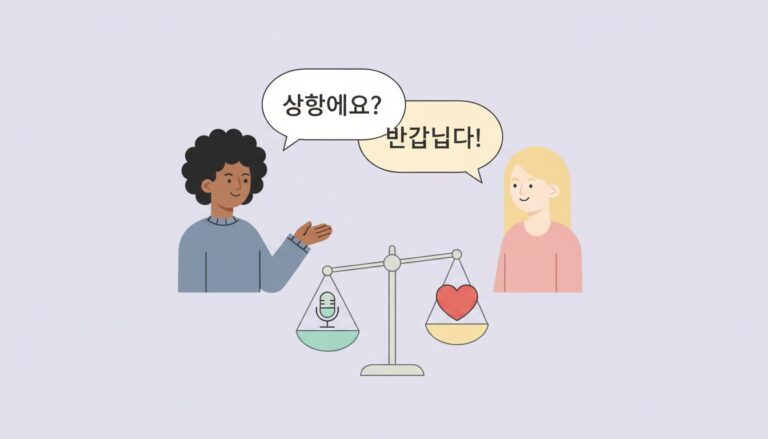
Have you ever watched a Korean legal drama like Extraordinary Attorney Woo or Law School? 🎬 You often hear characters debating about rights, justice, and what is right or wrong. Today, we are going to dive into a slightly serious but very useful topic: Democracy and the Limits of Freedom of Expression.
Don’t worry! We will keep it simple and fun. Learning these expressions will help you express your opinions more clearly and understand news or debates in Korean content. Let’s get started! 🚀
Key Expressions
Here are 4 key expressions to help you discuss freedom and its boundaries.
1. 표현의 자유 (Pyo-hyeon-ui ja-yu)
- English: Freedom of expression
- Detail: This is the core vocabulary for our topic. You will hear this often in news or serious discussions.
- 💡 Pronunciation Tip: In Korean, the particle 의 is written as ‘ui’, but when it indicates possession, it is often pronounced as [에] (e). So, it sounds like [Pyo-hyeo-ne ja-yu].
2. 책임이 필요해요 (Chaeg-im-i pil-yo-hae-yo)
- English: Responsibility is needed / You need responsibility.
- Detail: Freedom is important, but it comes with responsibility. Use this phrase to emphasize that actions have consequences.
- 💡 Pronunciation Tip: When a consonant is followed by a vowel, the sound carries over (Liaison). 책임이 sounds like [Chae-gi-mi].
3. 상처를 주면 안 돼요 (Sang-cheo-reul ju-myeon an dwae-yo)
- English: You shouldn’t hurt (others).
- Detail: ‘상처’ means a wound or hurt feelings. ‘~(으)면 안 돼요’ is a very important grammar point meaning “You must not” or “It is not allowed.” This sets the limit for freedom.
- 💡 Pronunciation Tip: 안 돼요 is often pronounced naturally as [An-dwae-yo]. Make sure to open your mouth wide for the ‘wae’ sound!
4. 제 생각은 달라요 (Je saeng-gag-eun dal-la-yo)
- English: My opinion is different / I disagree.
- Detail: In a democracy, it’s okay to disagree! This is a polite way to say you have a different view without being rude.
- 💡 Pronunciation Tip: 생각은 connects smoothly to sound like [Saeng-ga-geun].
Real Dialogue
Let’s see how these words are used in real life. Two friends, Minji and Jason, are talking about a mean comment on the internet.
Minji: 이 악플 좀 봐. 너무 심하지 않아?
(I ak-peul jom bwa. Neo-mu sim-ha-ji a-na?)
Look at this malicious comment. Isn’t it too harsh?
Jason: 와, 정말 나쁘다. 하지만 이것도 표현의 자유일까?
(Wa, jeong-mal na-ppeu-da. Ha-ji-man i-geot-do pyo-hyeon-ui ja-yu-il-kka?)
Wow, that’s really bad. But is this also freedom of expression?
Minji: 아니, 제 생각은 달라요.
(A-ni, je saeng-gag-eun dal-la-yo.)
No, my opinion is different.
Minji: 자유에는 책임이 필요해요. 다른 사람에게 상처를 주면 안 돼요.
(Ja-yu-e-neun chaeg-im-i pil-yo-hae-yo. Da-reun sa-ram-e-ge sang-cheo-reul ju-myeon an dwae-yo.)
Freedom needs responsibility. You shouldn’t hurt other people.
Cultural Tip 🇰🇷
“Akple” (악플) and Cyber Laws
In the dialogue, Minji mentioned “Akple” (악플). This is a combination of the Sino-Korean word ‘Ak’ (Evil/Bad) and the English word ‘Reply’. It refers to malicious online comments.
South Korea takes online defamation very seriously. Unlike some countries where speech is broadly protected, in Korea, you can face legal punishment for Cyber Defamation (cyberspace insult) if you post false rumors or even true facts that damage someone’s reputation publicly! 🚫👮
Conclusion & Quiz
Today we learned how to discuss the limits of freedom in Korean. Remember, speaking your mind is great, but being kind is even better! 😊
Let’s practice! Fill in the blanks:
- Freedom of expression is called [ _______ ] in Korean.
- You shouldn’t hurt others: 상처를 [ _______ ] 안 돼요.
- (O/X Quiz) In Korea, malicious comments (Akple) can be punished by law. ( )
Answers:
1. 표현의 자유 (Pyo-hyeon-ui ja-yu)
2. 주면 (ju-myeon)
3. O
Frequently Asked Questions (FAQ)
Q: What does "표현의 자유 (Pyo-hyeon-ui ja-yu)" mean in Korean and how do you pronounce it?
A: In Korean, "표현의 자유 (Pyo-hyeon-ui ja-yu)" is pronounced [Tip: In Korean, the particle 의 is written as 'ui', but when it indicates possession, it is often pronounced as [에] and means: a key conversational Korean expression covered in this lesson.
Q: What does "책임이 필요해요 (Chaeg-im-i pil-yo-hae-yo)" mean in Korean and how do you pronounce it?
A: In Korean, "책임이 필요해요 (Chaeg-im-i pil-yo-hae-yo)" is pronounced [Tip: When a consonant is followed by a vowel, the sound carries over (Liaison] and means: a key conversational Korean expression covered in this lesson.
Q: What does "상처를 주면 안 돼요 (Sang-cheo-reul ju-myeon an dwae-yo)" mean in Korean and how do you pronounce it?
A: In Korean, "상처를 주면 안 돼요 (Sang-cheo-reul ju-myeon an dwae-yo)" is pronounced [Tip: 안 돼요 is often pronounced naturally as [An-dwae-yo] and means: a key conversational Korean expression covered in this lesson.
Q: What does "제 생각은 달라요 (Je saeng-gag-eun dal-la-yo)" mean in Korean and how do you pronounce it?
A: In Korean, "제 생각은 달라요 (Je saeng-gag-eun dal-la-yo)" is pronounced [Tip: 생각은 connects smoothly to sound like [Saeng-ga-geun] and means: a key conversational Korean expression covered in this lesson.







