

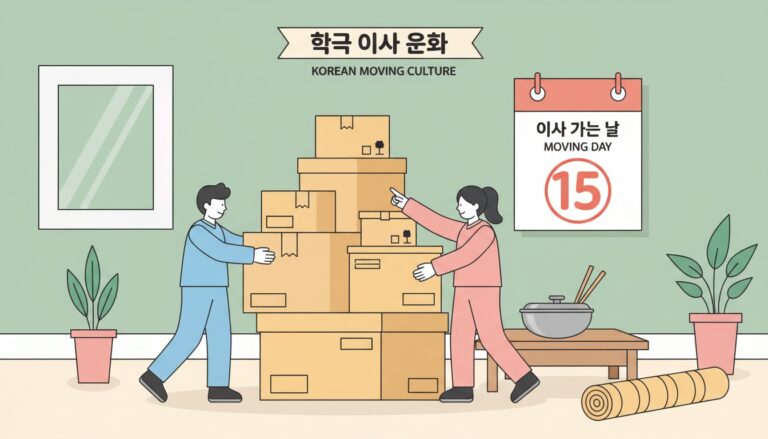
Moving Day in Korea? 📦 Let’s Talk Dates!
Hello! It’s Daily Hangul, here to upgrade your Korean skills! 👋✨
Have you ever watched a K-Drama where the main character moves to a new rooftop apartment? 🏠 Moving is a huge event in Korea, often symbolizing a fresh start! Today, we are going to learn how to talk about dates, specifically focusing on setting a moving day.
Numbers can be tricky, but don’t worry! I’ll make it super easy for you. Let’s get ready to move! 🚚💨
🔑 Core Expressions
1. 언제 이사해요? (When are you moving?)
- Pronunciation: [Eonje isahaeyo?]
- English: When are you moving?
- Explanation:
- 언제 (Eonje): When
- 이사해요 (Isahaeyo): To move (house).
- This is a polite way to ask about someone’s schedule. You will hear “Eonje” a lot in dramas when friends make plans!
2. 10월 24일에 가요. (I’m going on October 24th.)
- Pronunciation: [Si-wol isip-sa-ire gayo]
- English: I am going on October 24th.
- Explanation:
- Korean dates use Sino-Korean numbers (Il, I, Sam, Sa…).
- Month: Number + 월 (wol)
- Day: Number + 일 (il)
- Particle: ~에 (e) marks the time/date.
💡 Pronunciation Tip:
Watch out for October (10월)! Normally 10 is ‘Sip’, but for October, we drop the ‘p’ to make it smoother. So it is Si-wol, not Sip-wol!
Also, when saying the day일followed by에, the sounds link together.24일에sounds like [Isip-sa-i-re].
3. 손 없는 날 (Handless Day / Auspicious Day)
- Pronunciation: [Son eomneun nal]
- English: A lucky day for moving (Lit. Day without hands)
- Explanation:
- This is a unique cultural term! “Hands” refer to evil spirits that follow you. A “Handless day” means the spirits are gone, so it’s the best day to move. Moving costs are often more expensive on these days!
💬 Real Dialogue
Let’s see how two friends, Minji and Jason, talk about moving.
Minji: 제이슨, 언제 이사해요?
(Jason, when are you moving?)
[Jeiseun, eonje isahaeyo?]
Jason: 다음 주 금요일에 해요. 11월 5일이에요.
(I’m doing it next Friday. It is November 5th.)
[Daeum ju geumyoire haeyo. Sibi-rwol o-irieyo.]
Minji: 오, 도와줄까요?
(Oh, shall I help you?)
[O, dowajulkkayo?]
Jason: 괜찮아요! 이사 후에 짜장면 같이 먹어요! 🍜
(It’s okay! Let’s eat Jajangmyeon together after moving!)
[Gwaenchannayo! Isa hue Jjajangmyeon gachi meogeoyo!]
🇰🇷 Culture Tip: Moving Day Food
Did you notice Jason mentioned Jajangmyeon (Black Bean Noodles)? 🍜
In Korea, on moving day, people are too busy to cook and all the pots are packed in boxes. So, it is a tradition to order Jajangmyeon delivery! It’s cheap, fast, and delicious. If you ever move in Korea, or help a friend move, you MUST eat this! It tastes better after hard work. 😉
📝 Wrap-up & Quiz
Great job today! Now you can tell your friends when you are moving or traveling. Remember, for dates, use Sino-Korean numbers (Il, I, Sam…)!
Let’s practice! (True or False)
- To say “October”, you pronounce it as [Sip-wol]. (O / X)
- “언제 (Eonje)” means “Where”. (O / X)
- Koreans usually eat Pizza on moving day. (O / X)
Happy studying! See you next time! 안녕! 👋
[Answers]
1. X (It is [Si-wol])
2. X (It means “When”)
3. X (We eat Jajangmyeon!)
Frequently Asked Questions (FAQ)
Q: What does "언제 이사해요? (When are you moving?)" mean in Korean and how do you pronounce it?
A: In Korean, "언제 이사해요? (When are you moving?)" is pronounced [Eonje isahaeyo?] and means: a key conversational Korean expression covered in this lesson.
Q: What does "10월 24일에 가요. (I'm going on October 24th.)" mean in Korean and how do you pronounce it?
A: In Korean, "10월 24일에 가요. (I'm going on October 24th.)" is pronounced [Si-wol isip-sa-ire gayo] and means: a key conversational Korean expression covered in this lesson.
Q: What does "손 없는 날 (Handless Day / Auspicious Day)" mean in Korean and how do you pronounce it?
A: In Korean, "손 없는 날 (Handless Day / Auspicious Day)" is pronounced [Son eomneun nal] and means: a key conversational Korean expression covered in this lesson.







