

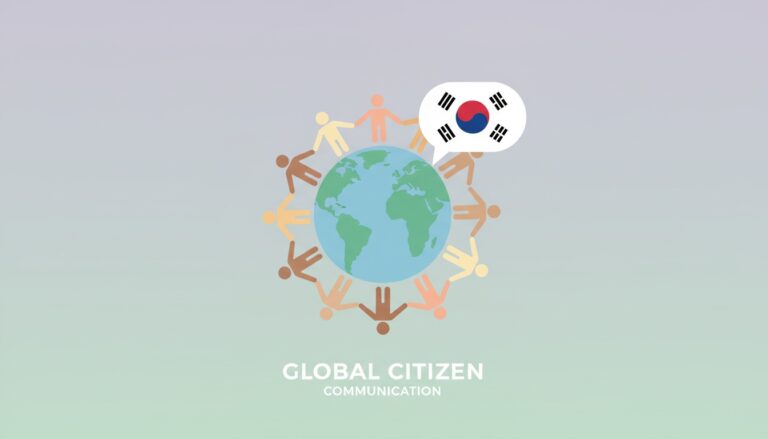
Are We Global Citizens? 🌏 Debating Multiculturalism in Korean!
Introduction
Hello, everyone! It’s your friendly Korean tutor, Daily Hangul (DailyHangul.com)! 👋✨
Have you ever watched a Korean news debate or a serious K-drama involving lawyers or politicians? You might hear them discussing deep topics like society and the future. Today, we are going to level up your Korean significantly! 🚀
We will tackle a slightly more advanced but very important topic: Immigration Policy and Multicultural Society. Specifically, we will learn how to discuss the “Ideals vs. Reality of Cosmopolitanism (Global Citizenship)”.
Don’t worry if it sounds difficult! I will teach you the key phrases you need to sound smart and express your opinions logically. These expressions are perfect for when you want to sound like an intellectual character in a drama! Let’s dive in! 📚🔥
Key Expressions
Here are 4 essential expressions to discuss global citizenship and debate opinions.
1. 세계시민 (Segyesimin)
- Meaning: Global Citizen / Cosmopolitan
- Pronunciation: [Se-gye-si-min]
- Explanation: This combines 세계 (world) and 시민 (citizen). It refers to the idea that all human beings belong to a single community based on a shared morality.
- 💡 Pronunciation Tip: Pronounce each syllable clearly. The ‘Gye’ (계) sound can sometimes sound like ‘Ge’ (게) in fast speech, but try to keep the ‘y’ sound for accuracy!
2. 이상과 현실 (Isanggwa hyeonsil)
- Meaning: Ideals and Reality
- Pronunciation: [I-sang-gwa hyeon-sil]
- Explanation: This is a classic phrase used when debating. 이상 is ‘ideal’ (what we want), and 현실 is ‘reality’ (what actually happens). You use this to point out the gap between theory and practice.
3. 제 생각에는… (Je saenggageneun…)
- Meaning: In my opinion… / I think…
- Pronunciation: [Je saeng-ga-ge-neun]
- Explanation: This is the number one phrase for starting your argument politely but firmly. You will hear this constantly in talk shows and meetings.
- 💡 Pronunciation Tip: Because of the particle ‘에는’ (eneun) following ‘각’ (gak), the ‘k’ sound moves over. So instead of ‘gak-e-neun’, it sounds like ‘ga-ge-neun’. This is called Liason (Yeoneum)!
4. 그 말도 일리가 있어요 (Geu maldo illiga isseoyo)
- Meaning: That point makes sense / You have a point.
- Pronunciation: [Geu mal-do il-li-ga i-sseo-yo]
- Explanation: Even if you disagree, it’s polite to acknowledge the other person’s point first. 일리 (illi) means ‘some reason’ or ‘validity’.
- 💡 Pronunciation Tip: When ‘l’ (ㄹ) meets another ‘l’ (ㄹ), the sound becomes a strong ‘L’. So ‘Il-li’ is pronounced clearly and strongly.
Real-life Dialogue
Let’s see how two friends, Ji-min and Alex, debate this topic at a cafe.
Alex: 요즘 뉴스를 보면 우리는 모두 세계시민이라는 말이 자주 나와요.
(Yojeum nyuseureul bomyeon urineun modu segyesiminiraneun mari jaju nawayo.)
Lately, when I watch the news, the phrase that we are all global citizens comes up often.
Ji-min: 맞아요. 하지만 이상과 현실은 좀 다르지 않을까요?
(Majayo. Hajiman isanggwa hyeonsileun jom dareuji aneulkkayo?)
That’s true. But aren’t the ideals and reality a bit different?
Alex: 왜요? 제 생각에는 국경 없이 서로 돕는 게 중요해요.
(Waeyo? Je saenggageneun gukgyeong eopsi seoro domneun ge jungyohaeyo.)
Why? In my opinion, helping each other without borders is important.
Ji-min: 그 말도 일리가 있어요. 하지만 현실적으로 이민 정책 문제는 복잡하잖아요.
(Geu maldo illiga isseoyo. Hajiman hyeonsiljeogeuro imin jeongchaek munjeneun bokjaphajanayo.)
You have a point there. But realistically, immigration policy issues are complicated.
Culture Tip 🇰🇷
“Damunhwa” (Multiculturalism) in Korea
In Korea, you will often hear the word 다문화 (Damunhwa), which literally means “multi-culture.” As Korea rapidly changes from a homogeneous society to a global one, the government supports 다문화 가정 (Damunhwa gajeong – Multicultural families).
However, just like in our dialogue, there is an ongoing debate about the ideals of accepting everyone as a “Global Citizen” versus the reality of cultural differences and policy. Being able to discuss this shows you have a deep understanding of modern Korea! 🧠✨
Conclusion & Quiz
Great job today! You tackled a very sophisticated topic. Now you can express your opinion like a pro debater! Don’t be afraid to use “Je saenggageneun…” (In my opinion…) in your next conversation! 😊
📝 Mini Quiz
Fill in the blanks with today’s expressions!
- A: We should all live as one family.
B: That is a nice concept, but the _______ (ideals and reality) are different. - _______ (In my opinion), learning Korean helps us understand the culture.
(Scroll down for answers!)
…
…
Answers:
1. 이상과 현실 (Isanggwa hyeonsil)
2. 제 생각에는 (Je saenggageneun)
Frequently Asked Questions (FAQ)
Q: What does "다문화" mean in Korean and how do you pronounce it?
A: In Korean, "다문화" is pronounced [Damunhwa] and means: , which literally means "multi-culture." As Korea rapidly changes from a homogeneous society to a global one, the government supports







