

Introduction
Hello! It’s your favorite Korean tutor, Daily Hangul (DailyHangul.com)! 👋✨
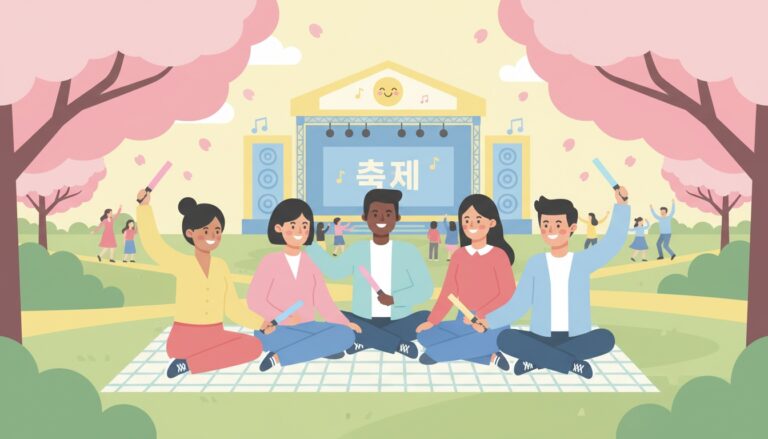
Have you ever watched a K-Drama where university students enjoy a huge outdoor concert, shouting and cheering? Or maybe you’ve seen the famous “Waterbomb Festival” on Instagram? 🎉
Spring and Autumn in Korea are the seasons of festivals (축제 – Chukje)! Whether it’s a jazz festival at the Hangang Park or a K-Pop concert, knowing how to enjoy it makes the experience 100x better.
Today, we will learn essential expressions to plan and enjoy an outdoor festival with your friends. Are you ready to scream? Let’s go! 😆🎤
Key Expressions
1. 같이 가자! (Gachi gaja!)
- Meaning: Let’s go together!
- Explanation: This is a casual way to invite a friend. If you want to be polite (to a coworker or senior), you should say “같이 가요 (Gachi gayo).”
- 💡 Pronunciation Tip:
- Wait, why does it sound like [Ga-chi] and not [Gat-i]?
- In Korean, when ‘ㅌ’ (t) meets ‘이’ (i), the sound changes to ‘치’ (chi). This is called Palatalization. So, pronounce it smoothly as [Ga-chi gaja]! 🗣️
2. 자리 맡자. (Jari matja.)
- Meaning: Let’s save a seat.
- Explanation: At outdoor festivals (like at the Han River), there are often no assigned chairs. You need to find a spot on the grass. You can say this when you want to claim a good spot before others do!
- 💡 Pronunciation Tip:
- The bottom consonant ‘ㅌ’ in ‘맡’ sounds like a ‘t’ (stop sound). When followed by ‘자’ (ja), the ‘j’ sound becomes tense/strong. Pronounce it like [Jari mat-jja].
3. 따라 부르자! (Ttara bureuja!)
- Meaning: Let’s sing along!
- Explanation: “따라 (Ttara)” means “follow,” and “부르자 (bureuja)” means “let’s sing.” Koreans love singing along at concerts. It’s almost a rule!
- 💡 Pronunciation Tip:
- Make sure to pronounce the double consonant ‘ㄸ’ (tt) with a strong, tense sound, like the ‘t’ in “stop” (without a puff of air).
Real Conversation
Situation: Mina and Paul are arriving at a beautiful outdoor music festival at the park. 🌳🎶
Mina: 와, 사람 진짜 많다! 같이 가자!
(Wa, saram jinjja manta! Gachi gaja!)
Wow, there are so many people! Let’s go together!
Paul: 응! 무대 앞쪽으로 갈까?
(Eung! Mudae apjjogeuro galkka?)
Yeah! Should we go toward the front of the stage?
Mina: 아니, 저기 나무 아래 자리 맡자.
(Ani, jeogi namu arae jari matja.)
No, let’s save a seat under that tree over there.
Paul: 좋아. 오늘 노래 다 아니까 크게 따라 부르자!
(Joa. Oneul norae da anikka keuge ttara bureuja!)
Good. I know all the songs today, so let’s sing along loudly!
Culture Tip: “Ddechang” (떼창) 🎤🔥
Have you heard of “Ddechang” (떼창)?
- 떼 (Dde): A large group / Crowd
- 창 (Chang): Singing
It refers to the unique Korean concert culture where the entire audience sings the whole song together along with the artist—not just the chorus! 😲
Many international pop stars (like Coldplay or Bruno Mars) are often shocked and moved to tears when they visit Korea because the fans sing every single word (even the guitar solos!). If you go to a festival in Korea, don’t be shy—singing loudly is how you show love to the artist! 💖
Conclusion & Quiz
Great job! Now you are ready to grab a picnic mat (돗자리) and enjoy a Korean festival. Don’t forget to practice the “magic sound” change in “Gachi” (Together)! 😉
📝 Mini Quiz
- How do you pronounce “같이” (Together)?
a) [Gat-i]
b) [Ga-chi] -
Fill in the blank: “Let’s save a spot on the grass!”
= 잔디밭에 ( ______ ) 맡자. -
True or False: In Korea, it is rude to sing along loudly at a concert.
( O / X )
[Answers]
1. b) [Ga-chi]
2. 자리 (Jari)
3. X (False! It’s called “Ddechang” and it’s encouraged!)
Frequently Asked Questions (FAQ)
Q: What does "같이 가자! (Gachi gaja!)" mean in Korean and how do you pronounce it?
A: In Korean, "같이 가자! (Gachi gaja!)" is pronounced [Tip:] and means: Let's go together!
Q: What does "자리 맡자. (Jari matja.)" mean in Korean and how do you pronounce it?
A: In Korean, "자리 맡자. (Jari matja.)" is pronounced [Tip:] and means: Let's save a seat.
Q: What does "따라 부르자! (Ttara bureuja!)" mean in Korean and how do you pronounce it?
A: In Korean, "따라 부르자! (Ttara bureuja!)" is pronounced [Tip:] and means: Let's sing along!







