

Annyeonghaseyo! 👋 Upgrade your Business Korean with Daily Hangul!
Hello, everyone! It’s your favorite Korean tutor, Daily Hangul! 🍎✨
Are you a fan of office K-dramas like “Misaeng” or “Start-Up”? You often see scenes where teams are frantically checking boxes before shipping products overseas, right? 🚢✈️
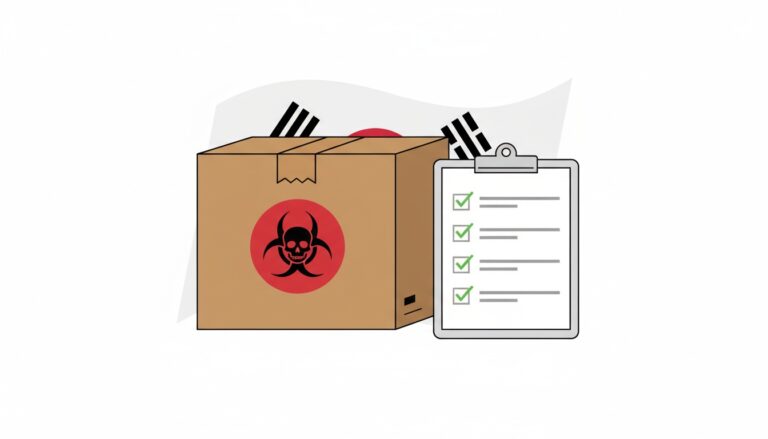
Today, we are going to learn some super useful expressions for “Global Supply Chain Management.” Specifically, we will talk about shipping hazardous materials safely! It sounds difficult, but don’t worry! I’ll make it easy and fun. Let’s become the smart manager in your own K-drama! 💼😎
📚 Key Expressions: Safe Shipping!
Here are 4 essential phrases you need when checking safety rules.
1. 위험물 (Wi-heom-mul)
- English: Hazardous material / Dangerous goods
- Meaning: This combines 위험 (Danger) + 물 (Object/Item). In a logistics context, it refers to items like batteries or chemicals that need special care.
- 💡 Pronunciation Tip: The ‘h’ sound in ‘heom’ is sometimes soft. Try saying it smoothly: [Wi-uhm-mul].
2. 규정 (Gyu-jeong)
- English: Regulation / Rule
- Meaning: These are the rules you must follow. In business, you often hear “International Regulations” as 국제 규정 (Guk-je Gyu-jeong).
- 💡 Pronunciation Tip: The ‘G’ is soft, like ‘k’ in ‘sky’.
3. 확인하다 (Hwa-gin-ha-da)
- English: To check / To confirm
- Meaning: The most common verb in business! You use this to ask if something has been reviewed.
- 💡 Pronunciation Tip: Liaison occurs here! The final consonant ‘ㄱ’ (k) moves to the next vowel block. It sounds like [Hwa-gi-na-da].
4. 지키다 (Ji-ki-da)
- English: To follow / To comply / To protect
- Meaning: While dictionaries might say ‘준수하다’ (comply – formal), in spoken office Korean, we often use 지키다 (to keep/follow the rules).
- Example: “규정을 지켜야 해요.” (We must follow the regulations.)
🗣️ Real Conversation: At the Logistics Office
Let’s see how Manager Kim (A) and Staff Lee (B) talk about a shipment.
Situation: Checking if a battery shipment follows international rules.
A (Manager Kim): 이 배터리, 위험물이죠?
(I bae-teo-ri, wi-heom-mul-i-jyo?)
This battery is a hazardous material, right?
B (Staff Lee): 네, 맞아요. 그래서 포장을 꼼꼼히 했어요.
(Ne, ma-ja-yo. Geu-rae-seo po-jang-eul kkom-kkom-hi haess-eo-yo.)
Yes, that’s correct. So I packed it very carefully.
A (Manager Kim): 국제 규정도 확인했나요?
(Guk-je gyu-jeong-do hwa-gin-haenn-na-yo?)
Did you check the international regulations too?
B (Staff Lee): 네! 규정을 잘 지켜서 보낼 거예요. 걱정 마세요!
(Ne! Gyu-jeong-eul jal ji-kyeo-seo bo-nael geo-ye-yo. Geok-jeong ma-se-yo!)
Yes! We will follow the rules well and send it. Don’t worry!
🇰🇷 Culture Tip: “Safety First” (안전 제일)
In Korea, you will see the phrase “안전 제일” (An-jeon Je-il) written in green and yellow at almost every construction site, factory, or logistics center. It means “Safety First.”
Even though Korea has a “Pali-pali” (Hurry, hurry!) culture, when it comes to Global Supply Chains and exports, following the rules is considered a matter of national pride and trust! Being fast is good, but being accurate (꼼꼼하다) is better in business!
📝 Wrap-up & Quiz
Great job today! You are now ready to handle dangerous goods like a pro. Let’s check what you remember!
Quiz: Fill in the blanks with the correct Korean word.
- Dangerous goods/materials: W______
- To check/confirm: H______
- Regulation: G______
Did you get them all? Keep practicing, and I’ll see you in the next lesson! Annyeong! 👋❤️
[Answers]
1. 위험물 (Wiheommul)
2. 확인하다 (Hwaganhaeda)
3. 규정 (Gyujeong)
Frequently Asked Questions (FAQ)
Q: What does "위험물 (Wi-heom-mul)" mean in Korean and how do you pronounce it?
A: In Korean, "위험물 (Wi-heom-mul)" is pronounced [Tip: The 'h' sound in 'heom' is sometimes soft. Try saying it smoothly: [Wi-uhm-mul] and means: This combines 위험 (Danger) + 물 (Object/Item). In a logistics context, it refers to items like batteries or chemicals that need special care.
Q: What does "규정 (Gyu-jeong)" mean in Korean and how do you pronounce it?
A: In Korean, "규정 (Gyu-jeong)" is pronounced [Tip: The 'G' is soft, like 'k' in 'sky'.] and means: These are the rules you must follow. In business, you often hear "International Regulations" as 국제 규정 (Guk-je Gyu-jeong).
Q: What does "확인하다 (Hwa-gin-ha-da)" mean in Korean and how do you pronounce it?
A: In Korean, "확인하다 (Hwa-gin-ha-da)" is pronounced [Tip: Liaison occurs here! The final consonant 'ㄱ' (k] and means: The most common verb in business! You use this to ask if something has been reviewed.
Q: What does "지키다 (Ji-ki-da)" mean in Korean and how do you pronounce it?
A: In Korean, "지키다 (Ji-ki-da)" is pronounced [see lesson guide] and means: While dictionaries might say '준수하다' (comply - formal), in spoken office Korean, we often use 지키다 (to keep/follow the rules).







