

Hello! It’s Daily Hangul (DailyHangul.com), here to upgrade your Korean skills! 🚀
안녕하세요! (Annyeonghaseyo!) 👋
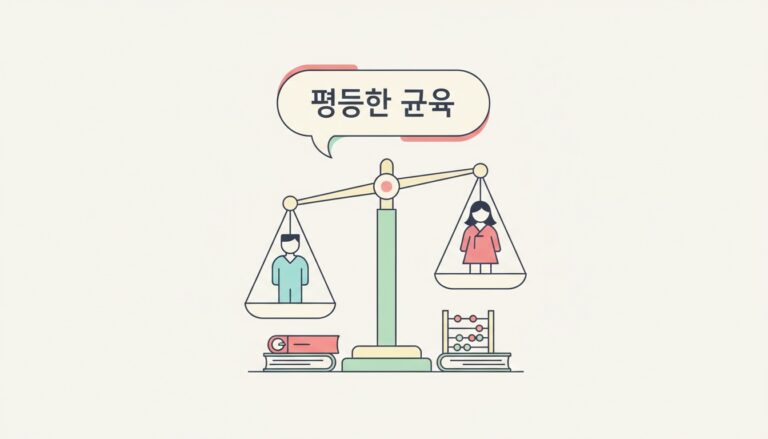
Today, we are going to dive into a slightly more serious but incredibly important topic: Global Citizenship and Gender Equality.
Have you watched K-dramas like “Extraordinary Attorney Woo” or “Search WWW”? These shows feature strong characters who fight for justice and fairness. To understand their passion and discuss social issues like a true global citizen, you need specific vocabulary!
Don’t worry, I’ve made it super easy for you. Let’s learn how to express opinions on equality and policies in Korean! Let’s go! (Gaja!) 🏃♀️💨
📚 Key Expressions
Here are 4 essential expressions to discuss gender equality policies.
1. 성평등 (Gender Equality)
- Pronunciation: [Seong-pyeong-deung]
- Meaning: Gender Equality
- Detail: ‘성’ (Seong) means gender/sex, and ‘평등’ (pyeong-deung) means equality. This is the core keyword for today’s topic. You will hear this often in news or serious debates.
- 💡 Pronunciation Tip: The ‘pyeong’ sound can be tricky. Make sure to pronounce the ‘ng’ (ㅇ) at the end softly in the throat.
2. 중요해요 (It is important)
- Pronunciation: [Jung-yo-hae-yo]
- Meaning: It is important
- Detail: When discussing policies, you want to emphasize your point. You can say “__ is important.” It comes from the adjective 중요하다 (to be important).
- 💡 Pronunciation Tip: In fast speech, ‘jung-yo’ often sounds like ‘jung-nyo’ due to nasalization, but sticking to [jung-yo] is perfectly fine for beginners!
3. 똑같이 (Equally / The same)
- Pronunciation: [Ttok-ka-chi]
- Meaning: Equally / The same way
- Detail: Use this when you want to say everyone should be treated the same. E.g., “Treat us equally.”
- 💡 Pronunciation Tip: Critical Rule! Even though it is written as ‘t-i’ (ㅌ+이), it is pronounced as [chi] (치). This rule is called Palatalization. So, never say “Ttok-gat-i”, say “Ttok-ka-chi”!
4. 바뀌어야 해요 (It needs to change)
- Pronunciation: [Ba-kkwi-eo-ya hae-yo]
- Meaning: It needs to change / It must change
- Detail: This uses the grammar pattern
~어야 하다(must/have to). Use this when suggesting that a policy or culture needs improvement.
🗣️ Real Conversation
Let’s see how these words are used in a conversation between two colleagues discussing workplace culture.
Minji: 우리 회사 정책이 좀 바뀌어야 해요.
[Uri hoesa jeongchaegi jom ba-kkwi-eo-ya hae-yo.]
(Our company policies need to change a bit.)
Alex: 맞아요. 성평등이 정말 중요해요.
[Majayo. Seong-pyeong-deung-i jeongmal jung-yo-hae-yo.]
(That’s right. Gender equality is really important.)
Minji: 모두에게 기회를 똑같이 줘야 한다고 생각해요.
[Moduege gihoereul ttok-ka-chi jwoya handago saeng-gak-hae-yo.]
(I think they should give opportunities to everyone equally.)
Alex: 저도 동의해요! 더 좋은 회사가 될 거예요.
[Jeodo dong-ui-hae-yo! Deo joeun hoesaga doel geo-ye-yo.]
(I agree too! It will become a better company.)
🇰🇷 Culture Tip: Parental Leave (육아휴직)
In the past, childcare was mostly seen as the mother’s role in Korea. However, things are changing! Nowadays, there is a policy called 육아휴직 (Yuka-hyujik), which is Parental Leave.
More and more Korean men are taking ‘Yuka-hyujik’ to share childcare responsibilities. It is a hot topic in Korea right now as the country tries to support working parents and improve gender equality. If you mention “Yuka-hyujik,” Koreans will be surprised by your deep cultural knowledge! 😲👍
📝 Wrap-up & Quiz
Today we learned how to speak up for a better world! Being a global citizen means being able to express these important values in any language.
Let’s test your knowledge!
- How do you pronounce 똑같이 (Equally)?
(A) Ttok-gat-i
(B) Ttok-ka-chi -
Fill in the blank: Gender equality is 성__.
(A) 평등 (pyeong-deung)
(B) 차별 (cha-byeol) -
True or False: 바뀌어야 해요 means “It is perfect already.”
( ) O / ( ) X
Answers:
1. (B) Ttok-ka-chi (Remember the ‘chi’ sound!)
2. (A) 평등
3. X (It means “It needs to change.”)
See you next time! 안녕! (Annyeong!) 👋
Frequently Asked Questions (FAQ)
Q: What does "성평등 (Gender Equality)" mean in Korean and how do you pronounce it?
A: In Korean, "성평등 (Gender Equality)" is pronounced [Seong-pyeong-deung] and means: Gender Equality
Q: What does "중요해요 (It is important)" mean in Korean and how do you pronounce it?
A: In Korean, "중요해요 (It is important)" is pronounced [Jung-yo-hae-yo] and means: It is important
Q: What does "똑같이 (Equally / The same)" mean in Korean and how do you pronounce it?
A: In Korean, "똑같이 (Equally / The same)" is pronounced [Ttok-ka-chi] and means: Equally / The same way
Q: What does "바뀌어야 해요 (It needs to change)" mean in Korean and how do you pronounce it?
A: In Korean, "바뀌어야 해요 (It needs to change)" is pronounced [Ba-kkwi-eo-ya hae-yo] and means: It needs to change / It must change







