

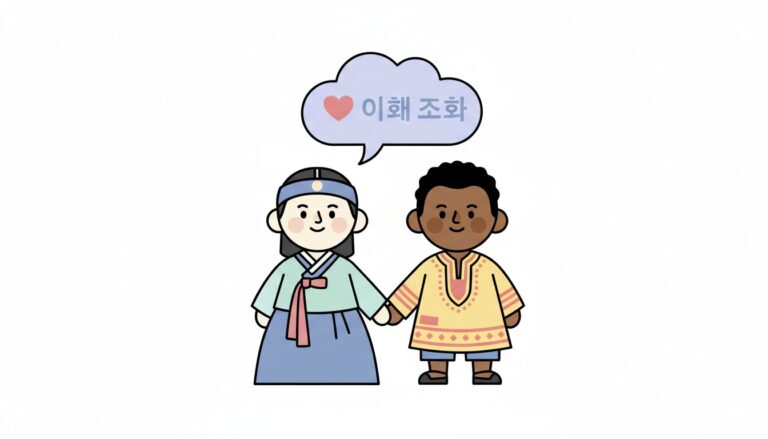
Introduction
Hello, everyone! It’s Daily Hangul here to upgrade your Korean skills! 😊👋
Have you ever watched a K-Drama where the main characters fight because they just don’t understand each other? Or maybe you’ve visited Korea and felt that some things were just… strange?
Today, we are diving into a very sophisticated topic but in a super easy way! We will learn how to talk about cultural differences without being rude. In academic terms, we are avoiding “ethnocentrism” (thinking your culture is the best). But in daily life, it’s simply about saying, “It’s not wrong, it’s just different!” 🌏✨
If you learn these expressions, you will sound like a very open-minded and kind person in Korean. Let’s start! 🚀
Core Expressions
Here are 3 essential phrases to show cultural respect and open-mindedness!
1. 다르다 (Dareuda)
- Pronunciation: [Dareuda]
- English Meaning: To be different
- Detail: This is the most important word today! Use this when you want to say something is not the same as what you are used to, but it’s okay.
- 💡 Pronunciation Tip: The ‘r’ in Dareuda is a soft flap, like the ‘tt’ in the American pronunciation of ‘butter’.
2. 틀리다 (Teullida)
- Pronunciation: [Teullida]
- English Meaning: To be wrong / incorrect
- Detail: This is the opposite of ‘correct’. Warning! Many Koreans mistakenly say “It is wrong” (틀렸어) when they actually mean “It is different” (달라). If you use Dareuda correctly instead of Teullida, you are already speaking better Korean than many natives! 😉
- 💡 Pronunciation Tip: The ‘ll’ sound is strong! Make sure your tongue touches the roof of your mouth firmly.
3. 그럴 수 있어 (Geureol su isseo)
- Pronunciation: [Geureol su isseo]
- English Meaning: That can happen / It’s possible / I understand
- Detail: This is a magic phrase for empathy! When someone does something you don’t understand, instead of judging them, you say this. It implies, “In your situation/culture, that makes sense.”
- 💡 Pronunciation Tip: Linking sound! Isseo sounds like [Is-seo].
Real-Life Conversation
Let’s see how to handle a cultural difference smoothly at a restaurant! 🍜
Situation: Alex is eating pizza with chopsticks, and Minji is surprised.
Minji: 알렉스, 왜 젓가락으로 피자를 먹어? 이상해!
(Alex, wae jeotgarageuro pijareul meogeo? Isanghae!)
Minji: Alex, why are you eating pizza with chopsticks? It’s weird!
Alex: 틀린 게 아니야. 그냥 문화가 다른 거야.
(Teullin ge aniya. Geunyang munhwaga dareun geoya.)
Alex: It’s not wrong. The culture is just different.
Minji: 아, 미안해. 네 말이 맞아. 그럴 수 있어.
(Ah, mianhae. Ne mari maja. Geureol su isseo.)
Minji: Ah, sorry. You’re right. That’s possible (I understand).
Alex: 이해해 줘서 고마워!
(Ihaehae jwoseo gomawo!)
Alex: Thanks for understanding!
Cultural Tip 🍯
“Different” vs. “Wrong” in the Korean Mindset
In Korea, because it was a homogeneous society for a long time, people sometimes use the word 틀리다 (wrong) when they actually mean 다르다 (different).
For example, a friend might say, “Your opinion is wrong (ni saenggageun teullyeosseo),” but they really just mean your opinion is different from theirs.
If you hear this in a drama or real life, don’t get offended! They probably just made a common vocabulary mistake. However, as a learner of “Daily Hangul,” you should try to use 다르다 (different) correctly to show respect for diversity! 🌈
Conclusion & Quiz
Today we learned how to respect other cultures using Korean! Remember, being different is never wrong. 😊
Pop Quiz! (True or False)
- 틀리다 (Teullida) means “to be different.” (O / X)
- If you see a culture you don’t know, it is polite to say “그럴 수 있어” (Geureol su isseo). (O / X)
- You should judge people who are different from you. (O / X)
Answers:
1. X (It means “to be wrong”! Use Darda for different.)
2. O (It shows understanding.)
3. X (We should respect differences!)
See you next time! 안녕! 👋
Frequently Asked Questions (FAQ)
Q: What does "다르다 (Dareuda)" mean in Korean and how do you pronounce it?
A: In Korean, "다르다 (Dareuda)" is pronounced [Dareuda] and means: To be different
Q: What does "틀리다 (Teullida)" mean in Korean and how do you pronounce it?
A: In Korean, "틀리다 (Teullida)" is pronounced [Teullida] and means: To be wrong / incorrect
Q: What does "그럴 수 있어 (Geureol su isseo)" mean in Korean and how do you pronounce it?
A: In Korean, "그럴 수 있어 (Geureol su isseo)" is pronounced [Geureol su isseo] and means: That can happen / It's possible / I understand







