

Introduction
Hello! It’s Daily Hangul (DailyHangul.com), here to upgrade your Korean skills! 🌟
Are you a fan of BTS? If you follow RM, you know he loves visiting art museums. This hobby is even called “Namjooning”! 🖼️ If you visit Korea, you might want to go “Namjooning” at the National Museum of Korea or the Leeum Museum of Art.
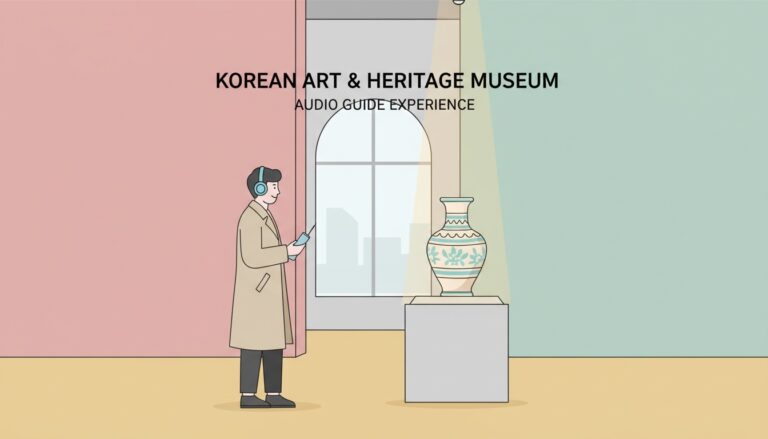
But wait, what if the descriptions are only in Korean? Don’t worry! Today, we will learn how to rent an audio guide so you can fully enjoy the beautiful Korean art without a language barrier. Let’s get started! 🎧
Core Expressions
Here are 3 essential phrases you need at the information desk.
1. 오디오 가이드 있어요? (Audio guide isseoyo?)
- English: Do you have an audio guide?
- Explanation: This is the first thing you ask. “Isseoyo?” means “Do you have?” or “Is there?”. You can put any noun before it!
- 💡 Pronunciation Tip: In Isseoyo [이써요], the ‘ss’ (ㅆ) sound carries over to the next empty vowel spot. So it sounds like i-sseo-yo, not it-eo-yo.
2. 영어 돼요? (Yeong-eo dwaeyo?)
- English: Is it available in English? (Does English work?)
- Explanation: “Yeong-eo” is English. “Dwaeyo?” literally means “Does it work?” or “Is it possible?”. This is a magic word in Korea! You can use it to ask if something is allowed or available.
- 💡 Pronunciation Tip: Dwaeyo [돼요] can be tricky. It sounds very similar to the English word “Day” but with a ‘w’ at the start. Try saying “D-wae-yo” quickly.
3. 하나 빌려주세요. (Hana billyeojuseyo.)
- English: Please lend me one.
- Explanation: “Hana” means one. “Billyeojuseyo” is a polite way to say “Please lend me.” If you are with a friend, you can say “Dul (two) billyeojuseyo.”
- 💡 Pronunciation Tip: In Billyeojuseyo [빌려주세요], the double ‘l’ (ㄹㄹ) sound is important. Make sure your tongue touches the roof of your mouth firmly, like the ‘l’ in “Lily.”
Real Conversation
Imagine you are at the museum ticket desk. Let’s see how to use these phrases!
🧑💼 Staff: 안녕하세요. (Annyeonghaseyo. / Hello.)
👤 You: 안녕하세요! 혹시 오디오 가이드 있어요? (Annyeonghaseyo! Hoksi audio guide isseoyo?)
🧑💼 Staff: 네, 있습니다. (Ne, isseumnida. / Yes, we have them.)
👤 You: 영어 돼요? (Yeong-eo dwaeyo?)
🧑💼 Staff: 네, 영어 가능합니다. (Ne, Yeong-eo ganeunghamnida. / Yes, English is available.)
👤 You: 좋아요. 하나 빌려주세요. (Joayo. Hana billyeojuseyo.)
Culture Tip 🇰🇷
“Please leave your ID!”
When you rent an audio guide or a stroller in Korea, the staff will often ask you to leave a form of ID (Identification) as a deposit. 🪪
Don’t be surprised if they say, “Sinbunjeung matgyeojuseyo” (Please leave your ID). As a foreigner, your Passport or Alien Registration Card (ARC) works perfectly. They will give it back to you safely when you return the device!
Conclusion & Quiz
Great job! Now you are ready to enjoy Korean history and art with an English explanation in your ear! 🏛️✨
Let’s check what we learned today:
📝 Mini Quiz
1. Fill in the blank: “Do you have an audio guide?” = 오디오 가이드 ( ______ )?
2. True or False: “Dwaeyo?” means “Hello”. ( O / X )
3. Which item do you often need to leave as a deposit? ( Money / Passport )
⬇️ Answers
1. 있어요 (Isseoyo)
2. X (It means “Does it work?” or “Is it possible?”)
3. Passport
Frequently Asked Questions (FAQ)
Q: What does "오디오 가이드 있어요? (Audio guide isseoyo?)" mean in Korean and how do you pronounce it?
A: In Korean, "오디오 가이드 있어요? (Audio guide isseoyo?)" is pronounced [Tip: In Isseoyo [이써요] and means: a key conversational Korean expression covered in this lesson.
Q: What does "영어 돼요? (Yeong-eo dwaeyo?)" mean in Korean and how do you pronounce it?
A: In Korean, "영어 돼요? (Yeong-eo dwaeyo?)" is pronounced [Tip: Dwaeyo [돼요] and means: a key conversational Korean expression covered in this lesson.
Q: What does "하나 빌려주세요. (Hana billyeojuseyo.)" mean in Korean and how do you pronounce it?
A: In Korean, "하나 빌려주세요. (Hana billyeojuseyo.)" is pronounced [Tip: In Billyeojuseyo [빌려주세요] and means: a key conversational Korean expression covered in this lesson.







