

Introduction
Annyeonghaseyo! (안녕하세요!) Hello! It’s Daily Hangul, here to upgrade your Korean skills! 🌟
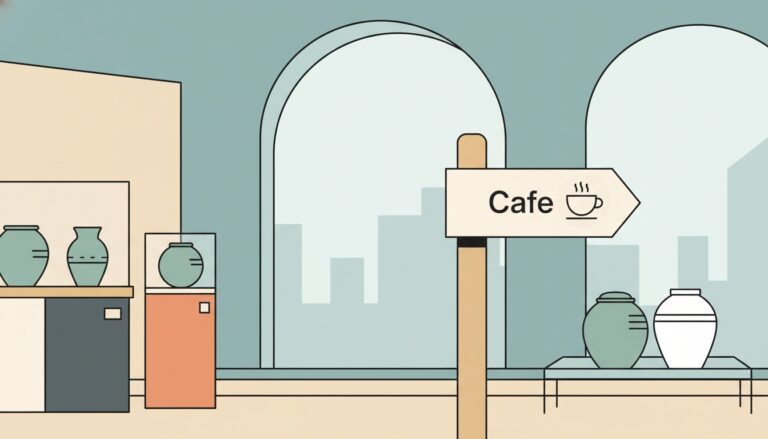
Imagine this: You are exploring the beautiful National Museum of Korea, just like the main characters in a romantic K-Drama date scene. 🏛️❤️ But after walking around for an hour, your legs are tired, and you desperately need an Iced Americano or a sweet rest.
How do you ask the staff where the cafe is? Don’t worry! Today, we will learn the essential survival phrases to find a cafe inside a museum or art gallery. Let’s get that coffee! ☕💪
Key Expressions
Here are 4 useful expressions to help you navigate!
1. 카페가 어디에 있어요?
- Pronunciation: [Kape-ga eodi-e isseoyo?]
- English Meaning: Where is the cafe?
- Detail: This is the most direct way to ask for a location.
- Cafe = Cafe (Easy, right?)
- Eodi-e = Where / At where
- Isseoyo? = Is there? / Do you have?
- 💡 Pronunciation Tip: In Korean, the subject marker ‘가 (ga)’ attaches to the noun. So it flows like “Kape-ga”. Try to say it smoothly without pausing between the word and the marker!
2. 몇 층이에요?
- Pronunciation: [Myeot cheung-i-e-yo?]
- English Meaning: Which floor is it on?
- Detail: Museums are often huge! You need to know the specific floor.
- Myeot = How many / Which (number)
- Cheung = Floor
- 💡 Pronunciation Tip: The ‘Cheung’ (층) sound can be tricky. It’s an aspirated ‘Ch’ sound, like the ‘ch’ in ‘cheese’ but with a strong burst of air.
3. 저쪽으로 가세요.
- Pronunciation: [Jeojjog-euro gaseyo.]
- English Meaning: Please go that way.
- Detail: You might hear this as an answer.
- Jeojjok = That side / Over there
- Gaseyo = Please go
- 💡 Pronunciation Tip: The double ‘jj’ in ‘Jeojjok’ is a tense sound. Tense your tongue and say it sharply!
4. 잠깐 쉬고 싶어요.
- Pronunciation: [Jamkkan swigo sipeoyo.]
- English Meaning: I want to rest for a moment.
- Detail: Use this if you want to tell your friend why you are looking for a cafe.
- Jamkkan = For a moment
- Swigo sipeoyo = I want to rest
Real-Life Dialogue
Let’s see how this works in real life! You (A) are asking a museum staff member (B) for help.
A: 저기요! 혹시 여기에 카페 있어요?
(Jeogiyo! Hoksi yeogi-e kape isseoyo?)
Excuse me! Is there a cafe here by any chance?
B: 네, 있어요.
(Ne, isseoyo.)
Yes, there is.
A: 카페가 어디에 있어요?
(Kape-ga eodi-e isseoyo?)
Where is the cafe?
B: 2층에 있어요. 저쪽으로 가세요.
(I-cheung-e isseoyo. Jeojjog-euro gaseyo.)
It’s on the 2nd floor. Please go that way.
A: 감사합니다!
(Gamsahamnida!)
Thank you!
Cultural Tip 🇰🇷
Did you know about the “Museum Goods”? 🎁
In Korea, museum cafes are often located right next to the Souvenir Shop (Ginyuempum-jeom). Lately, Korean museum merchandise (called “Goods” 굿즈) has become super trendy among young Koreans because of its beautiful, modern designs based on traditional artifacts!
So, after you grab your coffee, make sure to look around the shop. You might find a cute keychain or notebook that RM from BTS might love too! 😉
Wrap-up & Quiz
Great job today! Now you can find caffeine and rest anywhere in Korea. Let’s check if you remember the key phrase!
Pop Quiz! Fill in the blank:
Q: You want to ask
Frequently Asked Questions (FAQ)
Q: What does "카페가 어디에 있어요?" mean in Korean and how do you pronounce it?
A: In Korean, "카페가 어디에 있어요?" is pronounced [Kape-ga eodi-e isseoyo?] and means: Where is the cafe?
Q: What does "몇 층이에요?" mean in Korean and how do you pronounce it?
A: In Korean, "몇 층이에요?" is pronounced [Myeot cheung-i-e-yo?] and means: Which floor is it on?
Q: What does "저쪽으로 가세요." mean in Korean and how do you pronounce it?
A: In Korean, "저쪽으로 가세요." is pronounced [Jeojjog-euro gaseyo.] and means: Please go that way.
Q: What does "잠깐 쉬고 싶어요." mean in Korean and how do you pronounce it?
A: In Korean, "잠깐 쉬고 싶어요." is pronounced [Jamkkan swigo sipeoyo.] and means: I want to rest for a moment.






