

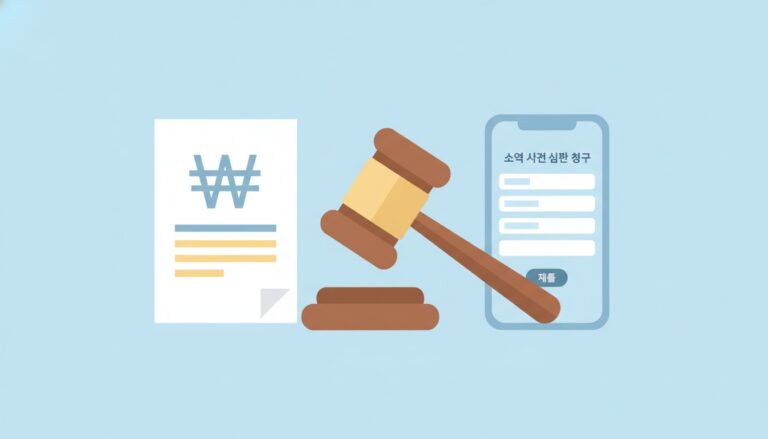
Fight for Your Rights! ⚖️ Easy Korean for Small Claims
1. Intro
Hello, everyone! It’s your friendly Korean tutor, Daily Hangul! 👋
Have you ever bought something online that never arrived? Or maybe you lent money to someone who refuses to pay it back? 😱 In K-Dramas, you often see characters shouting, “I’ll sue you!” (고소할 거야!).
Today, we are learning about Consumer Rights and a very useful system in Korea called “Small Claims Court”. It sounds difficult, but it’s actually a fast and simple way to solve problems involving money (usually under 30 million KRW). Let’s learn the essential words to protect yourself! 💪
2. Key Expressions 🔑
Here are 4 key words you need when facing a consumer dispute!
1. 소액 사건
- Pronunciation: [So-aek sa-geon]
- Meaning: Small claims case (literally: Small amount incident)
- Explanation: This refers to a lawsuit for claiming money below 30 million won. It is much faster and cheaper than a regular trial.
- 💡 Pronunciation Tip: The ‘ㅅ’ in 사건 sounds strong. Imagine saying ‘Sa-geon’.
2. 증거
- Pronunciation: [Jeung-geo]
- Meaning: Evidence
- Explanation: To win any dispute, you need proof! This can be chat logs, receipts, or photos.
- 💡 Pronunciation Tip: ‘Jeung’ sounds like the ‘ju’ in ‘ju’ngle + ‘ng’.
3. 접수하다
- Pronunciation: [Jeop-su-ha-da]
- Meaning: To file / To submit / To receive (an application)
- Explanation: You use this verb when you submit your complaint to the court or a consumer agency.
- 💡 Pronunciation Tip: [Jeop-ssu-ha-da]. Because of the ‘ㅂ’ (p) sound at the end of 접 (Jeop), the following ‘수’ (su) is pronounced strongly as ‘ssu’ (tense sound)!
4. 해결하다
- Pronunciation: [Hae-gyeol-ha-da]
- Meaning: To resolve / To solve
- Explanation: The goal of all this! You want to “resolve” the problem and get your money back.
3. Real-life Conversation 🗣️
Situation: Minji bought a laptop online, but the seller disappeared. She is talking to her friend, Sumi.
Minji: 노트북을 샀는데 판매자가 연락이 안 돼. ㅠㅠ
(I bought a laptop, but I can’t contact the seller.)
[Noteu-bugeul sat-neunde panmae-jaga yeollagi an dway.]
Sumi: 정말? 증거는 있어?
(Really? Do you have evidence?)
[Jeongmal? Jeung-geoneun isseo?]
Minji: 응, 채팅 기록이랑 입금 내역 있어.
(Yes, I have chat logs and transfer records.)
[Eung, chaeting girok-irang ipgeum naeyeok isseo.]
Sumi: 그럼 법원에 소액 사건으로 접수해! 금방 해결될 거야.
(Then file it as a small claims case at the court! It will be resolved quickly.)
[Geureom beob-wone so-aek sa-geoneuro jeop-su-hae! Geumbang hae-gyeol-dwel geoya.]
4. Culture Tip & K-Drama 🎬
Did you know? Korea has “Electronic Litigation” (전자소송)! 🖥️
Unlike the dramatic scenes in “Law School” or “Vincenzo” where lawyers run into the courtroom, in Korea, you can file a small claims lawsuit 100% online! You don’t even have to visit the court if you have a public certificate (digital ID).
Also, if going to court feels too scary, you can contact the Korea Consumer Agency (1372) first. They help mediate disputes before they go to court! 📞
5. Wrap-up & Quiz 📝
Don’t let bad sellers bully you! Now you know the words to fight back. Let’s practice!
Quiz: Fill in the blanks!
- To win a case, you need photos or receipts as ( _______ ).
- If the money is under 30 million won, it is a ( _______ ) case.
- I will ( _______ ) my complaint to the court today.
(Options: 소액 / 접수하다 / 증거)
⬇️ Answers ⬇️
- 증거 (Evidence)
- 소액 (Small amount)
- 접수하다 (File/Submit)
See you next time! 안녕! 👋
Frequently Asked Questions (FAQ)
Q: What does "증거" mean in Korean and how do you pronounce it?
A: In Korean, "증거" is pronounced [Jeung-geo] and means: Evidence
Q: What does "접수하다" mean in Korean and how do you pronounce it?
A: In Korean, "접수하다" is pronounced [Jeop-su-ha-da] and means: To file / To submit / To receive (an application)
Q: What does "해결하다" mean in Korean and how do you pronounce it?
A: In Korean, "해결하다" is pronounced [Hae-gyeol-ha-da] and means: To resolve / To solve







