

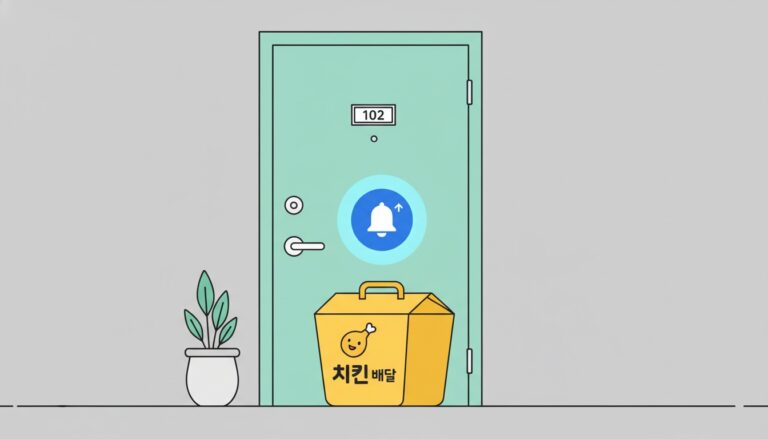
🛵 Delivery Korean: “Leave it at the door!”
👋 Hello! It’s Daily Hangul!
Hello, K-Culture fans! I’m your friendly Korean tutor, Daily Hangul! 🍎
Have you ever ordered delivery food (Baedal Eumsik) in Korea? Maybe you’ve seen K-Drama characters eating delicious Fried Chicken (Chimaek) or Tteokbokki at home. 🍗
But wait! What if you are in your pajamas, have a face mask on, or just feel too shy to meet the delivery rider face-to-face? 😱 Don’t worry! Today, we will learn the magic phrases to receive your food safely and comfortably without opening the door while the rider is there.
Let’s upgrade your Korean survival skills! 🚀
🗣️ Key Expressions
1. 문 앞에 두고 가 주세요.
- Pronunciation: [Mun ape dugo ga juseyo]
- Meaning: Please leave it in front of the door.
- Detail: This is the most useful phrase for delivery apps! You can write this in the “Request to Rider” (라이더님께 요청사항) box. It is polite and very common these days.
- 💡 Pronunciation Tip:
- Linking Sound: When you say 문 앞에 (Mun ape), the ‘n’ sound moves over. It sounds more like [Mu-na-pe]. Try to say it smoothly!
2. 벨 누르지 말아 주세요.
- Pronunciation: [Bel nureuji mara juseyo]
- Meaning: Please don’t ring the bell.
- Detail: Do you have a sleeping baby or a barking dog? Or maybe it’s late at night? Use this phrase! “Bel” comes from the English word “Bell.”
- 💡 Pronunciation Tip:
- Double ‘L’: In 벨 (Bel), make sure your tongue touches the roof of your mouth firmly.
3. 도착하면 문자 주세요.
- Pronunciation: [Dochakamyeon munja juseyo]
- Meaning: Please text me when you arrive.
- Detail: If you asked them not to ring the bell, you need to know when the food arrives, right? This phrase asks for a text message (Munja).
- 💡 Pronunciation Tip:
- Hard Sound: In 도착하면 (Dochakamyeon), the ‘k’ (ㄱ) and ‘h’ (ㅎ) meet to make a strong ‘K’ sound. It sounds like [Do-cha-ka-myeon].
💬 Real-life Conversation
Situation: Soo-min is ordering Chicken on a delivery app and writing a note to the rider.
(In the App – Request Note)
* Soo-min: 문 앞에 두고 가 주세요. (Please leave it in front of the door.)
* Soo-min: 벨 누르지 말아 주세요. 강아지가 짖어요. 🐶 (Please don’t ring the bell. The dog barks.)
(30 minutes later – Text Message 📱)
* Rider: 배달 완료했습니다. 문 앞에 두었습니다. (Delivery complete. I left it in front of the door.)
* Soo-min: 감사합니다! (Thank you!)
🇰🇷 Culture Tip & K-Drama Vibes
The “Untact” (Non-contact) Culture
Since the pandemic, “Bi-dae-myeon” (비대면 – Non-face-to-face) delivery has become a standard culture in Korea. In apps like Baedal Minjok or Coupang Eats, there is often a checkbox that says “Please leave it at the door.”
So, if you see a K-Drama character opening the door to find a bag of food on the floor, don’t be surprised! It’s not rude; it’s considered considerate and safe for both the customer and the rider. You are now ready to order like a local! 🛵💨
📝 Wrap-up & Quiz
Today we learned how to ask the rider to leave the food at the door. Let’s practice!
Q1. Fill in the blank:
“Please leave it in front of the door.”
= ______ 앞에 두고 가 주세요. (______ ape dugo ga juseyo.)
Q2. True or False?
It is rude to ask a Korean delivery rider to leave food at the door without meeting them.
( O / X )
⬇️ Check your answers below!
Answers:
1. 문 (Mun) – Door
2. X (False) – It is a very common and accepted culture called “Untact” delivery!
Frequently Asked Questions (FAQ)
Q: What does "문 앞에 두고 가 주세요." mean in Korean and how do you pronounce it?
A: In Korean, "문 앞에 두고 가 주세요." is pronounced [Mun ape dugo ga juseyo] and means: Please leave it in front of the door.
Q: What does "벨 누르지 말아 주세요." mean in Korean and how do you pronounce it?
A: In Korean, "벨 누르지 말아 주세요." is pronounced [Bel nureuji mara juseyo] and means: Please don't ring the bell.
Q: What does "도착하면 문자 주세요." mean in Korean and how do you pronounce it?
A: In Korean, "도착하면 문자 주세요." is pronounced [Dochakamyeon munja juseyo] and means: Please text me when you arrive.







