

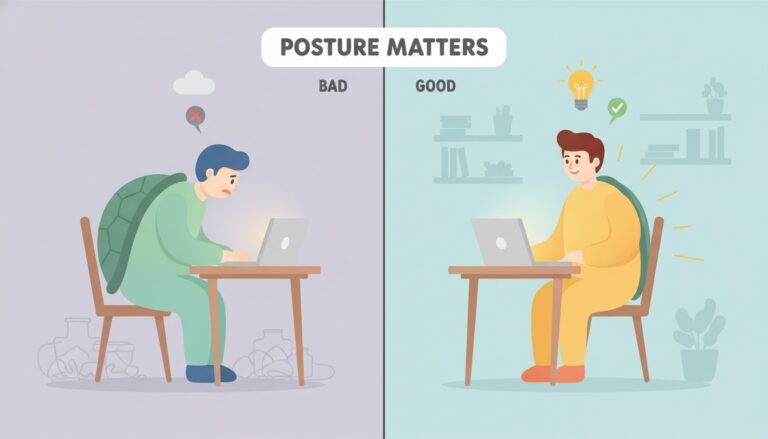
Stand Tall Like a K-Star! 🌟 Posture Tips
👋 Introduction
Hello! It’s Daily Hangul, here to upgrade your Korean skills! 🚀
Do you love binge-watching K-Dramas all weekend? Or maybe you study Korean for hours at your desk? If so, your neck might be screaming for help! 😱
Today, we are going to learn expressions about Posture Correction. In Korea, having a “good posture” is often associated with confidence and elegance—just like those charismatic CEOs or K-Pop idols we see on screen. Let’s learn how to talk about fixing our posture so we can look and feel great! 💪
📚 Key Expressions
1. 허리를 펴세요
- Pronunciation: [Heori-reul pyeoseyo]
- Meaning: Please straighten your back.
- Description: This is the most common phrase used in yoga classes, hospitals, or by concerned parents! ‘허리 (heori)’ means waist/back, and ‘펴다 (pyeoda)’ means to unfold or straighten.
- 💡 Pronunciation Tip: When you say ‘허리를’, the sound flows together like [Heorireul] because of the linking rule. Smoothly connect the sounds!
2. 거북목
- Pronunciation: [Geobungmok]
- Meaning: Turtle neck (Text neck syndrome)
- Description: This is a very interesting Korean word! 🐢 ‘거북 (Geobuk)’ means turtle, and ‘목 (mok)’ means neck. It refers to the posture where your head pokes forward like a turtle because of looking at smartphones too much.
- 💡 Pronunciation Tip: Watch out! It is written as ‘Geobukmok’, but pronounced [Geobungmok]. The ‘ㄱ’ (k) sound changes to an ‘ㅇ’ (ng) sound because it meets ‘ㅁ’ (m). This is called Nasalization.
3. 자세가 좋아요
- Pronunciation: [Jasega joayo]
- Meaning: Your posture is good.
- Description: Want to compliment someone? Use this! ‘자세 (Jase)’ means posture. You can also say “자세가 안 좋아요” (Your posture is bad).
- 💡 Pronunciation Tip: The ‘ㅎ’ in ‘좋아요’ is weak. It sounds more like [Joayo].
🗣️ Real-life Conversation
Situation: Two friends, Minji and Jason, are studying at a cafe.
Jason: 아, 목이 너무 아파요.
[A, mogi neomu apayo.]
(Ah, my neck hurts so much.)
Minji: 너 거북목 같아! 스마트폰 그만 봐.
[Neo Geobungmok gata! Seumateupon geuman bwa.]
(You look like you have turtle neck! Stop looking at your smartphone.)
Jason: 진짜? 어떻게 해야 해?
[Jinjja? Eotteoke haeya hae?]
(Really? What should I do?)
Minji: 허리를 펴고 앉아. 스트레칭 하자!
[Heori-reul pyeogo anja. Seuteureching haja!]
(Sit with your back straight. Let’s stretch!)
🎭 Culture Tip & Drama Scene
🐢 The “Turtle Neck” Check
In Korea, people are very conscious of Geobungmok (Turtle neck). You will often see ads for “Geobungmok Correction Pillows” or clinics on the subway!
🎬 Drama Context:
Have you seen the drama “What’s Wrong with Secretary Kim”? Park Seo-joon (Vice Chairman Lee) always walks with his chest out and back straight. That ‘자세가 좋은’ (good posture) look is a key visual trait to show confidence and high status in K-Dramas. If you want to look like a main character, start by straightening your back! ✨
📝 Wrap-up & Quiz
Great job today! Now you can take care of your health while speaking Korean. Remember to sit straight while studying! 😉
Let’s check what you learned:
- What is the Korean word for “Turtle neck” (Text neck)?
( Hint: 🐢 + Neck ) - Translate this sentence: “Heori-reul pyeoseyo.”
[Answers]
1. 거북목 (Geobungmok)
2. Please straighten your back.
See you next time! 안녕! 👋
Frequently Asked Questions (FAQ)
Q: What does "허리를 펴세요" mean in Korean and how do you pronounce it?
A: In Korean, "허리를 펴세요" is pronounced [Heori-reul pyeoseyo] and means: Please straighten your back.
Q: What does "거북목" mean in Korean and how do you pronounce it?
A: In Korean, "거북목" is pronounced [Geobungmok] and means: Turtle neck (Text neck syndrome)
Q: What does "자세가 좋아요" mean in Korean and how do you pronounce it?
A: In Korean, "자세가 좋아요" is pronounced [Jasega joayo] and means: Your posture is good.







