

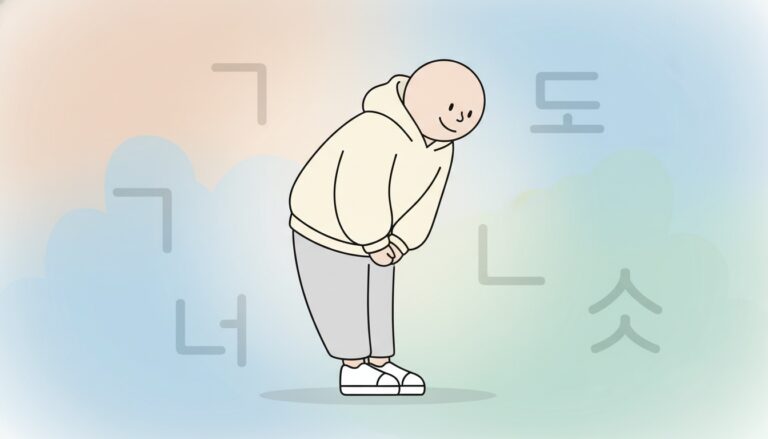
1. Introduction
Annyeonghaseyo! (안녕하세요!) 👋 Welcome back to [Daily Hangul], your best friend for learning Korean!
Have you ever watched a K-Drama and noticed how characters bow their heads while smiling shyly? Today, we are going to learn the most heartwarming expressions in any language: Thanking for Help!
Whether someone picks up your dropped phone or gives you directions to the best Tteokbokki place, knowing how to say “Thank you” properly is the key to showing your kindness. Plus, if you say it naturally, Koreans might mistake you for a local! Let’s dive in! 🚀
2. Key Expressions
Here are the top 3 ways to say “Thank you” depending on who you are talking to!
1️⃣ 감사합니다 (Gamsahamnida)
- Pronunciation: [Gam-sa-ham-ni-da]
- Meaning: Thank you (Formal & Polite)
- Explanation: This is the standard, most common way to say thank you to strangers, elders, or in formal settings. It comes from Sino-Korean words. You will hear this everywhere!
2️⃣ 고마워요 (Gomawoyo)
- Pronunciation: [Go-ma-wo-yo]
- Meaning: Thank you (Polite but friendly)
- Explanation: This is a native Korean expression. It is polite because it ends with ‘yo’ (요), but it sounds a bit softer and friendlier than ‘Gamsahamnida’. Use this with neighbors or colleagues you are close with.
3️⃣ 고마워 (Gomawo)
- Pronunciation: [Go-ma-wo]
- Meaning: Thanks (Casual / Informal)
- Explanation: This is Banmal (casual language). Only use this with close friends, people younger than you, or your boyfriend/girlfriend!
- K-Drama Tip: When the male lead whispers “Gomawo” to the female lead, it’s a romantic moment! 😍
💡 Pronunciation Tip (Honey Tip! 🍯)
Let’s look at 감사합니다 (Gamsahamnida).
Did you notice the spelling is ‘Hap-ni-da’ (합니다) but we say ‘Ham-ni-da’?
* Rule: When the final consonant ㅂ (b/p) meets the initial consonant ㄴ (n), the sound changes to ㅁ (m) for smoother flow.
* Practice: Don’t say “Gam-sa-hap-ni-da.” Say “Gam-sa-ham-ni-da!” It’s much easier, right?
3. Real-life Conversation
Imagine you are traveling in Seoul and you dropped your wallet. A kind stranger picks it up for you.
(Situation: On the street)
- Stranger: 저기요, 지갑 떨어뜨리셨어요!
- (Jeogiyo, jigap tteoreotteurisyeosseoyo!)
- Excuse me, you dropped your wallet!
- You: 아! 정말 감사합니다!
- (Ah! Jeongmal gamsahamnida!)
- Oh! Thank you so much!
- Stranger: 아니에요. 조심하세요. 😊
- (Anieyo. Josimhaseyo.)
- No problem. Be careful.
- You: 네, 도와주셔서 고맙습니다.
- (Ne, dowajusyeoseo gomapseumnida.)
- Yes, thank you for your help.
4. Culture Tip & K-Drama Scene 🎬
The Magical Bow (Insa) 🙇♂️
In Korea, words are not enough! To show true gratitude, you must coordinate your body language.
- The Angle Matters: When saying “Gamsahamnida,” you should bow your head slightly. For elders or someone you respect deeply, bow about 45 degrees.
- Hand Gesture: Sometimes, you might see people putting their hand on their chest while bowing. This shows sincerity and “heartfelt” thanks.
Drama Scene: Think of the scene in Crash Landing on You where Se-ri thanks the soldiers. Even in funny situations, the bow is essential!
5. Wrap-up & Quiz
Today we learned how to express gratitude like a true Korean! Remember, a smile and a bow make your “Thank you” perfect.
📝 Mini Quiz
1. Which phrase should you use with your teacher?
A) 고마워 (Gomawo)
B) 감사합니다 (Gamsahamnida)
- Which phrase is suitable for your best friend?
A) 고마워 (Gomawo)
B) 감사합니다 (Gamsahamnida) -
True or False: You should pronounce ‘Gamsahamnida’ with a strong ‘P’ sound like ‘Gamsahapnida’.
( )
Answers:
1. B
2. A
3. False (It sounds like ‘m’ – Hamnida!)






