

Hello! It’s Daily Hangul! 👋
Annyeonghaseyo, everyone! This is your friendly Korean tutor, Daily Hangul! 😊
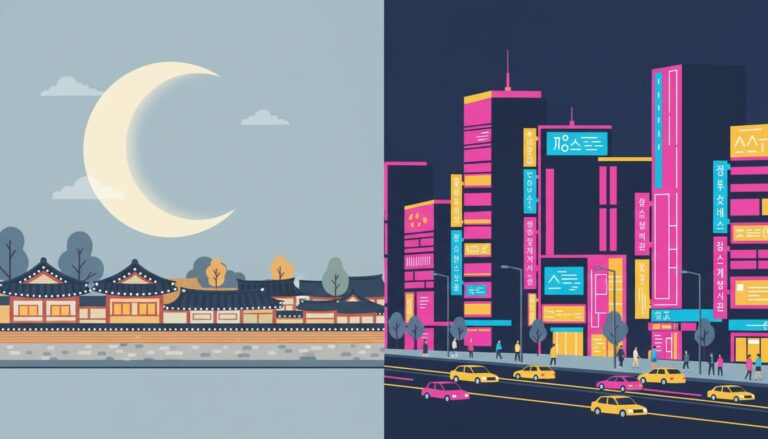
When you introduce your hometown or the city you currently live in, what do you usually say? Is it a bustling city that never sleeps, like the background of Itaewon Class? Or is it a peaceful, quiet village like in Hometown Cha-Cha-Cha? 🌊
Today, we are going to learn how to describe the atmosphere of a city. After this lesson, you’ll be able to tell your Korean friends exactly what your neighborhood feels like! Let’s dive in! 🚀
3 Key Expressions 🔑
Here are the most common adjectives to describe a place’s vibe!
1. 조용해요 (It’s quiet)
- Pronunciation: [Joyonghaeyo]
- English Meaning: It is quiet / It is peaceful.
- Detail: Use this when describing a library, a park, or a peaceful countryside. If you like relaxing environments, this is your word!
- 💡 Pronunciation Tip: The ‘ㅎ’ (h) sound in ‘해’ is very weak. Often, it sounds smoother, almost like [Joyongaeyo].
2. 시끄러워요 (It’s noisy)
- Pronunciation: [Sikkeureowoyo]
- English Meaning: It is noisy / It is loud.
- Detail: Use this for places with lots of cars, construction, or loud music. You might hear this in dramas when someone complains about their loud neighbors!
- 💡 Pronunciation Tip: The ‘ㄲ’ (kk) is a tense double consonant. You need to tense your throat and make a sharp, strong ‘k’ sound without letting air out. It’s not soft!
3. 복잡해요 (It’s crowded / complicated)
- Pronunciation: [Bokjaphaeyo]
- English Meaning: It is crowded / It is busy.
- Detail: Literally, it means “complicated,” but when talking about a city, it means there are too many people or cars. Think of the Gangnam subway station during rush hour! 😱
- 💡 Pronunciation Tip: When ‘ㅂ’ (b/p) meets ‘ㅎ’ (h), they combine to make a ‘ㅍ’ (p) sound. So, pronounce it as [Bok-ja-pae-yo].
Real Conversation Practice 🗣️
Let’s see how Min-su and Sarah talk about Sarah’s new neighborhood.
Min-su: 사라 씨, 동네는 어때요? 조용해요?
(Sarah, how is your neighborhood? Is it quiet?)
[Sara ssi, dongneneun eottaeyo? Joyonghaeyo?]
Sarah: 아니요, 시장이 있어서 조금 시끄러워요.
(No, there is a market, so it’s a little noisy.)
[Aniyo, sijang-i isseoseo jogeum sikkeureowoyo.]
Min-su: 아, 사람이 많아요?
(Ah, are there many people?)
[Ah, sarami manayo?]
Sarah: 네, 주말에는 정말 복잡해요.
(Yes, on weekends, it’s really crowded.)
[Ne, jumareneun jeongmal bokjaphaeyo.]
Culture Tip & K-Drama Vibes 🎭
🏙️ The “Yeok-se-gwon” (Station Area) Culture
In Korea, people love living near subway stations because it’s convenient. We call this area “Yeok-se-gwon” (역세권).
However, these areas are often 시끄러워요 (noisy) and 복잡해요 (crowded) because of restaurants and bars open late at night! In K-dramas, you often see the main character living in a quiet rooftop house (Oktapbang) to save money, but facing the loud city view. If you want a 조용해요 (quiet) place, you usually have to go a bit far from the main station or into residential complexes (Apartments).
Wrap-up & Quiz 📝
Today we learned how to describe the vibe of your city!
- Quiet = 조용해요
- Noisy = 시끄러워요
- Crowded = 복잡해요
Pop Quiz! Can you fill in the blank?
Q. My house is next to a big club. Every night, it is ________.
- 조용해요
- 시끄러워요
Check your answer at the bottom! See you next time! Annyeong! 👋
(Answer: 2. 시끄러워요)
Frequently Asked Questions (FAQ)
Q: What does "조용해요 (It's quiet)" mean in Korean and how do you pronounce it?
A: In Korean, "조용해요 (It's quiet)" is pronounced [Joyonghaeyo] and means: It is quiet / It is peaceful.
Q: What does "시끄러워요 (It's noisy)" mean in Korean and how do you pronounce it?
A: In Korean, "시끄러워요 (It's noisy)" is pronounced [Sikkeureowoyo] and means: It is noisy / It is loud.
Q: What does "복잡해요 (It's crowded / complicated)" mean in Korean and how do you pronounce it?
A: In Korean, "복잡해요 (It's crowded / complicated)" is pronounced [Bokjaphaeyo] and means: It is crowded / It is busy.






