

2. Introduction
Hello! It’s [Daily Hangul], here to upgrade your Korean skills! 👋✨
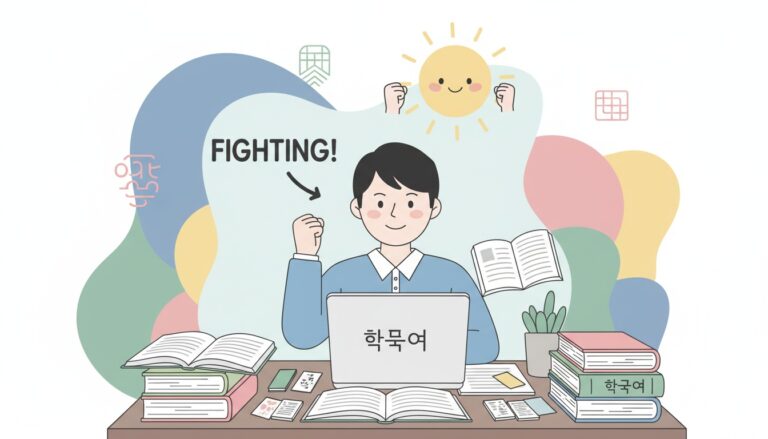
Have you ever started studying Korean with passion, only to lose motivation after a few days? In Korea, we call this “Jaksim-samil” (작심삼일), which means giving up after just three days. 😅
But don’t worry! Today, we are going to learn how to encourage ourselves and others to keep going. These expressions are super useful when you do language exchange or want to cheer up your friends. Imagine understanding your favorite K-Pop idol’s live stream when they say, “Don’t give up!” Let’s make that happen! 🚀
3. Core Expressions
Here are 3 essential expressions to boost your motivation and energy!
1. 포기하지 마세요 (Pogihaji maseyo)
- Pronunciation: [Pogihaji maseyo]
- English Meaning: Please don’t give up.
- Detail: This is the polite way to tell someone to keep trying. You often hear this in K-Dramas when the main character faces a hardship. If you want to say it to a close friend (casual), you can say “포기하지 마” (Pogihaji ma).
- 💡 Pronunciation Tip: The ‘h’ in ‘haji’ is often pronounced very softly, almost silent. It sounds like [Pogiyaji] when spoken fast, but try to pronounce the ‘h’ lightly!
2. 할 수 있어요 (Hal su isseoyo)
- Pronunciation: [Hal su isseoyo]
- English Meaning: You can do it / I can do it.
- Detail: This is a magic phrase! You can use it to encourage others (“You can do it!”) or to affirm yourself (“I can do it!”). It’s a huge confidence booster.
- 💡 Pronunciation Tip: When ‘수 (su)’ meets ‘있 (it)’, it flows smoothly. The double ‘ss’ in ‘isseoyo’ should be pronounced strongly, like the ‘s’ in ‘sea’.
3. 천천히 해도 괜찮아요 (Cheoncheonhi haedo gwaenchannayo)
- Pronunciation: [Cheoncheonhi haedo gwaenchannayo]
- English Meaning: It’s okay to take it slow.
- Detail: Learning a language is a marathon, not a sprint. Use this phrase when your language exchange partner feels stressed about making mistakes. It’s a very kind and comforting expression.
- 💡 Pronunciation Tip: In ‘괜찮아요 (gwaenchannayo)’, the bottom consonant ‘ㅎ(h)’ and ‘ㄶ(nh)’ are silent or blend in. It sounds more like [Gwaen-cha-na-yo].
4. Real Dialogue
Let’s see how friends encourage each other while studying at a cafe! ☕
Minji: 한국어 문법이 너무 어려워요. (Korean grammar is too hard.)
Alex: 포기하지 마세요! 민지 씨는 잘하고 있어요. (Don’t give up! You are doing well, Minji.)
Minji: 정말요? 하지만 단어가 안 외워져요. (Really? But I can’t memorize the vocabulary.)
Alex: 천천히 해도 괜찮아요. 우리 할 수 있어요! (It’s okay to take it slow. We can do it!)
Minji: 고마워요, 알렉스! 파이팅! (Thank you, Alex! Fighting!)
5. Culture Tip & Drama Vibes
🇰🇷 The “Fighting!” Culture
Did you notice Minji said “파이팅! (Paiting!)” or “화이팅! (Hwaiting!)” at the end?
Although it comes from the English word “Fighting,” in Korea, it doesn’t mean you want to fight someone! 🥊 It means “Cheer up!”, “Good luck!”, or “Let’s go!”.
You will see this in almost every Korean variety show or drama. When someone has a big test or a job interview, send them a text saying: “오늘도 화이팅!” (Hwaiting today too!). You’ll sound like a native instantly! 😎
6. Wrap-up & Quiz
Today, we learned how to stay motivated and encourage others. Remember, the secret to learning Korean is consistency! Don’t trigger “Jaksim-samil”! 😉
📝 Pop Quiz
Fill in the blanks with the expressions we learned today!
- A: This is too hard… I want to stop.
B: No! _______________! (Don’t give up!) -
A: I am so slow at learning.
B: Don’t worry. _______________. (It’s okay to take it slow.) -
A: Do you think we can pass the test?
B: Yes! We _______________! (We can do it!)
[Answers]
1. 포기하지 마세요 (Pogihaji maseyo)
2. 천천히 해도 괜찮아요 (Cheoncheonhi haedo gwaenchannayo)
3. 할 수 있어요 (Hal su isseoyo)
See you next time! 화이팅! ❤️
Frequently Asked Questions (FAQ)
Q: What does "할 수 있어요 (Hal su isseoyo)" mean in Korean and how do you pronounce it?
A: In Korean, "할 수 있어요 (Hal su isseoyo)" is pronounced [Hal su isseoyo] and means: You can do it / I can do it.
Q: What does "천천히 해도 괜찮아요 (Cheoncheonhi haedo gwaenchannayo)" mean in Korean and how do you pronounce it?
A: In Korean, "천천히 해도 괜찮아요 (Cheoncheonhi haedo gwaenchannayo)" is pronounced [Cheoncheonhi haedo gwaenchannayo] and means: It's okay to take it slow.







