

Hello! I’m “Daily Hangul,” your Korean tutor! 👋
Welcome back, K-Culture fans! 🌟
Have you ever watched K-dramas like “Extraordinary Attorney Woo” or “Vincenzo”? 📺 Did you notice that the courtroom scenes look a bit different from American shows like “Suits”?
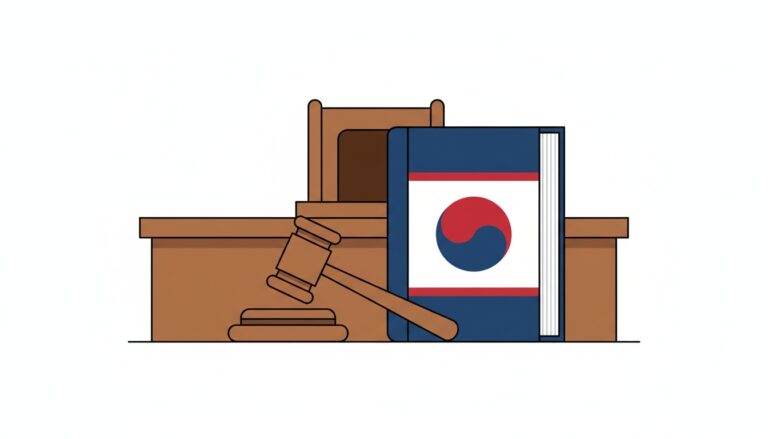
That’s because Korea uses a different legal system! Today, we will learn basic Korean words related to the Law and understand why Korean judges hold the gavel so tight! 🔨 Let’s become legal experts in Korean! GO GO! 🚀
3 Key Expressions 🔑
Here are the essential words you need to understand K-Drama court scenes!
1. 법 (Beop)
- Pronunciation: [Beop]
- English: Law
- Explanation: This is the foundation! Korea follows the Civil Law system (Continental Law), which means written rules (법) are the most important thing. Unlike the US (Common Law) where past cases matter most, in Korea, the written code is King! 👑
- 💡 Pronunciation Tip: The final ‘ㅂ’ sounds like a soft ‘p’. Close your lips tight at the end! Like “Stop“.
2. 판사 (Pansa)
- Pronunciation: [Pansa]
- English: Judge
- Explanation: In Korean courts, the 판사 is very powerful. Since there is usually no jury (unlike in the US/UK), the judge decides everything based on the written law. You will hear “Pansa-nim” (Honorable Judge) a lot in dramas!
3. 변호사 (Byeonhosa)
- Pronunciation: [Byeonhosa]
- English: Lawyer / Attorney
- Explanation: Like Woo Young-woo! A 변호사 defends people. In Korea, they focus on interpreting the written documents to convince the judge.
- 💡 Pronunciation Tip: The ‘h’ in ‘ho’ is soft. It flows like “Byeon-o-sa” when spoken fast.
Real Conversation Practice 🗣️
Imagine you are watching a legal K-Drama with a Korean friend.
A: 우영우 변호사는 정말 똑똑해요!
(Woo Young-woo byeonhosa-neun jeongmal ttokttokhaeyo!)
Attorney Woo Young-woo is really smart!
B: 맞아요. 법을 다 외우고 있어요.
(Majayo. Beop-eul da oeu-go isseoyo.)
That’s right. She is memorizing all the laws.
A: 그런데 배심원은 없어요?
(Geureonde baesimwon-eun eopseoyo?)
By the way, is there no jury?
B: 네, 한국은 판사님이 결정해요.
(Ne, Hanguk-eun Pansa-nim-i gyeoljeonghaeyo.)
Yes, in Korea, the Judge decides.
K-Culture Tip & Drama Context 🎬
📜 Why no “Objection!” to the Jury?
If you watch American dramas, lawyers often make emotional speeches to the Jury. But in Korea, which follows the Continental (Civil) Law system (influenced by Germany/France), trials center around the Judge (판사) and written documents.
So, in K-dramas, you’ll see the Lawyer (변호사) trying to prove logically that the action fits the written Law (법), rather than just swaying emotions.
- Fun Fact: Korea does have a jury system now for some criminal cases (called Kookmin Chamyeo Jaepan), but it’s not as common as in the West, and the judge can sometimes overrule the jury!
Wrap-up & Quiz 📝
Today we learned why K-Drama courts focus on the Judge and Written Law!
- 법 (Beop) = Law
- 판사 (Pansa) = Judge
- 변호사 (Byeonhosa) = Lawyer
Pop Quiz! (Answers at the bottom)
- Fill in the blank: “Woo Young-woo is a genius [ ].” (Korean word)
- O / X Quiz: In the traditional Korean legal system, the written law is very important.
See you next time! Annyeong! 👋
Answers:
1. 변호사 (Byeonhosa)
2. O (True – It is a Civil Law system!)
Frequently Asked Questions (FAQ)
Q: What does "법 (Beop)" mean in Korean and how do you pronounce it?
A: In Korean, "법 (Beop)" is pronounced [Beop] and means: a key conversational Korean expression covered in this lesson.
Q: What does "판사 (Pansa)" mean in Korean and how do you pronounce it?
A: In Korean, "판사 (Pansa)" is pronounced [Pansa] and means: a key conversational Korean expression covered in this lesson.
Q: What does "변호사 (Byeonhosa)" mean in Korean and how do you pronounce it?
A: In Korean, "변호사 (Byeonhosa)" is pronounced [Byeonhosa] and means: a key conversational Korean expression covered in this lesson.






