

Hello! This is [Daily Hangul], upgrading your Korean skills! 👋
Hello, K-culture fans! Welcome back to Daily Hangul! 🇰🇷✨
Have you ever watched a K-drama where a character gets scolded for shaking their leg? Or have you seen someone throwing salt after meeting an unwanted guest? Today, we are diving into the mysterious and fun world of Korean Superstitions (Misin)!
Learning these will help you understand why your favorite K-drama characters act in certain ways. Plus, it’s a great conversation starter with your Korean friends! Let’s get started! 🚀
3 Key Expressions 🔑
Here are the essential words to discuss superstitions!
1. 미신 (Misin)
- Pronunciation: [Mi-sin]
- English Meaning: Superstition
- Explanation: This is the noun for “superstition.” You will hear this a lot when people talk about old beliefs or luck.
- 💡 Pronunciation Tip: Pronounce ‘Mi’ like ‘Me’ and ‘sin’ like ‘seen’ but shorter. It’s clean and crisp!
2. 믿다 (Mitda)
- Pronunciation: [Mit-ta]
- English Meaning: To believe
- Explanation: This is the basic verb. When asking a friend, you conjugate it to “믿어? (Mideo?)”.
- 💡 Pronunciation Tip: Even though it is written as
믿다, theㄷ(d/t) at the bottom meets theㄷof다, causing a sound change called Tensification. So, it sounds like a strong [Mit-ta]!
3. 재수가 없다 (Jaesuga eopda)
- Pronunciation: [Jae-su-ga eop-ta]
- English Meaning: To be unlucky / To have no luck
- Explanation: “Jaesu” means luck or fortune. You use this when something goes wrong or to describe a situation (or person!) that brings bad luck.
- 💡 Pronunciation Tip: When
ㅂ(p/b) in없meetsㄷin다, theㄷbecomes a strongttsound. So,eopdais pronounced [eop-ta].
Real Conversation 🗣️
Imagine two friends, Minji and Jason, walking together at night.
Jason: (Whistling a tune) 😗🎶
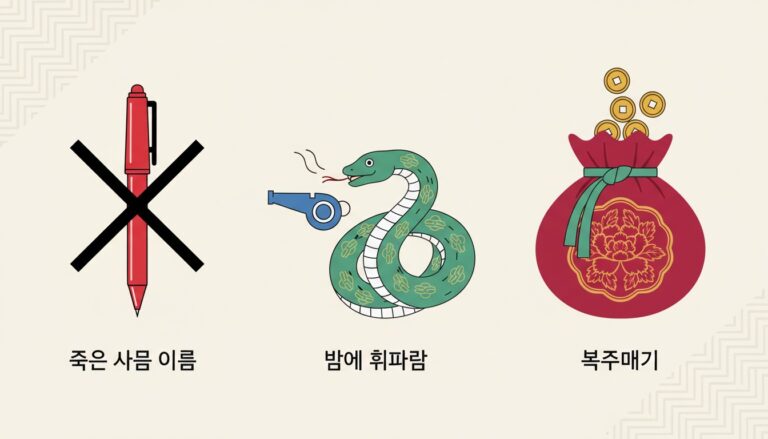
Minji: 앗! 밤에 휘파람 불지 마!
[At! Bame hwiparam bulji ma!]
(Ah! Don’t whistle at night!)
Jason: 왜? 무슨 문제 있어?
[Wae? Museun munje isseo?]
(Why? Is there a problem?)
Minji: 뱀 나온다고 했어.
[Baem naondago haesseo.]
(They say snakes come out.)
Jason: 너 혹시 미신 믿어?
[Neo hoksi misin mideo?]
(Do you happen to believe in superstitions?)
Minji: 응, 조심해서 나쁠 건 없잖아!
[Eung, josimhaeseo nappeul geon eopjana!]
(Yeah, no harm in being careful!)
Culture Tip & K-Drama Scene 🎬
🚫 Don’t Write Names in Red Ink!
In many K-dramas (and real life!), you might notice that Koreans never write a living person’s name in red ink.
Historically, red ink was used to write the names of the deceased in family registers or funeral banners to ward off evil spirits. Writing a living person’s name in red is considered very “Jaesuga eopda” (unlucky) because it implies you wish them harm or death. 😱
If you ask for an autograph from your favorite K-Pop idol, make sure your marker is black or blue! 🖊️💙
Wrap-up & Quiz 📝
Today we learned how to ask about superstitions. It’s a fun way to bond with Korean friends! Let’s check what you remember.
Q1. Fill in the blank:
“Do you believe in ______?”
= 너 ______ 믿어? (Neo ______ mideo?)
Q2. True or False:
In Korea, it is considered lucky to write names in red ink. ( O / X )
Q3. How do you pronounce ‘믿다’ (To believe)?
(A) Mid-da
(B) Mit-ta
Keep practicing, and I’ll see you next time! 안녕! 👋
Answers:
1. 미신 (Misin)
2. X (It is unlucky!)
3. (B) Mit-ta
Frequently Asked Questions (FAQ)
Q: What does "미신 (Misin)" mean in Korean and how do you pronounce it?
A: In Korean, "미신 (Misin)" is pronounced [Mi-sin] and means: Superstition
Q: What does "믿다 (Mitda)" mean in Korean and how do you pronounce it?
A: In Korean, "믿다 (Mitda)" is pronounced [Mit-ta] and means: To believe
Q: What does "재수가 없다 (Jaesuga eopda)" mean in Korean and how do you pronounce it?
A: In Korean, "재수가 없다 (Jaesuga eopda)" is pronounced [Jae-su-ga eop-ta] and means: To be unlucky / To have no luck







