

Hello! This is [Daily Hangul]! 👋
Welcome back, K-Culture fans! 🌟 Did you enjoy our last series on planning a trip? Today, we are talking about the feelings you have after the trip!
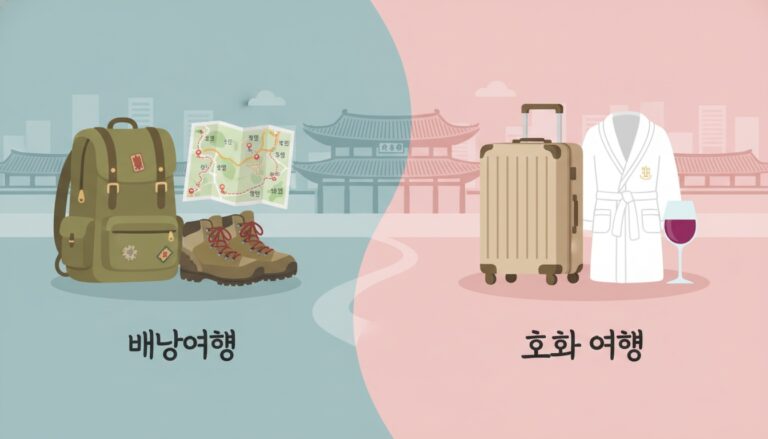
Whether you went on a tough Backpacking trip (배낭여행) or a relaxing Luxury trip (호캉스), you definitely have something to say about it, right?
In Korean variety shows like “Youth Over Flowers” (꽃보다 청춘), you often see stars reflecting on their journey at the end. Today, let’s learn how to express your feelings like a true Korean traveler! Let’s go! 🚀
3 Key Expressions for Post-Trip Reflections 🗣️
1. 기억에 남아요 (It’s memorable)
- Pronunciation: [Gieoge namayo]
- Meaning: It stays in my memory / It’s memorable.
- Detail: This is the perfect phrase to use when someone asks, “How was your trip?” You can use it for both good and unique experiences.
- 💡 Pronunciation Tip: Watch out for the liaison! The final consonant ‘ㄱ’ in 기억 moves over to ‘에’. So it sounds like [Gieo-ge], not [Gieok-e].
2. 정말 편했어요 (It was really comfortable)
- Pronunciation: [Jeongmal pyeonhaesseoyo]
- Meaning: It was really comfortable.
- Detail: If you went on a luxury trip or stayed at a nice hotel, use this! ‘정말’ means ‘really’, and ‘편했어요’ is the past tense of ‘comfortable’.
- 💡 Pronunciation Tip: The ‘ㅎ’ (h) sound in ‘편해(pyeonhae)’ can sometimes become weak. But try to pronounce the ‘h’ softly to sound polite!
3. 아쉬워요 (I feel sad it’s over / It’s a shame)
- Pronunciation: [Aswiwoyo]
- Meaning: I’m sad (that it’s over) / It’s a shame.
- Detail: This is a very Korean emotion! It’s not just “sad.” It specifically means you are sad because the good times are over, or you wish you could have done more. You will hear this A LOT in K-Dramas when a date ends! 😭
Real-life Conversation: Backpacker vs. Luxury Traveler 💬
Situation: Min-su (Backpacker) and Ji-min (Luxury Traveler) meet at a cafe after their trips.
- Min-su: 한국 여행 어땠어? (How was your Korea trip?)
- [Hanguk yeohaeng eottaesseo?]
- Ji-min: 호텔이 정말 편했어요. 너는? (The hotel was really comfortable. You?)
- [Hoteli jeongmal pyeonhaesseoyo. Neoneun?]
- Min-su: 나는 많이 걸어서 힘들었어. (I walked a lot, so it was hard.)
- [Naneun mani georeoseo himdeureosseo.]
- Ji-min: 그래도 재미있었어? (But was it fun?)
- [Geuraedo jaemiesseosseo?]
- Min-su: 응! 경치가 아름다워서 기억에 남아요. (Yes! The scenery was beautiful, so it’s memorable.)
- [Eung! Gyeongchiga areumdawoseo gieoge namayo.]
- Ji-min: 나도 벌써 집에 와서 아쉬워요. (I’m also sad that I’m already home.)
- [Nado beolsseo jibe waseo aswiwoyo.]
K-Culture Tip: Hocance (호캉스) 🏖️
Have you heard of “Hocance”?
It is a combination of Hotel (호텔) + Vacance (바캉스 – French for vacation).
In Korea, traveling doesn’t always mean going far away. Checking into a nice hotel in the city, wearing a robe, ordering room service, and doing nothing is a very popular travel style! If you say, “I went for Hocance,” Koreans will instantly understand you prefer a luxury, relaxing vibe over sweating with a backpack! 🥂
Also, don’t forget to take an “Insaeng-shot” (인생샷)—the best photo of your life—to post on social media! 📸
Wrap-up & Quiz 📝
Today we learned how to talk about our travel memories. Whether it was tiring or comfortable, every trip is special!
Pop Quiz! (Answers are at the bottom)
- How do you say “It stays in my memory” in Korean?
( 기 _ _ 남 _ _ ) -
True or False: “Aswiwoyo” (아쉬워요) means you are angry.
( O / X ) -
What is the Korean slang for a Hotel Vacation?
( H _ _ _ _ _ e )
See you next time! Annyeong! 👋
Answers:
1. 기억에 남아요 (Gieoge namayo)
2. X (It means sad/wistful that something is over)
3. Hocance (호캉스)
Frequently Asked Questions (FAQ)
Q: What does "기억에 남아요 (It’s memorable)" mean in Korean and how do you pronounce it?
A: In Korean, "기억에 남아요 (It’s memorable)" is pronounced [Gieoge namayo] and means: It stays in my memory / It’s memorable.
Q: What does "정말 편했어요 (It was really comfortable)" mean in Korean and how do you pronounce it?
A: In Korean, "정말 편했어요 (It was really comfortable)" is pronounced [Jeongmal pyeonhaesseoyo] and means: It was really comfortable.
Q: What does "아쉬워요 (I feel sad it's over / It's a shame)" mean in Korean and how do you pronounce it?
A: In Korean, "아쉬워요 (I feel sad it's over / It's a shame)" is pronounced [Aswiwoyo] and means: I’m sad (that it’s over) / It’s a shame.







