

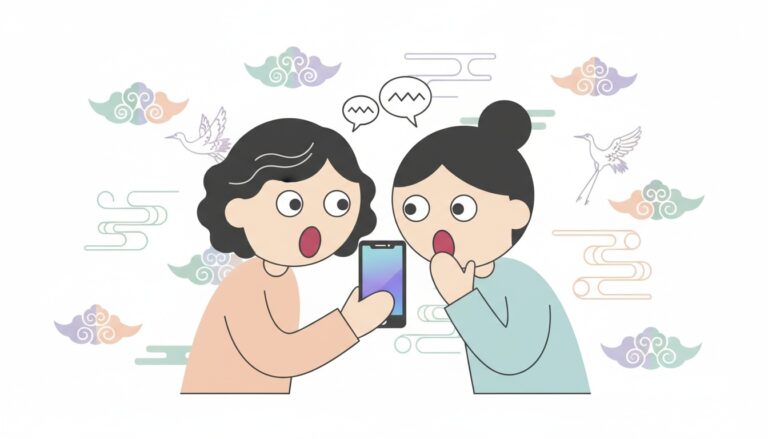
1. Title
Did You See That? Gossiping About SNS Rumors Like a Local! 🤫
2. Intro
Hello, everyone! This is Daily Hangul (매일한글), here to upgrade your Korean skills! 😊
Today, we are diving into a very exciting topic: Talking about rumors seen on SNS!
Have you ever seen a shocking post on Instagram or Twitter about your favorite K-Pop idol or K-Drama actor and wanted to discuss it with your Korean friends? “Wait, are they dating?” “Is that true?”
In Korea, information spreads very fast on SNS. Learning these expressions will help you jump right into the hottest conversations. You’ll sound just like the characters in K-Dramas when they gather at a cafe to gossip! Let’s get started! ☕️🔥
3. Key Expressions
1. 그거 봤어? (Geugeo bwasseo?)
- English: Did you see that?
- Pronunciation: [Geu-geo bwat-seo]
- Explanation: This is the best conversation starter! When you see breaking news or a funny photo on SNS, you use this to grab your friend’s attention. It’s casual (Banmal), so use it with close friends.
- 💡 Pronunciation Tip: When saying 봤어, the ‘ㅆ’ (ss) sound carries over to the next vowel. It sounds like [bwasseo].
2. ~대 (~dae)
- English: They say that… / I heard that…
- Pronunciation: [~dae]
- Explanation: This is the magic ending for rumors! It’s a short form of “~dago hae” (they say that). You attach it to the end of a verb or adjective to show you are repeating what you heard, not what you saw.
- Example: 가다 (to go) → 간대 (They say he is going)
- Example: 예쁘다 (pretty) → 예쁘대 (They say she is pretty)
- 💡 Pronunciation Tip: Pronounce it clearly as a short, sharp [dae].
3. 설마 (Seolma)
- English: No way / Don’t tell me… / Surely not
- Pronunciation: [Seol-ma]
- Explanation: You definitely heard this in K-Dramas! Use this when you can’t believe the rumor or hope it’s not true. It conveys shock and skepticism.
4. Real-life Conversation
Situation: Two friends, Mina and Sujin, are at a cafe looking at their phones.
Mina: 야, 인스타그램 그거 봤어?
(Ya, Instagram geugeo bwasseo?)
Hey, did you see that on Instagram?
Sujin: 아니, 왜? 무슨 일 있어?
(Ani, wae? Museun il isseo?)
No, why? Is something wrong?
Mina: 우리 최애 배우가 결혼한대!
(Uri choeae baeuga gyeolhonhandae!)
They say our favorite actor is getting married!
Sujin: 설마! 진짜야?
(Seolma! Jinjja-ya?)
No way! Is it true?
Mina: 응, 기사 났어. 대박이지?
(Eung, gisa nasseo. Daebak-iji?)
Yeah, the article is out. Isn’t it crazy (daebak)?
5. Culture Tip & Drama Context
🇰🇷 Culture Tip: “SNS”
In English, you might say “Social Media,” but in Korea, everyone calls it SNS (pronounced [Es-seu-en-es-seu]). If you ask a Korean, “Do you have social media?” they might be confused. Instead, ask “Do you do SNS?” (SNS 해요? – SNS haeyo?).
📺 Drama Context
In dramas like Cheer Up or True Beauty, rumors often start on anonymous school community apps. You will hear the ending “~대” (They say…) constantly as rumors fly through the school hallways! Now you can catch that word!
6. Conclusion & Practice
Today we learned how to spread the tea (gossip) in Korean! 🍵 Remember, use 그거 봤어? to start, ~대 to report, and 설마 to react!
📝 Mini Quiz
Fill in the blanks with the correct expression.
- A: Did you see the news? They say BTS is coming back!
B: ______! Really? (Meaning: No way!) -
To start a conversation about a post: “Instagram ______?”
-
(Transform the sentence): 먹다 (to eat) + rumor ending = ______ (They say he eats)
[Answers]
1. 설마 (Seolma)
2. 그거 봤어? (Geugeo bwasseo?)
3. 먹는대 (Meongneundae)
Frequently Asked Questions (FAQ)
Q: What does "~대 (~dae)" mean in Korean and how do you pronounce it?
A: In Korean, "~대 (~dae)" is pronounced [~dae] and means: a key conversational Korean expression covered in this lesson.
Q: What does "설마 (Seolma)" mean in Korean and how do you pronounce it?
A: In Korean, "설마 (Seolma)" is pronounced [Seol-ma] and means: a key conversational Korean expression covered in this lesson.







