

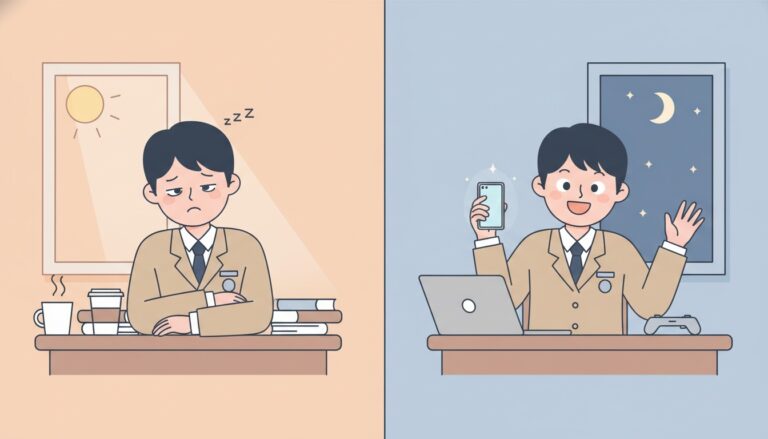
Korea’s Night Owls: The Science Behind Teen Sleep
Hello! Welcome back to [Maeil Hangul], here to upgrade your Korean skills to the next level!
Today, we’re moving beyond everyday conversation and diving into a more academic topic: the science of sleep. Have you ever wondered why teenagers seem to be biologically wired to stay up late and struggle to wake up in the morning? This isn’t just a behavioral issue; it’s deeply rooted in biology. In a country like South Korea, famous for its intense academic pressure and early school start times, this topic is incredibly relevant. Let’s explore the scientific reasons behind the sleep patterns of Korean ‘올빼미족’ (night owls) and learn the advanced vocabulary to discuss it like a native.
Core Expressions
Here are some key terms to help you discuss this topic with fluency and precision.
1. 생체 리듬 (saengche rideum)
* Pronunciation [Romanization]: saengche rideum
* English Meaning: Biological rhythm / Circadian rhythm
* Detailed Explanation: This term refers to the body’s internal 24-hour clock that regulates cycles of alertness and sleepiness. 생체 (生體) is a Sino-Korean word meaning ‘living body,’ and 리듬 is the Korean transliteration of the English word ‘rhythm.’ Understanding a teenager’s shifted 생체 리듬 is the first step to understanding their sleep habits.
* 💡 Pronunciation Tip: The final consonant ㅇ in 생 (saeng) is a velar nasal, similar to the ‘ng’ in ‘singing.’ It’s pronounced at the back of your throat, not with the tip of your tongue like ‘n’.
2. 수면 위상 지연 증후군 (sumyeon wisang jiyeon jeunghugun)
* Pronunciation [Romanization]: sumyeon wisang jiyeon jeunghugun
* English Meaning: Delayed Sleep Phase Syndrome (DSPS)
* Detailed Explanation: This is a clinical term for a circadian rhythm disorder. Let’s break it down: 수면 (睡眠) means ‘sleep,’ 위상 (位相) means ‘phase,’ 지연 (遲延) means ‘delay,’ and 증후군 (症候群) means ‘syndrome.’ In adolescents, their biological clock naturally shifts, causing them to feel sleepy much later than adults, a phenomenon often described as a temporary form of this syndrome.
* 💡 Pronunciation Tip: Notice the liaison (연음) in 지연. The ㅣ vowel is pronounced with a ‘y’ sound, making it [jiyeon], smoothly connecting the syllables.
3. 멜라토닌 분비 (mellatonin bunbi)
* Pronunciation [Romanization]: mellatonin bunbi
* English Meaning: Melatonin secretion
* Detailed Explanation: 멜라토닌 is the hormone that regulates sleep-wake cycles, and 분비 (分泌) means ‘secretion.’ The core biological reason for teenagers’ delayed sleep phase is that their brains begin to secrete melatonin later in the evening, signaling sleepiness at a later time.
* 💡 Pronunciation Tip: The ㅂ in 분비 (bunbi) is an unaspirated ‘b’ sound. It should be soft, without the strong puff of air you might hear in the English ‘p’.
4. 만성적인 수면 부족에 시달리다 (manseongjeogin sumyeon bujoge sidallida)
* Pronunciation [Romanization]: manseongjeogin sumyeon bujoge sidallida
* English Meaning: To suffer from chronic sleep deprivation
* Detailed Explanation: This is a powerful C1-level phrase. 만성적인 (慢性的인) means ‘chronic,’ 수면 부족 (睡眠不足) means ‘lack of sleep,’ and the verb 시달리다 means ‘to suffer from’ or ‘to be plagued by.’ This phrase perfectly captures the reality for many Korean students who must fight their biology to meet societal expectations.
* 💡 Pronunciation Tip: In 만성적인, the final ㄴ of 인 links to the following particle 은/는 if used, but here as an adjective, it’s pronounced clearly as [manseongjəgin]. The key is the smooth connection between 적 and 인.
Example Dialogue
Let’s see how these terms work in a natural conversation between two university students.
A: 제 고등학생 동생이 걱정이에요. 밤새 게임하고 아침마다 너무 피곤해 보여요.
(A: I’m worried about my high school-aged brother. He plays games all night and looks so tired every morning.)
B: 아, 청소년기에는 어쩔 수 없나 봐요. 원래 그 나이대에는 생체 리듬이 뒤로 밀리잖아요. 일종의 수면 위상 지연 증후군 같은 거죠.
(B: Ah, I guess it can’t be helped during adolescence. Their biological rhythm is naturally pushed back at that age. It’s like a form of Delayed Sleep Phase Syndrome.)
A: 정말요? 저는 그냥 반항하는 줄 알았어요. 그럼 멜라토닌 분비가 늦어져서 그런 거군요?
(A: Really? I just thought he was being rebellious. So it’s because his melatonin secretion is delayed?)
B: 맞아요. 그런데 학교는 일찍 가야 하니까, 대부분의 학생들이 만성적인 수면 부족에 시달리는 게 심각한 사회 문제예요.
(B: Exactly. But they have to go to school early, so the fact that most students suffer from chronic sleep deprivation is a serious social issue.)
Culture Tip & Trend Analysis
In South Korea, the conflict between teenage biology and societal demands is particularly extreme. The culture of 입시 지옥 (‘examination hell’) means students often attend 야간자율학습 (evening self-study) and 학원 (private academies) until late at night. They are expected to be at their desks early the next morning, often before 8 AM.
This system completely disregards the biological shift in their 생체 리듬. As a result, you’ll hear the term ‘좀비 교실’ (‘zombie classroom’) used in the media to describe classrooms full of sleep-deprived students. Understanding the scientific vocabulary we learned today allows you to engage in a deeper, more critical discussion about the Korean education system and its impact on youth wellness.
Let’s Review!
Today we learned that teenagers’ ‘night owl’ tendencies are based on a biological shift in their circadian rhythm, marked by delayed melatonin secretion. We also learned advanced Korean vocabulary to discuss this complex issue.
Practice Quiz:
1. Fill in the blank: 청소년기에는 뇌에서 ( )가 늦게 분비되어 잠드는 시간이 늦어진다. (The time to fall asleep is delayed in adolescence because the brain secretes [ ] late.)
2. What is the Korean term for the body’s internal clock?
Leave your answers in the comments below using the expressions we learned today! We’d love to see you try!







