

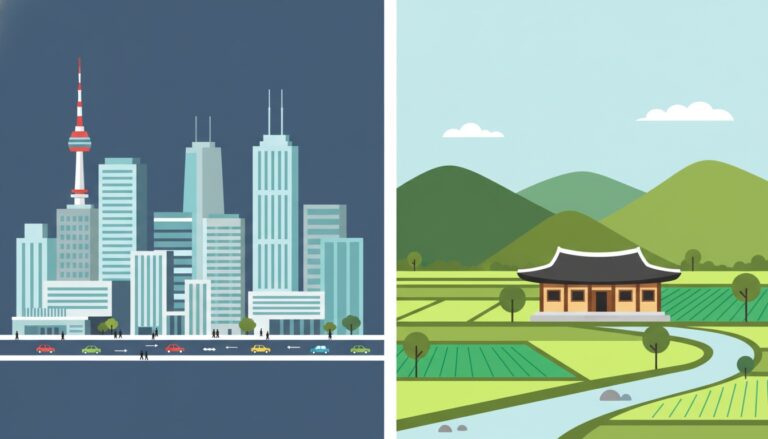
City vs. Countryside: Are You a City Slicker or a Country Soul in Korea?
Hello! Welcome to [Maeil Hangul], here to upgrade your Korean skills!
Have you ever wondered what it’s like to live outside the bustling city of Seoul? Today, we’re diving into a fascinating topic: the cultural differences between urban and rural life in Korea. This is super useful whether you’re planning a trip, thinking of living in Korea, or just want to understand K-dramas on a deeper level. Lately in Korea, there’s a growing trend of people moving from the city to the countryside, a phenomenon called ‘귀촌 (gwichon)’. Let’s find out why by exploring the unique concepts of city anonymity versus the tight-knit community of the countryside!
Core Expressions You Need to Know
Here are some key phrases that perfectly capture the vibe of city and country life.
1. 정 (Jeong)
* Pronunciation [Romanization]: Jeong
* English Meaning: A deep and warm feeling of connection, attachment, and affection.
* Detailed Explanation: This is one of the most important concepts in Korean culture! ‘정’ is a special bond you can share with people, places, or even things. It’s the feeling behind a grandmother packing you extra side dishes (반찬) or a neighbor sharing their harvest. It’s the foundation of the strong community spirit you’ll find in the countryside.
* 💡 Pronunciation Tip: The ‘ㅓ’ (eo) vowel can be tricky. It’s an open-mid back unrounded vowel, somewhere between the ‘o’ in ‘song’ and the ‘u’ in ‘uh’. Try making an ‘oh’ sound without rounding your lips. Listen to native speakers and mimic them!
2. 이웃사촌 (Iutsachon)
* Pronunciation [Romanization]: I-ut-sa-chon
* English Meaning: A neighbor who is as close as a cousin.
* Detailed Explanation: This compound word literally means ‘neighbor-cousin’ (이웃 = neighbor, 사촌 = cousin). It beautifully illustrates the ideal relationship in a Korean community, especially in rural areas. Your neighbors aren’t just people who live next door; they are like family you can rely on.
* 💡 Pronunciation Tip: The final consonant ‘ㅅ’ (s) in ‘이웃’ is not pronounced as ‘s’. When it’s at the end of a syllable, it makes a ‘t’ sound. So, you pronounce it [이욷 (iut)]. When followed by ‘사촌’, the ‘ㅅ’ sound gets tensed, making it sound more like [이욷싸촌 (iut-ssa-chon)].
3. 개인주의 (Gaeinjuui)
* Pronunciation [Romanization]: Gae-in-ju-ui
* English Meaning: Individualism.
* Detailed Explanation: This term is often used to describe the lifestyle in big cities like Seoul. It emphasizes personal freedom, independence, and privacy. While sometimes it can have a slightly negative nuance of being selfish, it’s generally understood as a neutral descriptor for a more modern, anonymous way of life where you don’t necessarily know your neighbors.
* 💡 Pronunciation Tip: This word has a lot of vowels! Break it down: 개 (gae) – 인 (in) – 주 (ju) – 의 (ui). The last syllable ‘의’ is a diphthong. It starts with an ‘ㅡ’ (eu) sound and glides quickly to an ‘ㅣ’ (i) sound. It sounds similar to ‘we’ but with your lips unrounded.
4. 오지랖이 넓다 (Ojirabi neolda)
* Pronunciation [Romanization]: O-ji-ra-bi neol-da
* English Meaning: To be nosy; to meddle in others’ affairs.
* Detailed Explanation: This is a fantastic idiom! ‘오지랖’ refers to the front flap of a coat. So, having a ‘wide’ one means you’re covering a lot of ground, including other people’s business! This can be seen as the flip side of ‘정’. A neighbor might ask you very personal questions, not to be rude, but out of a sense of ‘정’ and concern. It’s a tricky line to walk!
* 💡 Pronunciation Tip: Notice the pronunciation of ‘오지랖이’. The final ‘ㅂ’ (b/p) consonant in ‘오지랖’ moves over to the next syllable, which starts with a vowel. This is a rule called 연음 (yeon-eum) or liaison. So, instead of ‘ojirap-i’, it’s pronounced smoothly as [오지라비 (ojirabi)].
Example Dialogue
Let’s see these words in action!
A (Minjun, who moved from Seoul to the countryside): The people in my new village are so warm. They are true 이웃사촌. They shared so much food with me when I moved in. That’s real 정, isn’t it?
B (Sujin, who lives in Seoul): Wow, that’s amazing! In my apartment building, we practice a strong 개인주의. I don’t even know my next-door neighbor’s name.
A: It’s mostly great, but sometimes the 오지랖이 넓다. My neighbor asked me why I’m not married yet! It’s a bit much.
B: Haha, I can imagine! I guess you trade privacy for that warm community feeling.
Culture Tip & Trend Deep Dive
K-dramas like ‘Hometown Cha-Cha-Cha’ (갯마을 차차차) perfectly capture this dynamic. The drama showcases the beauty of ‘정’ and the ‘이웃사촌’ culture in a small seaside town, but it also humorously shows the main character, a dentist from Seoul, struggling with everyone’s ‘오지랖’.
For the Korean MZ generation, the idea of ‘귀촌’ (moving to the countryside) is becoming more popular. They are seeking a slower pace of life, a connection to nature, and a strong sense of community that is often missing in the hyper-competitive city. They are finding a new, modern way to appreciate the ‘정’ culture that their parents and grandparents knew.
Let’s Practice!
Time to check your understanding!
- Fill in the blank: Your friend’s mom insists on giving you a ride to the station and packs you snacks for the trip. This is a perfect example of Korean ____.
- Sentence Making: Using 개인주의, write one sentence about why you might prefer living in a big city.
Great job today! Don’t be shy, try using one of these new expressions in the comments below. We’d love to hear your thoughts!
Frequently Asked Questions (FAQ)
Q: What does "연음" mean in Korean and how do you pronounce it?
A: In Korean, "연음" is pronounced [yeon-eum] and means: or liaison. So, instead of 'ojirap-i', it's pronounced smoothly as







