

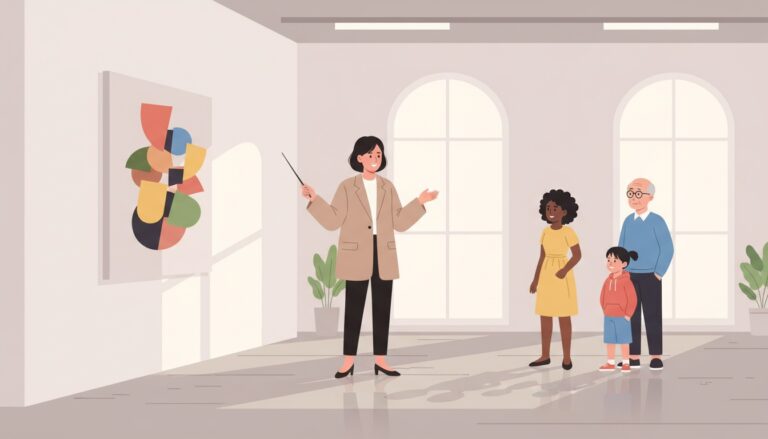
Unlock Korean Museums: Your Guide to Docent Tours!
Hello! This is Maeil Hangeul, here to upgrade your Korean skills!
Have you ever walked through a beautiful Korean museum, admiring the art but wishing you knew the stories behind it? You’re in luck! Today, we’re going to learn how to join a docent tour. Lately in Korea, visiting special art exhibitions has become a super trendy weekend activity and a popular date idea (we call it a ‘데이트 코스’ or ‘date course’). Knowing these phrases will not only deepen your appreciation for the art but also make you sound like a local!
Core Expressions
Let’s dive into the essential phrases you’ll need.
- 1. 도슨트 투어는 몇 시에 시작해요?
- Pronunciation [Romanization]: Dosenteu tueoneun myeot sie sijakaeyo?
- English Meaning: What time does the docent tour start?
- Detailed Explanation: This is the most direct and polite way to ask about the tour schedule.
도슨트 투어 (dosenteu tueo): “Docent tour,” an easy Konglish (Korean-style English) term.-는 (neun): A topic marker.몇 시에 (myeot sie): “At what time?”시작해요 (sijakaeyo): “Does it start?” (from the verb 시작하다, to start).
- 💡 Pronunciation Tip: The part ‘몇 시’ is not pronounced myeot-si but sounds like [며씨/myeo-ssi]. The final ‘ㅌ’ sound of ‘몇’ influences the ‘ㅅ’ of ‘시’, making it a stronger, tense sound like ‘ss’. It’s a small change that makes a big difference in sounding natural!
- 2. 지금 참여할 수 있을까요?
- Pronunciation [Romanization]: Jigeum chamyeohal su isseulkkayo?
- English Meaning: Can I join now?
- Detailed Explanation: Use this phrase if a tour is about to begin or has just started.
지금 (jigeum): “Now.”참여할 수 있을까요? (chamyeohal su isseulkkayo?): This is a combination of the grammar-(으)ㄹ 수 있다(can do something) and the polite question ending-(으)ㄹ까요?which softens the question, like asking for permission.
- 💡 Pronunciation Tip: For ‘있을까요’, the final ‘ㅆ’ consonant of ‘있’ links to the next syllable, so it’s pronounced [이쓸까요/isseulkkayo], not it-eul-kka-yo. This linking rule, called ‘연음 (yeoneum)’, is fundamental in Korean pronunciation.
- 3. 설명이 정말 재미있네요!
- Pronunciation [Romanization]: Seolmyeongi jeongmal jaemiinneyo!
- English Meaning: The explanation is really interesting!
- Detailed Explanation: This is a wonderful compliment to give the docent after the tour.
설명 (seolmyeong): “Explanation.”정말 (jeongmal): “Really.”-네요 (neyo): This is a sentence ending that expresses your genuine feeling or admiration upon learning or experiencing something new. It adds a touch of pleasant surprise.
- 💡 Pronunciation Tip: The pronunciation of ‘재미있네요’ is a bit tricky! It’s pronounced [재미인네요/jaemi-in-neyo]. Why? The final consonant sound of ‘있’ (which is a ‘ㄷ’ sound) changes to a ‘ㄴ’ sound right before the ‘ㄴ’ in ‘네요’. This is a pronunciation rule called ‘nasalization’ (비음화), and it makes the flow much smoother.
Example Dialogue
Here’s how you might use these phrases at the National Museum of Modern and Contemporary Art (MMCA) in Seoul.
- A (You): 저기요. 도슨트 투어는 몇 시에 시작해요? (Excuse me. What time does the docent tour start?)
- B (Staff): 오후 2시에 시작합니다. (It starts at 2 PM.)
- A (You): 아, 곧이네요! 지금 참여할 수 있을까요? (Oh, that’s soon! Can I join now?)
- B (Staff): 네, 그럼요. 저쪽에서 잠시만 기다려주세요. (Yes, of course. Please wait over there for a moment.)
(After the tour…)
- A (You to the docent): 설명이 정말 재미있네요! 감사합니다. (The explanation was really interesting! Thank you.)
Culture Tip & Trend Analysis
In Korea, some docents have become so popular for their witty and insightful explanations that they’ve earned the nickname ‘도슨트돌’ (doseunteu-dol), a combination of ‘docent’ and ‘idol’! People will actually check the schedule to make sure they attend a tour led by their favorite docent. It shows how much Koreans appreciate the art of storytelling. So, when you use the phrase
Frequently Asked Questions (FAQ)
Q: What does "'도슨트돌'" mean in Korean and how do you pronounce it?
A: In Korean, "'도슨트돌'" is pronounced [doseunteu-dol] and means: , a combination of 'docent' and 'idol'! People will actually check the schedule to make sure they attend a tour led by their favorite docent. It shows how much Koreans appreciate the art of storytelling. So, when you use the phrase







