

Korean Parenting 101: Raising an Independent Superstar!
Hello! Welcome to Maeil Hangul, here to upgrade your Korean skills!
Today, we’re diving into a topic that’s on every parent’s mind: how do we raise capable, independent children? It’s a universal goal, but how do Koreans talk about it? Lately in Korea, there’s a huge trend moving away from “helicopter parenting” and towards fostering 자립심 (jaripsim), or a spirit of independence. These phrases are perfect for discussing your parenting philosophy, understanding Korean family dramas, or even just reflecting on your own upbringing!
Let’s get started!
Core Expressions for Fostering Independence
Here are some key phrases you’ll hear when Koreans talk about raising kids.
1. 자립심을 키우다 (Jaripsimeul kiuda)
- Pronunciation [Romanization]: Ja-rip-si-meul ki-u-da
- English Meaning: To foster a sense of independence.
- Detailed Explanation: This is the core phrase for our topic! 자립심 (jaripsim) means “spirit of independence” or “autonomy,” and 키우다 (kiuda) means “to raise” or “to grow.” You use this phrase when talking about the goal of helping a child become self-reliant. It’s a very common and positive goal in modern Korean parenting.
- 💡 Pronunciation Tip: The syllable ‘심을’ is often pronounced more like [시믈/simeul]. The final consonant ‘ㅁ(m)’ of ‘심’ links to the vowel ‘으’ that follows, making it flow smoothly.
2. 스스로 하게 두다 (Seuseuro hage duda)
- Pronunciation [Romanization]: Seu-seu-ro ha-ge du-da
- English Meaning: To let (someone) do it by themselves.
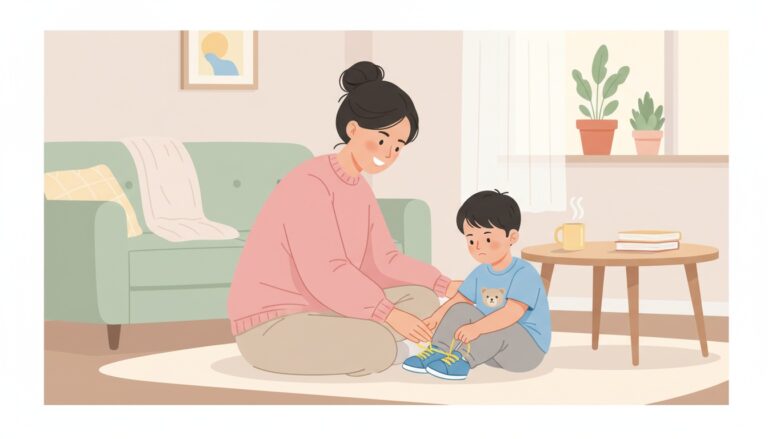
- Detailed Explanation: This is the practical action behind fostering independence. 스스로 (seuseuro) means “by oneself,” and the grammar pattern -게 두다 (-ge duda) means “to let/allow someone to do something.” Instead of jumping in to help your child tie their shoes, you can 스스로 하게 두다. It implies trusting them to try on their own.
- 💡 Pronunciation Tip: The ‘ㅅ(s)’ sound in Korean is softer than in English. For 스스로, think of it as a gentle hiss without a strong ‘s’ sound. It’s not sue-sue-ro, but a softer seu-seu-ro.
3. 시행착오를 겪다 (Sihaengchagoreul gyeokda)
- Pronunciation [Romanization]: Si-haeng-cha-go-reul gyeok-da
- English Meaning: To experience trial and error.
- Detailed Explanation: This four-character idiom, derived from Hanja (Chinese characters), is essential for talking about learning. 시행착오 (sihaengchago) means “trial and error,” and 겪다 (gyeokda) means “to experience” or “to go through.” Allowing a child to learn means accepting that they will make mistakes. This phrase perfectly captures that process.
- 💡 Pronunciation Tip: The final consonant cluster ‘겪’ has a tense, strong sound, written as [gyeok]. You should feel a burst of air when you say it. It’s a much stronger ‘k’ sound than in the English word ‘book’.
4. 칭찬은 고래도 춤추게 한다 (Chingchaneun goraedo chumchuge handa)
- Pronunciation [Romanization]: Ching-cha-neun go-rae-do chum-chu-ge han-da
- English Meaning: Praise can make even a whale dance.
- Detailed Explanation: This is a famous and beloved Korean proverb! It emphasizes the incredible power of positive reinforcement. When a child is struggling to learn something new, a little bit of praise—칭찬 (chingchan)—can motivate them to keep trying. It’s the perfect motto for any parent or teacher.
- 💡 Pronunciation Tip: The sound ‘ㅊ(ch)’ in 칭찬 and 춤추게 is an aspirated sound. This means you should release a strong puff of air, like the ‘ch’ in “chart.” Hold your hand in front of your mouth—you should feel the air!
Example Dialogue
Let’s see how two parents might use these phrases while watching their kids play.
- A: 우리 아들이 혼자 옷을 입으려고 해요. 시간이 너무 오래 걸리지만요.
(Uri adeuri honja oseul ibeuryeogo haeyo. Sigani neomu orae geollijimanyo.)
My son is trying to get dressed by himself. But it takes so long. - B: 그래도 스스로 하게 둬야지. 그게 자립심을 키우는 방법이잖아.
(Geuraedo seuseuro hage dwoyaji. Geuge jaripsimeul kiuneun bangbeobijana.)
Still, you have to let him do it himself. That’s how you foster independence, you know. - A: 맞아요. 그렇게 시행착오를 겪으면서 배우는 거겠죠?
(Majayo. Geureoke sihaengchagoreul gyeokkeumyeonseo baeuneun geogetjyo?)
You’re right. I guess he learns by going through trial and error like that. - B: 그럼! 성공하면 꼭 칭찬해주고. 칭찬은 고래도 춤추게 한다잖아!
(Geureom! Seonggonghamyeon kkok chingchanhaejugo. Chingchaneun goraedo chumchuge handajana!)
Of course! And make sure to praise him when he succeeds. You know what they say, praise can make a whale dance!
Culture Tip & Trend Deep Dive
While Korea is famous for its intense focus on education (교육열 – gyoyungnyeol), there’s a growing cultural conversation about the quality of that education. Many modern parents believe that skills like problem-solving and self-reliance are just as important as high test scores.
You’ll see this theme constantly in Korean media. Popular TV shows like “The Return of Superman” (슈퍼맨이 돌아왔다) often feature celebrity dads encouraging their kids to complete tasks on their own, from simple chores to buying groceries! When you see these scenes, you’ll now know that they are trying to 자립심을 키워주다 (jaripsimeul kiwojuda)—foster their child’s independence. Using these phrases will show you have a deep understanding of current Korean cultural values.
Let’s Practice!
Time to check your understanding!
- Fill in the Blank: A key part of learning is making mistakes. It’s natural to go through ___________.
(Hint: The phrase for “trial and error.”) -
Your Turn: Think of something a child can learn to do by themselves (e.g., cleaning their room, doing homework). Make a sentence using 스스로 하게 두다.
Great job today! You’ve learned some incredibly useful and culturally rich expressions. Why not try using one in the comments below? We’d love to hear from you!
Frequently Asked Questions (FAQ)
Q: What does "자립심을 키우다 (Jaripsimeul kiuda)" mean in Korean and how do you pronounce it?
A: In Korean, "자립심을 키우다 (Jaripsimeul kiuda)" is pronounced [Romanization] and means: To foster a sense of independence.
Q: What does "스스로 하게 두다 (Seuseuro hage duda)" mean in Korean and how do you pronounce it?
A: In Korean, "스스로 하게 두다 (Seuseuro hage duda)" is pronounced [Romanization] and means: To let (someone) do it by themselves.
Q: What does "시행착오를 겪다 (Sihaengchagoreul gyeokda)" mean in Korean and how do you pronounce it?
A: In Korean, "시행착오를 겪다 (Sihaengchagoreul gyeokda)" is pronounced [Romanization] and means: To experience trial and error.
Q: What does "칭찬은 고래도 춤추게 한다 (Chingchaneun goraedo chumchuge handa)" mean in Korean and how do you pronounce it?
A: In Korean, "칭찬은 고래도 춤추게 한다 (Chingchaneun goraedo chumchuge handa)" is pronounced [Romanization] and means: Praise can make even a whale dance.







