

Hello! This is Maeil Hangul, here to upgrade your Korean skills!
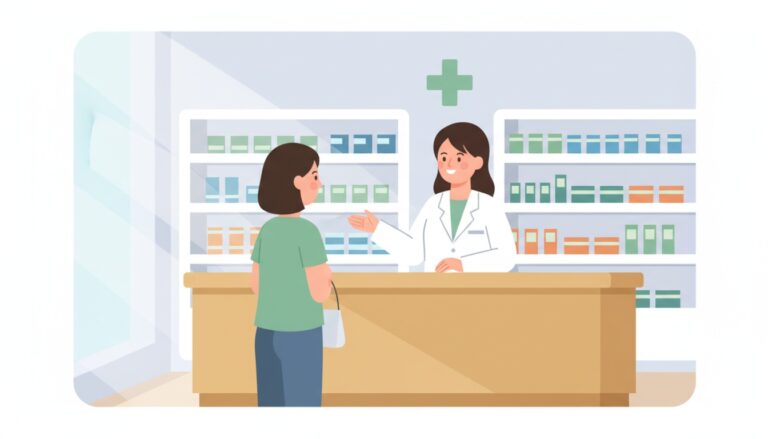
Have you ever been in a Korean pharmacy, holding a box of medicine and wondering about its side effects? Today, we’re going to learn how to confidently express your concerns to a pharmacist. Lately in Korea, there’s a huge trend around ‘이너뷰티’ (inner beauty) supplements and new over-the-counter medications. While they promise great results, it’s always smart to be an informed consumer. Let’s learn how to ask the right questions!
Key Expressions for the Pharmacy
Here are some essential phrases to help you discuss your medical concerns like a native speaker.
1. -(ㄹ/을)까 봐 걱정돼요 (-(l/eul)kka bwa geokjeongdwaeyo)
* Pronunciation [Romanization]: -kka bwa geok-jjeong-dwae-yo
* English Meaning: I’m worried that… / I’m concerned that… might happen.
* Detailed Explanation: This is a crucial grammar pattern for expressing anxiety or concern about a potential negative future event. You attach it to a verb stem. It’s more nuanced than just saying “I’m worried,” as it specifically points to a feared outcome.
* 💡 Pronunciation Tip: The ‘걱’ in ‘걱정’ often sounds more tensed, like [걱쩡/geokjjeong]. This is due to a phenomenon called ‘tensification’ where a plain consonant (ㅈ) becomes a tense consonant (ㅉ) after a preceding stop consonant (ㄱ).
2. 혹시 (hoksi)
* Pronunciation [Romanization]: hok-ssi
* English Meaning: By any chance… / Perhaps…
* Detailed Explanation: ‘혹시’ is a fantastic word that softens your questions, making you sound more polite and considerate. It’s perfect for when you’re about to ask something that might be a little sensitive or an imposition. You place it at the beginning of your question.
* 💡 Pronunciation Tip: The ‘ㄱ’ (g) at the end of ‘혹’ and the ‘ㅅ’ (s) at the beginning of ‘시’ combine to create a tensed ‘ㅆ’ (ss) sound. So, instead of ‘hok-si’, it sounds like [혹씨/hokssi].
3. 복용 시 주의사항 (bogyong si juuisa-hang)
* Pronunciation [Romanization]: bo-gyong si ju-ui-sa-hang
* English Meaning: Precautions for taking (this medication).
* Detailed Explanation: This is a more formal and technical phrase you’ll see on medicine labels or hear from a healthcare professional. ‘복용’ (bogyong) means ‘taking medicine’, ‘시’ (si) means ‘at the time of’, and ‘주의사항’ (juuisa-hang) means ‘points of caution’ or ‘precautions’.
* 💡 Pronunciation Tip: Notice the word ‘주의’ (juui). While written with two separate vowels, it’s often pronounced quickly as a single syllable, almost like [주의/juyi]. Listen carefully to how native speakers say it!
4. 체질에 따라 (chejire ttara)
* Pronunciation [Romanization]: che-ji-re tta-ra
* English Meaning: Depending on one’s constitution.
* Detailed Explanation: The concept of ‘체질’ (chejil), or one’s unique physical constitution, is very important in Korean health culture. This phrase is used to explain why a medicine or food might affect people differently. It acknowledges that reactions are not universal.
* 💡 Pronunciation Tip: The ‘ㄹ’ (r/l) in ‘체질에’ links to the next vowel, a process called ‘liaison’ or ‘연음 (yeoneum)’. So, it’s not ‘chejil-e’ but flows smoothly as [체지레/chejire].
Example Dialogue
Let’s see these expressions in a real conversation at a pharmacy.
- A (Customer): 안녕하세요. 요즘 유행하는 그 피로회복제 좀 주세요.
(Hello. I’d like to get that fatigue recovery supplement that’s popular these days.) - B (Pharmacist): 아, 네. 여기 있습니다.
(Ah, yes. Here you are.) - A (Customer): 감사합니다. 혹시 이걸 먹으면 속이 쓰릴까 봐 걱정돼요. 제가 위가 좀 약해서요.
(Thank you. By any chance, I’m worried that it might cause heartburn. My stomach is a bit weak.) - B (Pharmacist): 음, 복용 시 주의사항을 보면 그런 부작용은 거의 없어요. 하지만 체질에 따라 다를 수 있으니 식사 후에 바로 드시는 걸 추천합니다.
(Hmm, according to the precautions for taking it, that side effect is very rare. However, it can differ depending on one’s constitution, so I recommend taking it right after a meal.)
Culture Tip & Trend Deep Dive
In Korea, pharmacists (약사님) are highly respected and very accessible. Don’t hesitate to ask them questions, even about over-the-counter products! They are a great source of professional advice.
The concept of ‘체질’ (chejil) we learned today is a key part of understanding Korean wellness. It’s rooted in traditional medicine and suggests that everyone’s body is different. When you use the phrase ‘체질에 따라’, you show a deeper understanding of this cultural perspective, which will surely impress native speakers! You’ll hear this not just about medicine, but also about food, exercise, and skincare.
Let’s Practice!
Now it’s your turn to use what you’ve learned.
- Fill in the blank: I heard this skin supplement is good, but I’m worried I might have an allergic reaction.
→ 피부 영양제가 좋다고 들었는데, 알레르기 반응이 나타날______. -
Make a sentence: How would you politely ask a pharmacist, “By any chance, are there any precautions for taking this cold medicine?”
Great job today! Try using one of these phrases to write a sentence in the comments below!
Frequently Asked Questions (FAQ)
Q: What does "'체질'" mean in Korean and how do you pronounce it?
A: In Korean, "'체질'" is pronounced [chejil] and means: we learned today is a key part of understanding Korean wellness. It's rooted in traditional medicine and suggests that everyone's body is different. When you use the phrase







