

Hello! Welcome to Maeil Hangeul, here to upgrade your Korean skills!
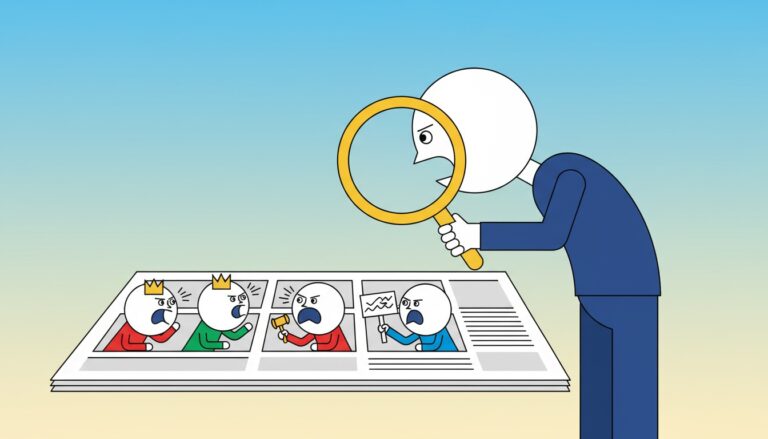
Ever seen a cartoon in a Korean newspaper and wondered what it meant? Today, we’re diving into the witty and insightful world of Korean political cartoons! This is a fantastic way to level up your Korean because you’ll learn to understand not just the language, but also cultural humor and current events. Recently in Korea, discussions about new policies and the economy are hot topics, and political cartoons are capturing it all with sharp wit. Let’s learn how to decode them!
Key Expressions for Understanding Political Cartoons
Here are some essential words you need to know.
1. 풍자 (Pungja)
* Pronunciation [Romanization]: Pung-ja
* English Meaning: Satire, Sarcasm
* Detailed Explanation: This is the core concept! 풍자 is a style of humor that uses exaggeration or irony to criticize people’s foolishness or vices, particularly in the context of politics. A political cartoon is a type of 풍자 art.
* 💡 Pronunciation Tip: The final consonant ‘ㅇ’ (ng) in 풍 (pung) is similar to the ‘ng’ in ‘singing’. Make sure you don’t pronounce it like an ‘n’ or ‘g’. It’s a soft, nasal sound made at the back of your throat.
2. 비판하다 (Bipanhada)
* Pronunciation [Romanization]: Bi-pan-ha-da
* English Meaning: To criticize
* Detailed Explanation: This verb is the main action of most political cartoons. They often 비판하다 (criticize) politicians, policies, or societal issues. It’s a neutral word for criticism and can be used in formal and informal contexts.
* 💡 Pronunciation Tip: The ‘ㅍ’ (p) in 판 (pan) is an aspirated sound. This means you should release a strong puff of air when you say it, like the ‘p’ in ‘park’. It’s stronger than the ‘ㅂ’ (b/p) sound. Hold your hand in front of your mouth – you should feel a burst of air!
3. 과장하다 (Gwajanghada)
* Pronunciation [Romanization]: Gwa-jang-ha-da
* English Meaning: To exaggerate
* Detailed Explanation: Caricature is all about exaggeration! Artists 과장하다 (exaggerate) the physical features of politicians or the scale of a problem to make a point and create humor.
* 💡 Pronunciation Tip: The ‘과’ (gwa) is a diphthong, a combination of two vowel sounds. Start with a ‘g’ sound, quickly move to a ‘w’ shape with your lips, and then open up to the ‘ah’ sound. Practice saying ‘gwa’ smoothly in one syllable.
4. 상징하다 (Sangjinghada)
* Pronunciation [Romanization]: Sang-jing-ha-da
* English Meaning: To symbolize
* Detailed Explanation: Cartoons are full of symbols. A dove might 상징하다 (symbolize) peace, while a broken piggy bank might symbolize economic problems. Understanding these symbols is key to interpretation.
* 💡 Pronunciation Tip: Notice the two ‘ㅇ’ (ng) sounds here. The first one in 상 (sang) is a final consonant [ng], but the second one in 징 (jing) is also a final consonant. Practice them to distinguish from the initial ‘ㅇ’ which is silent.
Example Dialogue
Let’s see these words in action! Two friends, Minjun and Chloe, are looking at a cartoon on a phone.
- A (Chloe): 민준아, 이 그림은 무슨 뜻이야? 정치인 코가 엄청 기네.
(Minjun, what does this picture mean? The politician’s nose is so long.) - B (Minjun): 아, 이건 요즘 정책을 풍자하는 만평이야. 거짓말을 많이 해서 피노키오처럼 코를 길게 과장해서 그린 거지.
(Ah, this is a cartoon that uses satire on recent policies. They exaggerated his nose to be long like Pinocchio because he tells a lot of lies.) - A (Chloe): 그렇구나. 언론의 자유를 상징하는 새를 새장 안에 가두고 있네. 정부를 비판하는 내용이구나.
(I see. And he’s trapping a bird that symbolizes freedom of the press in a cage. It’s criticizing the government.) - B (Minjun): 맞아. 정확히 이해했어!
(That’s right. You understood it perfectly!)
Culture Tip & Trend Analysis
In Korea, political cartoons are called 시사만화 (sisa-manhwa) or, more commonly in newspapers, 만평 (manpyeong). They are a powerful part of journalism and public discourse. Don’t be surprised to see them on the front page of major news websites!
Here’s a pro-tip: Korean political cartoons often use animals to 상징하다 different countries or political parties. For example, a tiger often represents Korea, while a bear might represent Russia and an eagle represents the USA. Knowing these common symbols will make you look like a real insider!
Wrap-up & Practice!
Great job today! You’ve learned four key verbs and nouns—풍자 (satire), 비판하다 (to criticize), 과장하다 (to exaggerate), and 상징하다 (to symbolize)—that will help you unlock the meaning of Korean political cartoons.
Quick Quiz: Fill in the blank!
- 만평은 종종 정치인들의 실수를 ___________ 위해 재미있는 그림을 사용해요. (Manpyeong-eun jongjong jeongchiin-deurui silsu-reul ___________ wihae jaemi-inneun geurim-eul sayonghaeyo.)
(Political cartoons often use funny pictures to ___________ politicians’ mistakes.)
Answer: 비판하기 (bipanhagi) or 풍자하기 (pungjahagi)
Try finding a Korean 만평 online this week! Can you understand its message using the words we learned today? Share your thoughts in the comments below!
Frequently Asked Questions (FAQ)
Q: What does "풍" mean in Korean and how do you pronounce it?
A: In Korean, "풍" is pronounced [pung] and means: is similar to the 'ng' in 'singing'. Make sure you don't pronounce it like an 'n' or 'g'. It's a soft, nasal sound made at the back of your throat.
Q: What does "판" mean in Korean and how do you pronounce it?
A: In Korean, "판" is pronounced [pan] and means: is an aspirated sound. This means you should release a strong puff of air when you say it, like the 'p' in 'park'. It's stronger than the 'ㅂ' (b/p) sound. Hold your hand in front of your mouth – you should feel a burst of air!
Q: What does "상" mean in Korean and how do you pronounce it?
A: In Korean, "상" is pronounced [sang] and means: is a final consonant [ng], but the second one in
Q: What does "징" mean in Korean and how do you pronounce it?
A: In Korean, "징" is pronounced [jing] and means: is also a final consonant. Practice them to distinguish from the initial 'ㅇ' which is silent.







