

Beyond the Crowds: Discussing Overtourism in Korean
Hello! Welcome to Maeil Hangul, here to upgrade your Korean skills!
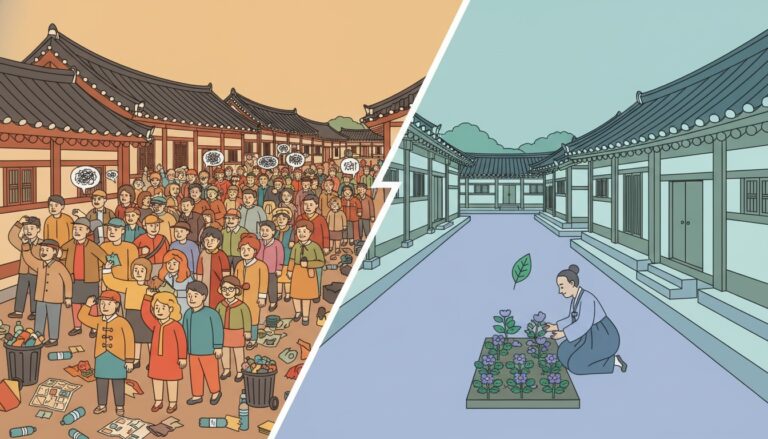
Today, we’re tackling a very important and timely topic: overtourism and its effect on cities. This is a perfect theme for advanced learners who want to discuss social issues in Korean. If you’ve seen the news about popular spots like Bukchon Hanok Village in Seoul or the beautiful Jeju Island, you’ll know that Korea is currently grappling with how to balance a booming tourism industry with the well-being of its residents and environment. Let’s learn how to talk about it like a pro!
Core Expressions for In-Depth Discussion
Here are some key phrases to help you articulate your thoughts on this complex issue.
1. 과잉 관광 (gwa-ing gwan-gwang)
* Pronunciation [Romanization]: Gwa-ing gwan-gwang
* English Meaning: Overtourism
* Detailed Explanation: This is the direct term for ‘overtourism.’ ‘과잉’ (gwa-ing) means ‘excess’ or ‘surplus,’ and ‘관광’ (gwan-gwang) means ‘tourism.’ It’s a formal term you’ll frequently encounter in news articles, documentaries, and academic discussions about the negative impacts of too many tourists in one place.
* 💡 Pronunciation Tip: The ‘ㅇ’ (ng) at the end of ‘과잉’ and ‘관광’ is a soft ‘ng’ sound, similar to the end of the English word ‘sing.’ Make sure not to pronounce it with a hard ‘g’ sound.
2. 지속가능성 (ji-sok-ga-neung-seong)
* Pronunciation [Romanization]: Jisokganeungseong
* English Meaning: Sustainability
* Detailed Explanation: This is a crucial word in modern global discussions. It’s composed of ‘지속’ (jisok – continuation), ‘가능’ (ganeung – possibility), and ‘성’ (seong – nature/suffix for nouns). It refers to the ability to maintain something at a certain rate or level, especially in relation to the environment and society. You’ll use this when discussing long-term solutions.
* 💡 Pronunciation Tip: When syllables run together like this, Korean ‘liaison’ (연음 – yeoneum) rules apply. The final consonant of a syllable often moves to the next syllable if it starts with a vowel. For example, ‘지속’ and ‘가능’ are pronounced together smoothly as [지속가능 – jisokganeung], not [jisok-ganeung].
3. ~에 몸살을 앓다 (~e mom-sal-eul al-ta)
* Pronunciation [Romanization]: ~e mom-sal-eul al-ta
* English Meaning: To suffer from / to be plagued by
* Detailed Explanation: This is a fantastic idiomatic expression. ‘몸살’ is a word for body aches, often from fatigue or a cold. ‘앓다’ means to be sick or to suffer. So, literally, it means ‘to be sick with body aches.’ Figuratively, it’s used to describe a place, organization, or society that is suffering greatly from a persistent problem. It’s much more descriptive than just saying ‘have a problem.’
* 💡 Pronunciation Tip: The ‘앓’ (al) sound can be tricky. The ‘ᆶ’ is a consonant cluster of ‘ㄹ(l)’ and ‘ㅎ(h)’. When followed by a vowel like in ‘앓아’ (ara), the ‘ㅎ’ is silent and the ‘ㄹ’ moves over: [아라]. However, in ‘앓다’ (al-ta), the ‘ㅎ’ sound modifies the following ‘ㄷ(d)’ into a ‘ㅌ(t)’ sound, making the pronunciation [알타 – alta].
4. 상생 방안을 모색하다 (sang-saeng bang-an-eul mo-saek-ha-da)
* Pronunciation [Romanization]: Sang-saeng bang-an-eul mo-saek-ha-da
* English Meaning: To seek a win-win solution / a plan for coexistence
* Detailed Explanation: This is a very formal and sophisticated phrase, perfect for C1 learners. ‘상생’ (sang-saeng) means ‘coexistence’ or ‘mutual prosperity.’ ‘방안’ (bang-an) is a ‘plan’ or ‘measure.’ ‘모색하다’ (mo-saek-ha-da) is a formal verb for ‘to seek’ or ‘to explore.’ You would use this phrase in a debate, a formal presentation, or when writing an essay about solving the overtourism issue.
* 💡 Pronunciation Tip: In ‘방안을’, the final ‘ㄴ(n)’ of ‘방안’ links to the following vowel ‘을’, so it’s pronounced smoothly as [방아늘 – bang-a-neul].
Example Dialogue
Let’s see how these expressions are used in a real conversation.
A: 요즘 제주도 과잉 관광 문제가 다시 뉴스에 나왔더라. (Yojeum Jeju-do gwa-ing gwan-gwang munjega dasi nyuseu-e nawatdeora.)
I saw the overtourism problem in Jeju Island was on the news again.
B: 맞아. 아름다운 자연이 훼손되고 주민들의 고충도 심각하대. 도시 전체가 몸살을 앓는 것 같아. (Maja. Areumdaun jayeon-i hwesondoego jumindeurui gochungdo simgakadae. Dosi jeonche-ga mom-sal-eul al-neun geot gata.)
Right. They say the beautiful nature is being damaged and the residents’ struggles are serious. It seems like the whole island is suffering.
A: 관광 산업도 중요하지만, 이제는 정말 지속가능성을 생각해야 할 때야. (Gwan-gwang saneopdo jung-yohajiman, ijeneun jeongmal ji-sok-ga-neung-seong-eul saenggakhaeya hal ttaeya.)
The tourism industry is important, but now it’s really time to think about sustainability.
B: 동감이야. 관광객과 주민 모두를 위한 상생 방안을 모색해야 해. (Donggam-iya. Gwan-gwang-gaek-gwa jumin modureul wihan sang-saeng bang-an-eul mosaekhaeya hae.)
I agree. We need to find a win-win solution for both tourists and residents.
Culture Tip & Trend Deep Dive
In Korea, the conversation around overtourism isn’t just academic. Local governments are actively trying to find solutions. For example, in Seoul’s Bukchon Hanok Village, where many residents live in traditional houses, the city has implemented ‘restricted visiting hours’ to ensure residents’ peace and quiet in the early morning and late evening. Jeju Island is even considering introducing a ‘tourism tax’ to fund environmental protection. When you use a phrase like 상생 방안을 모색하다, you’re not just using advanced vocabulary; you’re tapping into a real, ongoing social debate in Korea. Showing you understand this context will make you sound less like a textbook and more like an informed speaker.
Let’s Practice!
Time to put your knowledge to the test!
1. Fill in the blank:
많은 유명 관광지들이 ____________ 때문에 어려움을 겪고 있다.
(Many famous tourist spots are experiencing difficulties due to ____________.)
2. Sentence Building:
Using the grammar point ~에 몸살을 앓다, create a sentence about a city or place suffering from a problem (e.g., traffic, pollution, etc.).
Great job today! Try using one of these expressions to leave a comment below about a famous tourist spot in your country. We’d love to hear your thoughts!







