

Hello! This is Maeil Hangul, here to upgrade your Korean skills!
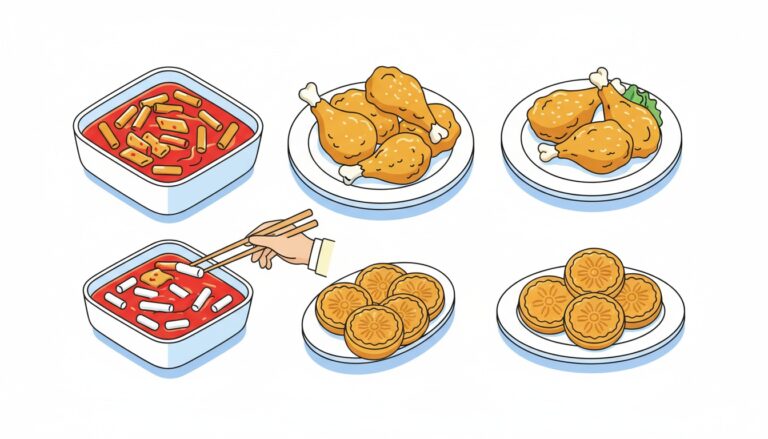
Have you ever watched a Korean mukbang or food show and wondered how they describe the food so vividly? Today, we’re going to learn how to describe the taste and texture of food just like a native Korean speaker! It’s super useful for when you’re eating with Korean friends or trying out a recipe. Especially these days, with Korean snacks and street food like Tanghulu and Yakgwa becoming a global trend on social media, you’ll be able to share your foodie thoughts perfectly!
Core Expressions
Let’s dive into some essential words that will make your Korean food descriptions come alive.
1. 달콤하다 (Dalkomhada)
* Pronunciation [Romanization]: Dalkomhada
* English Meaning: To be sweet
* Detailed Description: This is the standard and most common way to say something is sweet. You can use it for desserts, fruits, sweet sauces, and drinks. It’s a descriptive verb, so you conjugate it like one: 달콤해요 (dalkomhaeyo) in the polite form.
* 💡 Pronunciation Tip: The first syllable ‘달’ ends with a ‘ㄹ’ (l) consonant, which is followed by ‘ㅋ’ (k). In this position, the ‘ㄹ’ is pronounced with your tongue touching the roof of your mouth, similar to a light ‘l’ sound. Try to say it as one smooth motion: [dal-kom-ha-da].
2. 바삭바삭하다 (Basak-basak-hada)
* Pronunciation [Romanization]: Basak-basak-hada
* English Meaning: To be crispy, crunchy
* Detailed Description: This is a fantastic mimetic word (의태어) that imitates the sound and feeling of biting into something crispy. Think of fried chicken, chips, or the crispy shell of a well-fried dumpling. Repeating the word ‘바삭’ emphasizes the texture.
* 💡 Pronunciation Tip: The key here is the ‘ㅅ’ (s) sound. It’s a plain consonant, so don’t make it too strong like the ‘ss’ in ‘pass’. It’s a softer ‘s’. The final ‘ㄱ’ (k) in ‘삭’ is a gentle, unreleased ‘k’ sound. Imagine you’re about to say ‘k’ but stop just before the air comes out: [ba-sak-ba-sak-ha-da].
3. 쫄깃쫄깃하다 (Jjolgit-jjolgit-hada)
* Pronunciation [Romanization]: Jjolgit-jjolgit-hada
* English Meaning: To be chewy
* Detailed Description: This is the perfect word for describing the delightful texture of things like Korean rice cakes (tteok), noodles, or jellies. Like ‘바삭바삭하다’, it’s a mimetic word that perfectly captures that satisfying, springy mouthfeel.
* 💡 Pronunciation Tip: The initial ‘ㅉ’ (jj) is a ‘tense’ consonant. To make this sound, you should feel a bit of tension in your throat, as if you’re pushing the sound out forcefully. It’s stronger than a ‘j’ in English. Also, the final consonant in ‘깃’ is ‘ㅅ’, but it’s pronounced as [t] when at the end of a syllable. This is a very common rule! So you say [jjol-git-jjol-git-ha-da].
Example Dialogue
Let’s see how these words are used in a real conversation about a popular Korean snack!
- A: 와, 이 약과(yakgwa) 맛있어 보여요! (Wa, i yakgwa masisseo boyeoyo!)
Wow, this yakgwa looks delicious! - B: 한번 먹어봐요. 겉은 바삭바삭하고 속은 쫄깃쫄깃해요. (Hanbeon meogeobwayo. Geoteun basak-basak-hago sogeun jjolgit-jjolgit-haeyo.)
Try one. The outside is crispy and the inside is chewy. - A: 음! 정말 달콤해요! 너무 맛있어요. (Eum! Jeongmal dalkomhaeyo! Neomu masisseoyo.)
Mmm! It’s so sweet! It’s so delicious.
Culture Tip & Trend Deep Dive
In Korea, using mimetic and onomatopoeic words like 바삭바삭 and 쫄깃쫄깃 is incredibly common, especially in the world of food. If you watch Korean TV shows or YouTube mukbangs, you’ll hear these words constantly! Using them makes you sound much more fluent and expressive. It’s not just about describing the food; it’s about sharing the experience of eating it. The recent trend of freezing yakgwa (a traditional honey cookie) and eating it cold enhances its 쫄깃쫄깃한 texture, a fact many Korean influencers on social media love to point out using this exact expression!
Let’s Practice!
Time to check what you’ve learned. How would you describe the texture of Korean fried chicken?
Fill in the blank: 한국 치킨은 정말 ______.
(Hangguk chikin-eun jeongmal ______.)
Korean chicken is really ______.
(Hint: It’s known for its crunchiness!)
Great job today! You’re now one step closer to sounding like a true Korean foodie. Try using these expressions the next time you eat. Don’t forget to leave a comment below using one of the phrases you learned today!
Frequently Asked Questions (FAQ)
Q: What does "달콤해요" mean in Korean and how do you pronounce it?
A: In Korean, "달콤해요" is pronounced [dalkomhaeyo] and means: in the polite form.







