

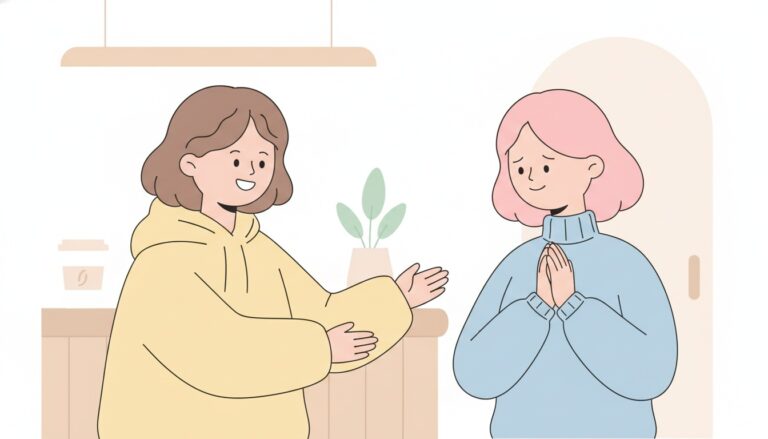
Hello! Welcome to [Maeil Hangul], here to upgrade your Korean skills!
Have you ever been invited to something you couldn’t attend? Saying ‘no’ can be awkward in any language. In Korean, being polite and considerate of the other person’s feelings is super important. So today, we’ll learn how to politely decline an invitation without hurting any feelings!
Recently in Korea, the ‘work-life balance’ (워라밸) trend is huge. People are making more fun plans, but it’s also become important to protect your personal time. This is the perfect skill to have when your calendar is just too full!
Key Expressions for Saying ‘No’ Politely
Here are three essential phrases to help you decline like a pro.
1. 미안해요. 약속이 있어요. (Mianhaeyo. Yaksogi isseoyo.)
* Pronunciation [Romanized]: Mianhaeyo. Yaksogi isseoyo.
* English Meaning: I’m sorry. I have a prior engagement/plans.
* Detailed Explanation: This is the most standard and polite way to decline. ‘약속 (yaksok)’ means ‘promise’ or ‘appointment,’ so you’re saying you’re already busy. You don’t need to explain what the plan is! It’s a perfect, polite excuse.
* 💡 Pronunciation Tip: Notice how ‘약속이’ is pronounced [yakso-gi], not [yaksok-i]. In Korean, when a syllable ending in a consonant is followed by a syllable starting with a vowel, the consonant sound often ‘links’ or moves over to the next syllable. So, the ‘ㄱ(k)’ sound at the end of ‘속(sok)’ moves to the beginning of ‘이(i)’, making it sound like [gi].
2. 아쉽지만 다음에 갈게요. (Aswipjiman daeume galgeyo.)
* Pronunciation [Romanized]: Aswipjiman daeume galgeyo.
* English Meaning: It’s a pity, but I’ll go next time.
* Detailed Explanation: This is a very soft and friendly way to say no. ‘아쉽다 (aswipda)’ means ‘it’s a shame’ or ‘it’s a pity.’ By saying this, you’re showing that you want to go, but you just can’t this time. It really softens the rejection.
* 💡 Pronunciation Tip: The syllable ‘쉽’ ends with a ‘ㅂ(b/p)’ sound. When it’s followed by ‘지(ji)’, the sound changes. It’s pronounced [aswip-jji-man] with a slightly stronger ‘jj’ sound. This happens for easier pronunciation!
3. 다음에 꼭 같이 가요! (Daeume kkok gachi gayo!)
* Pronunciation [Romanized]: Daeume kkok gachi gayo!
* English Meaning: Let’s definitely go together next time!
* Detailed Explanation: This is a fantastic phrase to add after you’ve declined. ‘꼭 (kkok)’ means ‘definitely’ or ‘for sure.’ It emphasizes that you are serious about meeting up in the future and helps maintain a good relationship with your friend.
* 💡 Pronunciation Tip: The word ‘같이’ is spelled ‘gat-i’ but is pronounced [gachi]. This is a classic example of palatalization (구개음화) in Korean. When the final consonant ‘ㅌ(t)’ meets the vowel ‘ㅣ(i)’, it transforms into a ‘ㅊ(ch)’ sound. This makes the pronunciation smoother. So instead of a hard ‘ga-ti’, it flows nicely as ‘ga-chi’.
Example Dialogue
Let’s see how these phrases work in a real conversation. Imagine two friends talking about a new, trendy cafe.
A: 민준아, 이번 주말에 새로 생긴 디저트 카페 갈래? SNS에서 완전 핫해!
(Minjun, wanna go to the new dessert cafe this weekend? It’s super hot on social media!)
B: 와, 좋은데! 근데 미안해요. 약속이 있어요.
(Wow, sounds great! But I’m sorry, I have plans.)
A: 아, 진짜? 아쉽다.
(Oh, really? That’s too bad.)
B: 응. 아쉽지만 다음에 갈게요. 우리 다음에 꼭 같이 가요!
(Yeah. It’s a pity, but I’ll go next time. Let’s definitely go together next time!)
Culture Tip: The Art of ‘Nunchi’ (눈치)
In Korea, being mindful of others’ feelings, or having good ‘nunchi’ (눈치), is very important. A direct ‘아니요 (Aniyo / No)’ can sometimes feel too blunt or cold when declining a social invitation.
That’s why Koreans often use the phrases we learned today. By saying you’re sorry (미안해요), expressing that it’s a shame (아쉽다), and promising to join next time (다음에 꼭), you are showing consideration for the person who invited you. It’s all about keeping the relationship positive and friendly!
Wrap-up & Practice!
Great job today! You’ve learned how to politely say ‘no’ in Korean while still being a great friend. Remember to:
- Start with an apology (
미안해요). - Give a simple reason (
약속이 있어요). - Express your regret and promise for the future (
다음에 꼭 같이 가요).
Now, let’s practice! Fill in the blank below.
Quiz: Your friend asks you to go see a movie, but you have to study. How would you respond?
친구: 영화 보러 갈래? (Wanna go see a movie?)
나: __________. 공부해야 돼요. (__________. I have to study.)
Leave your answer in the comments using one of the expressions we learned today!







