

DIY in Seoul: Essential Korean for Home Repairs!
Hello! This is [Maeil Hangul], here to upgrade your Korean skills!
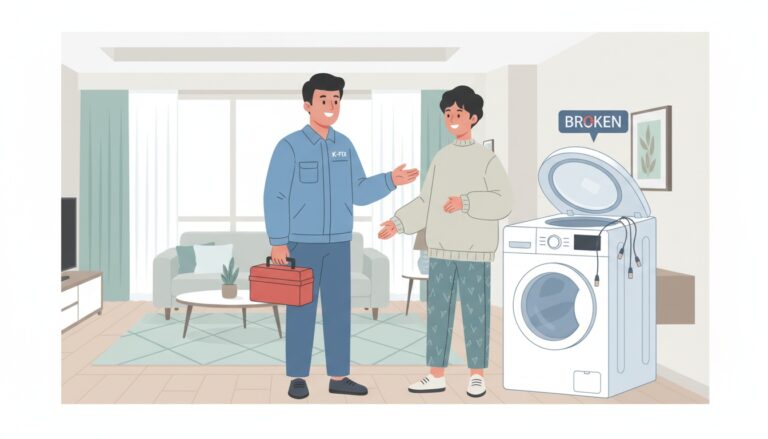
Lately in Korea, ‘self-interior’ (셀프 인테리어) and decorating your own space, known as ‘집 꾸미기’ (jip-kkumigi), is a huge trend. It’s all fun and games until something breaks! Don’t panic. Today, you’ll learn the essential Korean phrases to confidently explain any household problem to a repair technician (기사님 – gisanim) and get it fixed in no time.
Core Expressions for Your Toolkit
Here are the must-know phrases to save your day.
1. ~이/가 고장 났어요 (i/ga gojang nass-eoyo)
* Pronunciation [Romanization]: i/ga go-jang nat-seo-yo
* English Meaning: It’s broken.
* Detailed Explanation: This is your universal phrase for anything that’s broken or out of order. Simply put the name of the broken item before it. For example, ‘에어컨이 고장 났어요’ (The air conditioner is broken). Use ‘이’ for nouns ending in a consonant and ‘가’ for nouns ending in a vowel.
* 💡 Pronunciation Tip: The ‘ㅆ’ in ‘났어요’ is a tensed consonant. It’s pronounced stronger and shorter than a single ‘ㅅ(s)’. Make a sharp [ss] sound, like the ‘s’ in ‘hiss’, giving you [nass-eoyo].
2. 작동이 안 돼요 (Jakdong-i an dwaeyo)
* Pronunciation [Romanization]: Jak-ttong-i an dwae-yo
* English Meaning: It’s not working.
* Detailed Explanation: This is perfect for electronics and machines that won’t turn on or function correctly. ‘작동’ means ‘operation’. So you’re literally saying, ‘Operation doesn’t happen.’
* 💡 Pronunciation Tip: Listen closely to ‘작동이’. It sounds like [jakdong-i], not ‘jak-dong i’. This is because of a rule called linking (연음 – yeoneum), where a final consonant of a syllable smoothly moves to the next syllable if it starts with a vowel. It makes your Korean sound much more natural!
3. 물이 새요 (Muri saeyo)
* Pronunciation [Romanization]: Mu-ri sae-yo
* English Meaning: It’s leaking water.
* Detailed Explanation: A crucial phrase for any plumbing emergency! ‘물’ means ‘water’, and ‘새다’ is the verb ‘to leak’. Use this for sinks, toilets, pipes, or even ceilings.
* 💡 Pronunciation Tip: The vowel ‘ㅐ’ in ‘새요’ is pronounced like the ‘a’ in the English word ‘apple’. Make sure to distinguish it from ‘ㅔ’ (e), which is like the ‘e’ in ‘bed’.
Example Dialogue: Getting it Fixed!
Let’s see how these phrases work in a real conversation with a technician (기사님).
- A: 안녕하세요, 기사님. 보일러가 고장 났어요. (Hello, technician. The boiler is broken.)
- B: 아, 그러세요? 어떻게 문제가 있나요? (Oh, really? What’s the problem?)
- A: 어제부터 작동이 안 돼요. 그리고 이상한 소리가 나요. (It hasn’t been working since yesterday. And it’s making a strange noise.)
- B: 네, 알겠습니다. 바로 확인해 볼게요. (Okay, I understand. I’ll check it right away.)
Culture Tip: The ‘Jip-kkumigi’ Trend
As we mentioned, ‘집 꾸미기’ (home decorating) is more than a hobby in Korea; it’s a lifestyle! Apps like ‘오늘의집’ (Ohouse) are massive social platforms where people share photos of their beautifully decorated homes, creating a blend of Instagram, Pinterest, and an online store. This trend shows how much Koreans value creating a personal, comfortable living space. While DIY is popular, knowing how to call a ‘기사님’ (gisanim) is a vital life skill. Using this title is a respectful way to address any technician, engineer, or even a driver!
Let’s Practice!
Ready to test your new skills?
Quick Quiz: Your kitchen sink is leaking! How would you tell the technician, “The sink is leaking water. Please repair it.”? (Hint: ‘Sink’ is ‘싱크대’ and ‘Please repair’ is ‘수리해 주세요’).
Fill in the blanks:
싱크대에서 _______. _______해 주세요.
Great job today! You’re now equipped to handle a home repair crisis in Korean. Try making your own sentence with today’s phrases in the comments below!







