

Hello! Welcome to Maeil Hangul, here to upgrade your Korean skills!
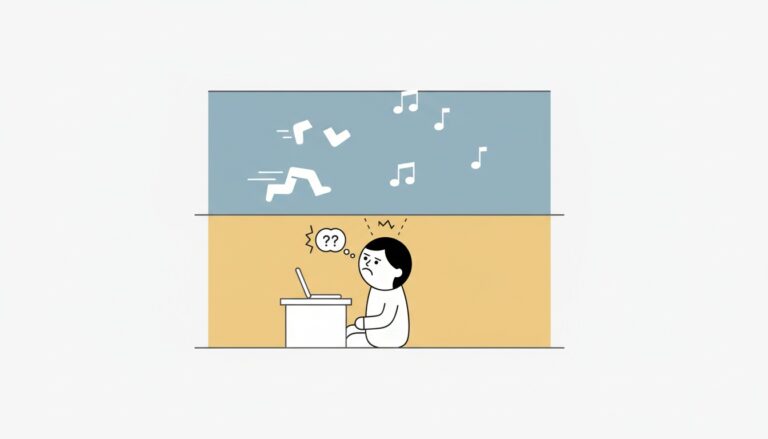
Ever tried to study or sleep, only to be interrupted by the sound of footsteps or loud music from your neighbors? You’re not alone! In Korea, where the majority of people live in apartment buildings, dealing with neighbor noise is a very common issue. Lately, with more people working and studying from home, noise complaints, especially ‘층간소음’ (cheung-gan-so-eum), or ‘inter-floor noise,’ have become a major social topic.
Today, let’s learn the essential Korean phrases and cultural etiquette to handle this situation politely and effectively, whether you’re a tenant or a landlord!
Core Expressions You Need to Know
Here are some key phrases to help you navigate noise issues.
1. 층간소음 (Cheung-gan-so-eum)
- Pronunciation [Romanization]: Cheung-gan-so-eum
- English Meaning: Inter-floor noise (noise between apartment floors)
- Detailed Explanation: This is a crucial vocabulary word. It’s a compound noun: 층 (cheung) means ‘floor/story,’ 간 (gan) means ‘between,’ and 소음 (so-eum) means ‘noise.’ It specifically refers to noise that travels between floors in a multi-unit residence, like footsteps, vacuuming, or children running. It’s a much more specific and commonly used term than just ‘noise’ (소음).
- 💡 Pronunciation Tip: The pronunciation is quite straightforward. Just remember to pronounce each syllable clearly. Think of it as three distinct parts: Cheung + gan + so-eum.
2. 조용히 좀 해 주세요. (Joyonghi jom hae juseyo.)
- Pronunciation [Romanization]: Jo-yong-hi jom hae ju-se-yo.
- English Meaning: Please be a little quieter.
- Detailed Explanation: This is the standard polite way to ask someone to lower their noise level. 조용히 (joyonghi) means ‘quietly,’ and 해 주세요 (hae juseyo) is the polite ‘please do’ form. The word 좀 (jom), which means ‘a little,’ is added to soften the request and make it sound less demanding and more polite.
- 💡 Pronunciation Tip: The ‘ㅎ (h)’ in 조용히 (joyonghi) is very soft, almost silent, when it comes between two vowels. So, instead of a strong ‘Jo-yong-Hi,’ it sounds more like a smooth [joyongi].
3. 관리사무소에 연락했어요. (Gwalli-samuso-e yeollakaesseoyo.)
- Pronunciation [Romanization]: Gwal-li-sa-mu-so-e yeol-la-kaes-seo-yo.
- English Meaning: I contacted the management office.
- Detailed Explanation: In almost every Korean apartment complex, there is a 관리사무소 (gwalli-samuso), or ‘management office.’ This is your first point of contact for any building-related issues, including noise complaints. Directly confronting a neighbor can sometimes lead to bigger conflicts, so going through the management office is the recommended first step.
- 💡 Pronunciation Tip: Notice the double ‘ㅆ (ss)’ in 했어요 (haesseoyo). This creates a tensed sound, pronounced like the ‘ss’ in ‘hiss.’ This tense consonant sound is very common in past-tense verbs and is important for a natural accent.
Example Dialogue
Let’s see how these expressions are used in a real conversation. Here, Minjun is complaining to his friend, Jieun.
- A (Minjun): 아, 정말 미치겠어. 위층 층간소음 때문에 잠을 잘 수가 없어.
- A, jeongmal michigesseo. Wicheung cheung-gan-so-eum ttaemune jameul jal suga eopseo.
- (Ugh, I’m going crazy. I can’t sleep because of the inter-floor noise from upstairs.)
- B (Jieun): 또? 너무 심한데. 혹시 관리사무소에 연락해 봤어?
- *Tto? Neomu simhande. Hoksi gwalli-samuso-e yeollakae bwasseo?
- (Again? That’s too much. Have you tried contacting the management office?)
- A (Minjun): 응, 어제 관리사무소에 연락했어요. 직원이 위층에 주의를 줬다고는 하는데… 그대로야.
- Eung, eoje gwalli-samuso-e yeollakaesseoyo. Jigwoni wicheunge juuileul jwossdagoneun haneunde… geudaeroya.
- (Yeah, I contacted the management office yesterday. They said they warned the upstairs neighbor… but it’s still the same.)
- B (Jieun): 그럼 쪽지를 써서 문에 붙여보는 건 어때? ‘밤에는 조용히 좀 해 주세요‘ 라고 정중하게.
- Geureom jjokjireul sseoseo mune buchyeoboneun geon eottae? ‘Bameneun joyonghi jom hae juseyo‘ rago jeongjunghage.
- (Then how about writing a note and putting it on their door? Politely, like ‘At night, please be a little quieter.’)
Culture Tip & Trend Deep Dive
Why is 층간소음 such a big deal in Korea? Over 60% of the population lives in apartments, often in high-rise buildings packed closely together. This high-density living means noise travels easily.
The Unwritten Rule: The golden rule is to avoid direct confrontation. Knocking on your neighbor’s door angrily is seen as very aggressive. The standard, most respected procedure is:
1. Call the Management Office (관리사무소): They will act as a neutral third party.
2. Leave a Polite Note: If the noise continues, a polite, non-accusatory note is the next step.
3. Involve the Landlord (집주인): As a tenant, informing your landlord is a good idea, as they can also speak to the other party’s landlord.
Recently, there have been viral stories on Korean social media about ‘revenge speakers’ (보복 스피커), where people install speakers on their ceiling to blast noise back upstairs. While it makes for a funny story, it’s illegal and can make the situation much worse! The best approach is always the polite and official one.
Wrap-up & Practice Quiz
Great job today! You’ve learned the essential vocabulary and cultural etiquette for handling one of the most common challenges of living in Korea: 층간소음. Remember to use ‘조용히 좀 해 주세요’ for polite requests and to contact the ‘관리사무소’ first!
Now, let’s test your knowledge!
Fill in the blank:
My upstairs neighbor is having a party at 2 AM. The noise is terrible! The first thing I should do is call the ___________.
(A) 경찰 (Police)
(B) 집주인 (Landlord)
(C) 관리사무소 (Management Office)
Let us know the answer in the comments! Have you ever experienced 층간소음? Share your story using the phrases you learned today!
Frequently Asked Questions (FAQ)
Q: What does "층간소음 (Cheung-gan-so-eum)" mean in Korean and how do you pronounce it?
A: In Korean, "층간소음 (Cheung-gan-so-eum)" is pronounced [Romanization] and means: Inter-floor noise (noise between apartment floors)
Q: What does "조용히 좀 해 주세요. (Joyonghi jom hae juseyo.)" mean in Korean and how do you pronounce it?
A: In Korean, "조용히 좀 해 주세요. (Joyonghi jom hae juseyo.)" is pronounced [Romanization] and means: Please be a little quieter.
Q: What does "관리사무소에 연락했어요. (Gwalli-samuso-e yeollakaesseoyo.)" mean in Korean and how do you pronounce it?
A: In Korean, "관리사무소에 연락했어요. (Gwalli-samuso-e yeollakaesseoyo.)" is pronounced [Romanization] and means: I contacted the management office.







